
You are currently browsing leonidobusch’s articles.
Recently Google announced an extension to its “Transparency Report“, which now also includes a section on requests to remove search results that link to material that allegedly infringes copyrights. Last month, Google processed 1,294,762 copyright removal requests by 1,109 reporting organizations, representing 1,325 copyright owners. The Figure below illustrates how the number of requests has increased between July 2011 to mid May 2012.

The growing number of removal requests points to the relevance of search technology as a means for copyright enforcement. Since for many Internet users what is not found by Google appears to be non-existent, removing search results from Google’s results lists is obviously a powerful tool for private copyright enforcement. However, several downsides are connected with such private copyright enforcement practices:
In European regulatory discourse as well as copyright research, there is a debate whether the US Fair Use model is better suited to deal with innovation in general and digital challenges in particular than the European system of exceptions. It makes sens to discuss the state of the art of research on Fair Use in the US and what we can learn in Europe.
In the course of a visit in Europe, Pamela Samuelson from UC Berkeley Law School & School of Information gave an interesting talk about “Fair Use in Europe? Lessons from the US and Open Questions”. Her main message could be summarized in two points: First, flexible regulation such as the US Fair Use clause is better suited to rapid technological changes than the comparably static system of exceptions and limitations in European copyright. To illustrate this point, Samuelson mentioned several innovations such as scholarly data-mining in Google Book Search (Ngram Viewer)* or Brewster Kale’s “Wayback Machine” that would have been much more difficult to realize without the Fair Use exemption.
Second, Samuelson explicitly did not recommend to get rid of or avoid specific exceptions all together; rather, keeping limitations and exceptions that provide legal certainty would be desirable even when introducing some form of fair-use-like clause into the European copyright system.
Let’s talk about Porn. According to Wikipedia, „[d]epictions of a sexual nature are as old as civilization“. And of course, paraphrasing Walter Benjamins famous essay, works of porn have changed in the age of mechanical reproduction. New means for (re-)producing works of art – printing press, photography, video, the Internet – have always and early on been used for producing and distributing pornographic works. And in the Internet age, porn has become more widespread than ever. Wondracek et al. (2010, PDF) report in their paper entitled “Is the Internet for Porn?” that 42,7% of all Internet users view pages with pornographic content. Also, popularity of peer-to-peer file-sharing technologies is connected to access to pornographic content (see Coopersmith 2006, PDF).
In spite of these well-known facts regarding the importance of pornography in the context of new copyright-related technologies, talking about the role of both producers and consumers of pornographic content in regulatory struggles is uncommon in journalistic and scholarly analyses alike. As a first step to acknowledging this role, I just want to list examples I can recall where porn producers and/or users have been influential in the field of copyright-related struggles: Read the rest of this entry »
In the academic world, the conflict between research institutions and publishers about the latter’s reluctance to embrace open access strategies has been looming for years. While the Internet makes distribution of research much cheaper and easier, subscription fees for the most important journals kept rising. Already in 2009, the MIT Faculty had unanimously adopted a university-wide Open Access rule (“Universities as Copyright Regulators: Power and Example“). In 2012, we can finally observe open battles on the issue.

Reading Room at Harvard (Faolin42, CC-BY)
After earlier this year more than 10.000 researchers had joined the boycott of Elsevier (see also “Elsevier Withdraws Support for Research Works Act, Continues Fight Against Open Access“), last week Harvard University issued an official “Memorandum on Journal Pricing“. After criticizing the “untenable situation” that “many large journal publishers have made the scholarly communication environment fiscally unsustainable and academically restrictive”, the memorandum suggests the following 9 points to faculty and students (F) and the Library (L): Read the rest of this entry »
Last weekend the board of the Wikimedia Foundation, the organization behind the free onlince encyclopedia Wikipedia, met in Berlin to decide on recommendations for restructuring (see “Wikimedia Governance: Showdown on the Board” and “Redrawing the Borders of Wikimedia Governance“). Three important things happened at and around the board meeting.
First, Wikimedia executive director Sue Gardner’s recommendation to centralize fundraising and funds dissemination was largely followed. Only four local Wikimedia chapter organizations – Germany, France, UK and Switzerland – will be allowed to process donations on their own when received via the main Wikimedia project pages such as Wikipedia language versions. A new funds dissemination committee (FDC) will decide on how the funds will be distributed and the whole process will be evaluated in 2015.
Second and probably more importantly, the Wikimedia foundation increases the diversity of potential models of affiliation, previously discussed under the label “movement roles”: Read the rest of this entry »
While the big win of the German Pirate Party in Berlin was big news, reported even by the New York Times (see also “Boarding Berlin“), yesterday’s win in the state of Saarland had already been expected and thus received less international attention. However, the success is remarkable. With 7,4 percent of the votes, the Pirate Party will receive twice as many seats in Saarland’s state parliament than the Greens. Even more importantly, the Saarland results refute two common explanations of the Berlin victory. First, the success in Berlin was no one shot wonder. Second, Pirates can also win in more rural areas outside of city states .
As a result, media commentators turned to another narrative, attributing the Pirate Party’s success mainly to collecting protest votes. I think this is wrong. While protest does play a role, several indicators suggest that this is not the dominant one.
Strong membership base: Fueled by local election successes, the German Pirate Party reports growing membership numbers all over the country (see Figure below). However, becoming a member can be interpreted as a sign of identification with an organization and differs from mere protest that is directed against the so-called “established parties”.
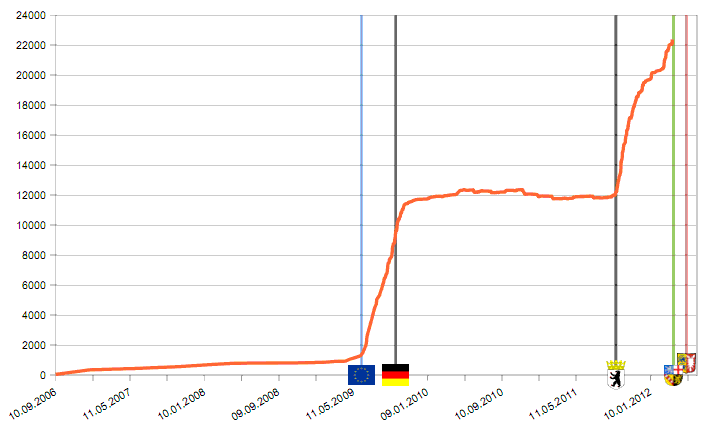
Membership trend of the German Pirate Party (Source: http://wiki.piratenpartei.de/Mitglieder)
Earlier this year, Wikimedia executive director Sue Gardner proposed to centralize fundraising activities and to move beyond geography-based chapter associations as the primary means of organizing (see “Redrawing the Borders of Wikimedia Governance: Turning the Money Screw“). Her move has inspired severe criticism and respective responses by prominent chapter organizations such as Germany, Italy and several chapters of Spanish-speaking countries. Specifically Wikimedia Germany, the largest chapter in terms of both members and fundraising, invested heavily in a detailed counterproposal entitled “Wikimedia’s culture of sharing: Remarks on common goals, localized fundraising and global action“.
A good impression of the intensity and the front lines of this debate is provided by the comments on a blog post by Wikimedia board member Stu West, where he explained “Why [he] supported the Board letter on fundraising“. The discussion thread also nicely illustrates the challenge of transnational governance, when West is accused of being US-centric:
There is a world outside the U.S. where people act according to different standards and think and decide differently. Our movement has to pay tribute to this fact.
After two months of discussion, Gardner has recently presented a revised version of her recommendations and asked the Foundation’s board to decide on it. The most controversial clause of her initial proposal is still part of her final list of recommendations: Read the rest of this entry »
About one month ago, Fields Medalist Tim Gowers complained in a blog post about Elsevier’s publication practices, which inspired the mathematics PhD student Tyler Neylon to launch the campaign “The Cost of Knowledge“. The website makes three main accusations against Elsevier:
- They charge exorbitantly high prices for subscriptions to individual journals.
- In the light of these high prices, the only realistic option for many libraries is to agree to buy very large “bundles”, which will include many journals that those libraries do not actually want. Elsevier thus makes huge profits by exploiting the fact that some of their journals are essential.
- They support measures such as SOPA, PIPA and the Research Works Act, that aim to restrict the free exchange of information.
So far, 7434 researchers have signed a petition to publicly declare that they will not support any Elsevier journal unless they radically change how they operate. Most of the signers even specified that they “won’t publish, won’t referee, and won’t do editorial work” for Elsevier any more. And Elsevier, one of the largest and most profitable publishing houses of the world, seems to begin to falter.
In preparation for an upcoming workshop on “organization as communication“, I have engaged more deeply with the phenomenon of Anonymous (see also “Anonymous Attacks German Collecting Society GEMA“). Specifically, I am interested in questions such as how to theoretically grasp this online “collective” and how its organizational identity and boundaries are created and (re-)produced.
In this regard, those incidents are of particular interest, where the attribution to Anonymous is contested. In August 2011, for example, a group claiming to be part of the hacktivist collective declared a “war on facebook”, which was soon countered by another Anonymous activist via twitter, stating that “#OpFacebook is being organised by some Anons. This does not necessarily mean that all of #Anonymous agrees with it.” (see Washington Post). In November 2011, when the takedown of facebook was supposed to happen, activists of Anonymous even exposed the originator of the threat to demonstrate that “#OpFacebook” was in fact not supported by Anonymous, as cnet reported:
“One skiddy queer chap named Anthony [last name redacted] from the US in Ohio decided to take it upon himself to have some lulz with creating an imaginary opfacebook and pawning it off as a legit anon op,” the statement said. “Despite us telling this mate several times we did not support his op, he continued to push his agenda for lulz. This op is phony but he continues to say it’s an anon op.”
In other words: Anonymous decided to expel wannabe activists by lifting the veil of anonymity and exposing their identity to the public. In a way, expelling by exposing is the logical boundary practice of an organized informality under the lablel “Anonymous.”
While the dust of the SOPA and PIPA battle in the US has not settled yet, we quickly approach the next showdown around an acronym in the realm of intellectual property regulation. This time the main battleground is Europe, the acronym is ACTA. The “Anti-Counterfeiting Trade Agreement” had been negotiated secretly for years until in early 2010 a draft of the agreement was leaked (see Michael Geist; for a critical and more up to date overview see the ACTA info portal of La Quadrature du Net (LQDN)). Since this leak, the draft had been substantially reworked and, last week, the treaty was signed by representatives of the European Commission and 22 member states in an official signing ceremony.
However, the political controversy is far from being over. For one, the treaty needs to be approved by the European Parliament, which is now the main target for mobilization of both supporters and opponents. For another, the signing of ACTA has sparked surprisingly strong protests in some EU member states, above all in Poland (see video below). The intensity of the Polish opposition has in turn raised attention in neighboring states, most importantly in Germany, as well.

 governancexborders.com