
You are currently browsing leonidobusch’s articles.
Last week Google announced the “introduction of usage limits to the maps API“, which effectively represents a first attempt to monetize the service beyond location-based advertisements:
If you find that your site does exceed the usage limits each day you can opt to pay for your excess usage by enabling billing on your APIs Console project. We will then start billing excess usage to your credit card when we begin enforcing the usage limits in early 2012.

Logo of the OpenStreetMap project
While some see Microsoft’s bing map as profiting from this decision, the real winner of Google’s decision to restrict access to the maps API might be the OpenStreetMap project (see also the very informative Wikipedia entry). Similar to Wikipedia, OpenStreetMap is created collaboratively by a globally dispersed community of volunteers. Consequently, the self-description reads “The Free Wiki World Map”.
Since both rendered images and the vector dataset are licensed under a Creative Commons Attribution-ShareAlike license, commercial usage of the project’s maps is explicitly granted. For example, already in 2010 bing maps started to integrate an OpenStreetMap layer into its services.
And more commercial application does not seem to crowd out the motivation of volunteers to contribute; quite on the contrary – and different to Wikipedia with its recently stagnating editor numbers – the OpenStreetMap community is still growing fast, reaching the number of 400.000 contributors in May this year.
(leonhard)
The media hypes Amazon’s new tablet “Kindle Fire” (see the commercial above) as the first credible competitor to Apple’s iPad. And some, such as Forbes’ Timothy B. Lee, celebrate the Kindle Fire as “the Triumph of Open Source“. Comparing the tablet market to the early PC market, where “the 1980s were a period of intense competition and rapid innovation, followed by the 1990s when Windows became utterly dominant and the pace of innovation slowed”, Lee argues that
[t]hings are different now because both the browser and OS markets are becoming dominated by open source software. In the browser market, the two fastest-growing browsers—Safari and Chrome—are both built on top of WebKit, an open source project started by Apple. And now Amazon’s new browser, called Silk, is also built on WebKit. It’s unlikely Amazon would have entered the browser market if they’d had to build a browser from scratch.
This leads him to the conclusion that, even if the market may be dominated by a single platform such as Android or WebKit, there will still be competition between several companies that build products based upon the underlying, shared code. Read the rest of this entry »
As my stay here at the Social Science Research Center (WZB) draws to a close, I am happy to present some of the work I did during summer. In preparation for the upcoming First Berlin Symposium on Internet and Society, October 25-28, I wrote a paper entitled “The Digital Public Domain: Relevance and Regulation” (PDF). The following is taken from the abstract:
After clarifying the notion and different areas of the (digital) „public domain“ – specifically with reference to related terms such as public goods and (anti-)commons –, the paper engages in discussing literature on its relevance for society in general and economic innovation in particular. […] How effective these abstract potentials of the public domain are utilized depends on the respective public domain regulation. […] In the last section, the paper presents open research questions and makes some preliminary suggestions for potential research strategies.
At the symposium, the paper will be discussed in workshop on October 26, chaired by Martin Kretschmer and with comments provided by Felix Stalder and Juan Carlos de Martin. Of course, comments prior to this workshop are most welcome!
(leonhard)
This blog is supposed to deal with issues related to governance across borders. So why devote so much space to the results of a regional election in Germany? The answer is twofold.

Logo of the Pirate Parties International meta-organization
First, as mentioned already in yesterdays FAQ (see “Boarding Berlin“), the Pirate Party’s election win in Berlin would not have been possible without its relations to a much broader and transnational movement. For one, these are fellow pirate parties in over 40 different countries, most of which are members of the meta-organization (Ahrne and Brunsson 2008) Pirate Parties International. For another, the pirate party movement is itself only one of several related and partly overlapping social movements inspired by the new technological possibilities of Internet and digital technologies.
Most these movements address regulation that is considered incompatible or even harmful to new technology-related freedoms, often related to surveillance and intellectual property regulation. And all of these movements are transnational in both perspective and activism. Wikipedia, for example, lists five “movements” in the field of “Intellectual property reform activism”, namely the Access to Knowledge Movement, Anti-Copyright, Cultural Environmentalism, the Free Culture Movement, and the Free Software Movement. Prominent transnational organizations within these movements include, as pioneers, the Free Software Foundation and the Electronic Frontier Foundation as well as more recent examples such as Creative Commons or the Wikimedia Foundation. In a way, the pirate party movement can be considered the political arm of these movements – even though not all of the movement members feel comfortable being associated with “Pirates” (see, for example, “Lessig on Abolitionism, Copyright Zealots & the Cultural Flatrate“). The similarity to the origins of the Green Party, which also emerged out of several interrelated envirnomentalist movements are in any case striking, not to forget that Jamie Boyle called for an “environmentalism for the net” already in 1997. Read the rest of this entry »
 Returning to Berlin from the Creative Commons Global Summit 2011 in Warsaw (see live-blogposts on the event), the political landscape of the city has been shaken by a Pirate Party election success. Two years ago, the German Pirate Party won 2 percent in the German federal election (see “Pirate Parties: Transnational mobilization and German elections“). Today, they boarded Berlin’s state parliament with 8.9 percent of the votes and 15 seats (see English Wikipedia). This is the first time the German Pirate Party was able to enter a state parliament, proving that the 2009 election results were not just a flash in the pan.
The dimension of the win was completely unexepected even for the Pirate Party, which is best illustrated by the following fun fact: the Berlin Pirate Party had only nominated 15 candidates for the state-wide election, all of which are now members of the parliament; had the Pirate Party won only one more seat it would not have been able to fill it.
The following Q&A is meant to give some background information to a non-German-speaking audience.
Is the success of the pirate party in Berlin only a regional exception?
Yes and No. Yes, because at least so far the German Pirate Party has only succeeded in urban areas and not at all on the state level – even in city-states such as Hamburg it had not gotten more than 2.1 percent (see graph below). For now, the dimension of the election success of the Pirate Party in Berlin is a regional peculiarity.

No, because the German Pirate Party is part of a transnational movement critical of the prevalent regime of strong intellectual property rights protection (see, again, “Pirate Parties: Transnational mobilization and German elections“), which manifests in currently 22 official registered and about 25 still unregistered national pirate parties. Read the rest of this entry »
This post has been written “live” at the Creative Commons Global Summit 2011, taking place from September 16-18 in Warsaw, Poland.
 Among the seemingly neverending issues connected with Creative Commons licenses is the NonCommercial module. In 2008, Creative Commons even did a large quantitative study entitled “Defining Noncommercial” (see “Standardizing via Polling? Creative Commons’ Study on Its Noncommercial-Clause”).
Reflecting on the results of these study, Creative Commons representative Mike Linksvayer emphasized that licensors say they are somewhat liberal in expectations of what licensees will do, which might explain lack of open disputes with regard to license interpretation in spite of the module’s ambiguity. With regard to license adoption numbers, Linksvayer showed graphs illustrating that NC is still the most popular license module while the license-mix is changing with a very slow downward trend in the use of the NC module.
Describing the upcomming license versioning process as “a once-in-a-deacade-or-more opportunity”, Linksvayer listed a number of issues that could be addressed within a new version 4.0 of the licenses. Read the rest of this entry »
This post has been written “live” at the Creative Commons Global Summit 2011, taking place from September 16-18 in Warsaw, Poland.
 Continuing the debate on license porting in the realm of Creative Commons (see “The End of the Porting Experiment?“), Paul Keller of CC Netherlands took a clear stance, calling for developing only one, global license in the future. In his talk, he mentioned the following advantages of the global approach:
- Reducing (potential) incompatibilities
- Forces us to take a consistent position on issues that are specific to certain regions (e.g. moral rights, database rights)
- Will produce licenses that better meet users’ expectations
- Will cover all jurisdictions, not ‘just’ 55
- Has the potential to initiate a inter-jurisdictional discussion on the substance of the licenses
- Frees time for other activities (community building, promoting adoption, policy work, implementation advice)
Keller was followed by Massimo Travostino from Creative Commons Italy, who added his opinion that the more a license is successfully “ported”, the more likely it is to create problems in other jurisdiction. Read the rest of this entry »
This post has been written “live” at the Creative Commons Global Summit 2011, taking place from September 16-18 in Warsaw, Poland.

In the field of open content licensing, Creative Commons licenses have been the first and still are the only licenses that are adapted (“ported”) to local jurisdictions. Free/open source software licenses such as the GNU GPL, which had served as the role model for Creative Commons in the first place, are generally unported licenses. And also in the realm of Creative Commons, not all licenses are ported.
In the first session on the upcoming versioning process, Paul Keller (CC Netherlands) mentioned the “no rights reserved” (CC0) license as an example for a Creative Commons license working without any adaption to local jurisdictions. Therefore, Keller argued, the laborious task of license porting could be abondoned as the licenses approach version 4.0. This statement was followed by several legal arguments with respect to the benefits and pitfalls of license porting.
Today, Google announced its acquisition of Motorola Mobility for not less than $12.5 billion in cash. And I completely agree with Forbes’ contributor Eric Jackson, who states that

Saad Irfan, CC BY-NC-ND
[i]f you think this is about Google getting into the handset business, think again. If Google were to get into the handset business, they would turn their back on partners like HTC, Samsung and others.
Today’s deal is all about acquiring Motorola’s backlog of mobile-related patents. When Google lost out on the batch of Nortel patents, they worried that Android was significantly at risk.
A risk stemming from the fact that, in spite of developing Android under an open source license, powerful patent holders such as Microsoft were able to squeeze out licensing fees from corporate Android users. The bizarre result being that Google, the main developer of Android, gives away its contributions to the operating system for free while its not-contributing competitor Microsoft charged hardware producer HTC $5 for any shipped Android (!) smartphone (see business insider). Read the rest of this entry »
Google Books Ngram Viewer is a fantastic tool showing how certain phrases have occurred in a corpus of books over a selected period of time. Recently, fellow bloggers over at orgtheory have played around with this tool (see, for example, “market – science- religion“).
Working on the issue of the digital public domain during my stay at the WZB, I was curious to compare the mentions of “public domain” and “intellectual property”, which are depicted in the graph below:
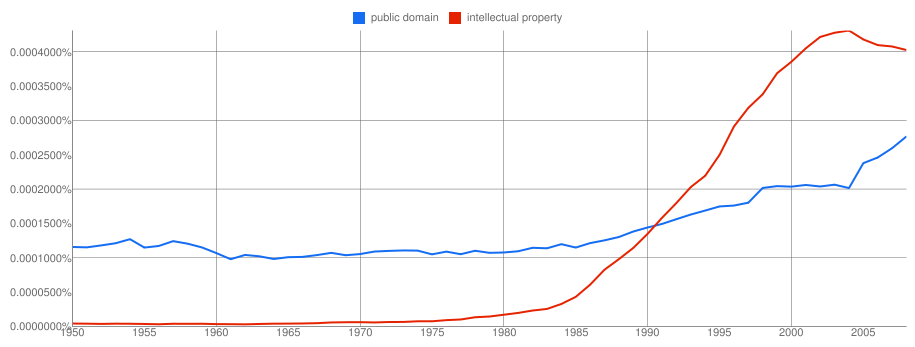
The resulting graph is pretty interesting. First, I did not know that the term “intellectual property” was virtually non-existant at all prior to 1980. This is remarkable since the negotiations that in the end led to the WTO’s agreement on Trade-Related Aspects of Intellectual Property Rights (TRIPS) had started in the early 1980s. Again, we can observe a shifting baseline effect (see “Shifting Baseline in Assessing Copyright Regulation?“): today the concept of “intellectual property” has become completely taken for granted, while 30 years ago even the phrase hadn’t been used. Read the rest of this entry »

 governancexborders.com