
You are currently browsing the category archive for the ‘Miscellaneous Governance Issues’ category.
In this entry, I will report not on governance but on a book on governance from a neighbouring discipline that sociologists, organizational scholars and political scientists often ignore – social anthropology:
I found this book interesting and important for a number of reasons. First, I found many parallels to my own work. Second and more important, the book motivates reflecting on the concept of culture and its place in the transnational governance dynamics.
In her book, Sally Engle Merry explores how different actors – both state and nonstate, local and global – translate global norms associated with human rights and gender violence into practices in societies and communities where human rights are nonexistent as a concept and where gender violence is not defined in human rights terms, is considered a part of a national culture and protected as such. Read the rest of this entry »
This entry is part two of a mini-series dedicated to the fascinating institutional landscape found on the Eastern edge of the European Union. It deals with the dearth of the public sector and the rejuvenation of religion.
Someone must have built all this infrastructure which now lies decaying throughout Eastern Europe. It bears the signs of more than twenty years of decay, so almost certainly it was the governments of the Warsaw Pact which paved the roads to the majority of villages, laid tracks between cities, erected gargantuan grain silos and stamped huge factory complexes out of the ground.
Yet many of today’s Eastern European states have too few resources (or hardly any at all) to provide the public infrastructure necessary for success in the game of capitalist competition. And, as regards the private sector, the current mode of production knows no place for means of production accumulated under the Five-Year-Plans of yesteryear.
The new European Union member states Romania and Bulgaria show many signs that transnational institutions can catalyse the development of infrastructure; while Ukraine and Moldova demonstrate the counterpoint of the damage that lack of investment by the public sector can do. All the while, across the border between the two worlds – at least that is how the border between EU and non-EU can feel, and is locally perceived – the church consoles the post-socialist sorrows of the masses. Read the rest of this entry »
When we write about such phenomena as governance across borders, our conceptualisation always hinges on dividing lines, those borders which governance may span. Especially for a research group working on transnational institutions, it’s important to contemplate: What do borders really mean?
The reality of borders takes on a wholly different dimension when leaving the comfort of Western Europe, with its checkpoint-free border crossings. Travelling along Europe’s (still somewhat wild) Eastern frontier, the significance of national boundaries and the institutions that sometimes do, sometimes don’t span them, is illuminated starkly, highlighting what one takes for granted.
Here, I’ll be sharing some – hopefully not too wanton – snapshots and insights into the fascinating institutional landscape which I encountered during some recent travels. Read the rest of this entry »
„Obama Lies, Grandma Dies“, „Obamahdinejad“ or „euthanasia bill“ are slogans you find on protest poster angry people hold up at town hall meetings, where the US health care reform is debated. In general, everybody in a community is invited to attend Town Hall meetings to discuss political issues with elected officials. Such meetings are usually seen as a good way of giving voice to people in decision-making, therefore making politics more democratic by enhancing its input legitimacy. That is why social scientists like to take it as an example for studying public deliberation and discursive participation. But in the current health care debate, there is not a lot of deliberation taking place. Instead, you see an explosion of emotions, fierce resistance and conflict. Mailing-lists and websites give advice on how to best disrupt those meetings. Here are some examples:
“The objective is to put the rep [representative] on the defensive with your question and follow-up. The rep should be made to feel that a majority, and if not, a significant portion of at least the audience, opposes the ‘Socialist agenda’ in Washington…If he blames Bush for something or offers other excuses – call him on it, yell back and have someone else follow-up with a shout-out.” (rightprinciples)

The diamond trade hasn’t exactly enjoyed a great reputation over the past years. Not least thanks to Hollywood movies like Blood Diamond, these gems are inextricably percieved as covered with the blood spilt in civil wars all over Africa.
But diamonds are also a key export of many poor African nations.
Despite some initial progress being achieved by the Kimberly Process certification scheme, diamonds’ persisting bloody reputation isn’t exactly undeserved. Many still find their way into the world market, dominated by De Beers, from appalling sources.
Groups like Amnesty International and One Sky have criticised the certification scheme as lacking impartial, obligatory monitoring. Global Witness, an NGO specialising on the link between natural resource exploitation and violence reported the scheme to be failing to address issues of non-compliance, smuggling, money laundering and human rights: “The clock is running out on Kimberley Process credibility.”
Other problems include that diamonds from conflict-ridden Zimbabwe are still considered legitimate under the Kimberly Process; and the mind boggles as to what real effects membership of countries like the Democratic Republic of Congo may have on the ground. Several civil wars currently rage within the Congo’s boundaries.
Microsoft’s 1991 “Press Computer Dictionary” defined “Vaporware” as follows (taken from Bayus et al.):
“vaporware n. (1) a product that the vendor keeps promising is about to arrive ‘really soon now’, but it goes so long past its shipment date that no one believes it will ever really ship […] (2) slang for announced software that may never materialize […]; (3) a term used sarcastically for promised software that misses the announced release date, usually by a considerable length of time”
Into management language “vaporware” could probably best be translated as “strategic product pre-announcement”. Especially in technological network markets, corporations with strong market power pre-announce upcoming products and promise a wide range of features so that customers refrain from adopting or even switching to an already existing alternative solution. The rationale behind those strategies is relatively simple and it transcends network markets, reaching into the realm of standardization with network effects in general: “the standard that is expected to become the standard will become the standard”, as Shapiro and Varian put it in their seminal book “Information Rules” (1999, p. 13).
For decades, Microsoft was the uncrowned king of vaporware. (Actually, already in 1985 Bill Gates received the “Golden Vaporware Award” by Infoworld’s editor Stewart Alsop.) The long pre-announced introduction of Windows 95 is legendary and has just recently been topped by Microsoft starting to announce new features of Windows 7 immediately after the release of its unloved Windows Vista.
Seen in this light, the recent reactions of Microsoft officials to Google’s pre-announcement of “Chrome OS” (see “Microsoft vs. Google: New Fronts in a Paradigmatic Battle“) do not lack unintentional humor. Microsoft’s Senior Vice President, Bill Veghte, bemoaned in an interview that “so far Google’s Chrome OS is nothing more than a blog post.” Even more revealing is yesterday’s remark of Microsoft founder Bill Gates, as reported by CNET:
“Gates said it was hard to really say much about Chrome OS, since Google has said so little about how it will actually work. ‘The more vague they are, the more interesting it is,’ he said.”
Both critiques resemble accusations Microsoft regularly had to deal with in the past. But maybe Microsoft is right and Google will be its successor to the throne of vaporware. We will see.
(leonhard)
Together with our recent guest blogger Sebastian Botzem from the Social Science Research Center in Berlin I prepared a piece for this year’s EGOS Colloquium, which is taking place in wonderful Barcelona. In the sub-theme titled “The social dynamics of standardization” we are presenting our paper “The Rule of Standards: Codifying Power in the Transnational Arena” (PDF), in which we try a relatively unorthodox comparison: We contrast the case of Microsoft Windows as a technological market standard with non-technological and negotiated accounting standards in the realm of the International Accounting Standards Board (IASB).
Not least to our own surprise, both examples of standardization show many similarities that allow drawing conclusions for transnational governance by standard setting in general. Among these are the following:
- Due to coordination effects, in both cases an increase in the total number of adopters paves the way for – though not guaranteeing – one dominating standard.
- While having been developed differently (market competition vs. political negotiation), in both cases growing standard diffusion reduced the need for participatory or inclusive modes of standard-setting (see the figure below).
- Finally and again observable in both cases, growing adoption can trigger what we call the dialectics of power in standardization: The successful establishment of a standard redistributes benefits and power among affected actors and feeds back into the standard formation process.
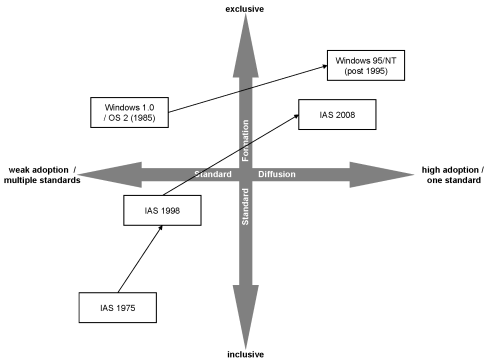
But aside from these conclusions, the paper may also illustrate why gathering seemingly very different empirical fields under the common umbrella of “governance across borders” in this blog might make sense after all.
(leonhard)
In 2009, many received wisdoms of late capitalism are crumbling. To mention a few disappointments, which it didn’t take a telescope to see from a mile away,
- No – we haven’t overcome the business cycle.
- Sorry – China and India aren’t gonna drag us out of the recession.
- Nope – deregulation doesn’t bring widespread prosperity.
- Too bad – wealth doesn’t grow on trees or in banks or hedge funds.
- Please – add your own favourite here: __________________________
A crisis is a moment in which illusions or expectations fall apart. In the Nigerian novel “Things Fall Apart”, the patriarchal protagonist Okonkwo confronts a world of changing values (colonialism, Christianity) in which he finds he has no leading role left to play. Rather than adapt to these circumstances, he takes his life.
This pessimistic example, however, doesn’t seem to apply to some international organisations in the current crisis. Rather, after years of seeming anachronistic, the World Bank, IMF, NATO and OECD are experiencing something of a revival – notable absentee: the UN.
According to classical (or vulgar?) institutional theory, institutions persist rather statically until some kind of “critical juncture” suddenly occurs, at which point they disappear or reinvent themselves (or are reinvented). As far as critical junctures go, they don’t get much bigger than the 2007 to 20xx? global capitalist crisis. Read the rest of this entry »
German daily newspaper Die Tageszeitung reported last week (Frauen sollen Krise lösen by Beate Willms, April 2 2009) the results of the seven-year study of the effects of the voluntary agreement of German companies to support employed women. Seeking to avoid governmental regulation, companies concluded the agreement in 2001. On behalf of the Federal Ministry of Family, Seniors, Women and Youth Affairs (das Bundesministerium für Familie, Senioren, Frauen und Jugend), the researchers of the German Institute for Economic Research (Deutsches Institut für Wirtscharsforschung, DIW) monitored the share of women in leading positions in the private sector between 2001 and 2007. The results are not particularly surprising. The share of women in leading positions did not change significantly: It increased from 26 to 31% between 2001 and 2006 but went down to 27% in 2007. 98% of positions in management board of 200 largest companies were still occupied by men in 2007. The share of women occupying positions in supervisory boards equaled 10% but the researchers explain it by the pressure form work councils and trade unions.
Although these findings are not directly relevant to the questions of cross-border governance, they made me think about several parallels to transnational private regulation. The findings raise the question of the effectiveness of business self-regulation, which has been one of the core issues in scholarly and policy debates on transnational private regulation. How effective are voluntary agreements and programs and how to improve their effectiveness? These are essentially empirical questions and there are no straight-forward answers. Read the rest of this entry »


 governancexborders.com