Tom Heinemann’s film “The Micro Debt” has received a lot of flak from the microfinance community. The documentary, posing a sharp critique of microfinance, features interviews with microfinance borrowers, proponents and critics on three continents. It deals particularly critically with the work of Muhammad Yunus and the Grameen Bank in Bangladesh. One response to Heinemann’s criticism has been the production of counter-counter-knowledge (against Heinemann’s counter-knowledge), promoted via Youtube, courtesy of the world’s most trustworthy PR company. Another has been to draw into question Heinemann’s integrity as a journalist, referring to the film as “grossly inaccurate”, “false and defamatory”, and “digging for dirt”.

But “The Micro Debt” isn’t going away. It has been shown in over 14 different countries and awarded numerous prizes. Most recently, last Friday it was awarded the Lorenzo Natali Journalism Prize Grand Prize, a prestigious award for journalistic work granted by the European Union in co-operation with Reporters Without Borders. “The Micro Debt” was selected out of a field of 1,300 contenders and commended as “a shining example of world-class investigative journalism, challenging entrenched assumptions”.

Courtesy of the prize, “The Micro Debt” is now also viewable online.

Part 1; Part 2; Part 3; Part 4

Tom Heinemann was vilified for not whistling everyone else’s tune; now, the Lorenzo Natali Prize is rehabilitating the film and the filmmaker. It shows that telling an unpopular story and confronting received wisdom is still what investigative and independent journalism is about. Conversely, what (if anything) has the world learned from microfinance promotion films like “To Catch a Dollar“? As for the claims of factual inaccuracy levied by Friends of Grameen against Heinemann, a short follow-up segment, to be aired early next year in Norway, may bring more clarity; watch this space.

(phil)

CGAP is the World Bank’s (not-quite-so-)arm’s-length sub-organisation whose role is to promote microfinance. CGAP (“see-gap“) once stood for “Consultative Group to Assist the Poorest“, now it officially stands for “Consultative Group to Assist the Poor”. Actually, if nomen were to be omen, it should probably stand for “Consultative Group to assist (those who lend to) the Poor (and not-so poor)”.

Giant_Knife_1[1]

So many functions … but can it cut? Image: Slartibartfass (CC BY-SA 3.0)

I don’t expect CGAP to function as an independent evaluator of microfinance. What I do expect is that CGAP publications have minimum standards of research quality and logic.

The most recent CGAP report, entitled “Latest Findings from Randomized Evaluations of Microfinance” (Bauchet et. al.), however, is appalling on both counts. Nearly everything about this report is problematic. It is racked by wishful thinking – to paraphrase: “we may not have evidence that microfinance does what it was supposed to, but we still believe it works” – and it has a disturbing feel about it, which derives from: (1) what the authors have left out, and (2) the heavy tension between concern for the poor and patronising them.

Read the rest of this entry »

Wikipedia provides an extensive list of plagiarism controversies, with examples ranging from Ciceros speeches against Mark Antony (1st century BCE) to Dan Brown’s The Da Vinci Code (see also: “Some Reflexions on Originality, Plagiarism, Intertextuality, and Remix“). What is still missing is a list of self-plagiarism controversies. In academia, the most recent self-plagiarism incident that received substantial attention was the case of the economist Bruno Frey (University of Zurich). The case has been meticulously documented by Olaf Storbeck, International Economics Correspondent with the German business daily Handelsblatt.

Today, I stumbled upon an article in the Austrian weekly profil, dealing with another field of alleged ‘self-plagiarism’: architecture. They juxtapose several buildings by famous architects such as Frank Gehry, Daniel Libeskind or Zaha Hadid. Due to copyright issues I cannot simply provide all the examples below, but with the help of Wikimedia commons I managed to reproduce two examples of alleged ‘self-plagiarism’ and one of mere ‘plagiarism’ presented in the Article:

Frank Gehry

Disney Concert Hall in Los Angeles

Guggenheim Museum Bilbao

Read the rest of this entry »

Recently, together with Jeanette Hofmann, I have been discussing a research proposal on sharing cultures. In this context, we were asking ourselves whether the notion of “sharing” has shifted in the digital realm. Sharing knowledge is different from sharing a cake. George Bernard Shaw is ascribed the following quote, illustrating this difference:

“If you have an apple and I have an apple and we exchange apples then you and I will still each have one apple. But if you have an idea and I have an idea and we exchange these ideas, then each of us will have two ideas.”

This leads to the conventional wisdom that sharing immaterial goods is different from material goods. In the digital age, more and more goods can be easily shared in form of perfect copies. And even when the economic value of a digital good might depreciate if it is shared freely, sharing can at the same time generate indirect returns (for examples see Anderson 2009). Consequently, authors such as Lawrence Lessig paint the picture of a “hybrid” or “sharing economy“, which they deem to be beneficial for all parties involved. Prerequisite for such a sharing economy to work is a sharing culture, which includes practices such as giving attribution or using open formats and licenses. Read the rest of this entry »

You use it whenever you need it. You want it to be clean. You sit down, you stand, or you squat. You use paper, or maybe water. You flush… and whatever your business there may have been, it disappears. You leave, you wash your hands. So simple… you take it for granted.

If you’re lucky.

Any traveler to another continent soon learns that the toilet is a highly cultural thing. Sanitation is a cultural practice. Sometimes even a trip from one country to another is enough to cause mild shock and awe – for instance, how every German holiday-maker in France feels when they (re-)discover the French squat toilet. Or how a French traveler feels when discovering the German “Flachspüler“. Or the Irish, when voting on the Lisbon Treaty. Toilets are deeply culturally embedded, so much that Slavoj Žižek has a special theory about their differences and their effects on national mindsets, politics, and philosophical traditions.

Westerners have a lot to learn

Read the rest of this entry »

Two weeks ago the First Berlin Symposium on Internet and Society took place in Berlin, celebrating the opening of the Alexander von Humboldt Institute for Internet and Society. Specifically for this event I had prepared a paper on “The Digital Public Domain: Relevance and Regulation” (SSRN), which was presented and then commented upon by Juan Carlos de Martin and Felix Stalder. Both provided very thoughtful criticsm and extensions to the paper, introducing an overall discussion that was very constructive and focused on the issues tackled in the paper.

While I have not managed to blog about the workshop so far, Anne-Catherine Lorrain from the COMMUNIA Association has now provided an extensive summary. There  she documents why mapping the public domain empirically is a worthwhile exercise:

The empirical mapping of the public domain should help identifying more precisely the economic relevance of the public domain. The regulation framework applying to the public domain can produce some direct effects on the economy, and more particularly on innovation. As a matter of fact, businesses can suffer genuine legal uncertainty when it comes to identify what is protected by IP rights and what is not. The positive economic impact of content being in the public domain is sometimes already acknowledged in practice. For instance, some patent rights holders can decide to donate patentable inventions in order to create a pre-competitive market. Like the “adjustment process” (Schumpeter), the utility of the public domain to improve competition should be demonstrated, although the question about how this aspect should be echoed within legislation remains.

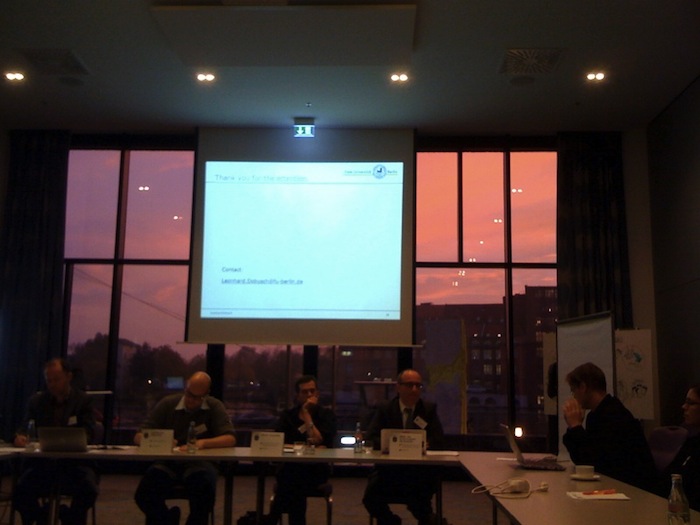
Besides, her summary features the pink sky over Berlin towards the end of the workshop:

Pink sunset on the Spree behind the Public Domain session speakers from left to right Martin Kretschmer, Leonhard Dobusch, Felix Stadler, Juan Carlos De Martin; picture: Anne-Catherine Lorrain

 I can only thank Anne-Catherine very much for providing this great summary and endorse reading the whole transcript.

(leonhard)

Last week Google announced the “introduction of usage limits to the maps API“, which effectively represents a first attempt to monetize the service beyond location-based advertisements:

If you find that your site does exceed the usage limits each day you can opt to pay for your excess usage by enabling billing on your APIs Console project. We will then start billing excess usage to your credit card when we begin enforcing the usage limits in early 2012.

Logo of the OpenStreetMap project

While some see Microsoft’s bing map as profiting from this decision, the real winner of Google’s decision to restrict access to the maps API might be the OpenStreetMap project (see also the very informative Wikipedia entry). Similar to Wikipedia, OpenStreetMap is created collaboratively by a globally dispersed community of volunteers. Consequently, the self-description reads “The Free Wiki World Map”.

Since both rendered images and the vector dataset are licensed under a Creative Commons Attribution-ShareAlike license, commercial usage of the project’s maps is explicitly granted. For example, already in 2010 bing maps started to integrate an OpenStreetMap layer into its services.

And more commercial application does not seem to crowd out the motivation of volunteers to contribute; quite on the contrary – and different to Wikipedia with its recently stagnating editor numbers – the OpenStreetMap community is still growing fast, reaching the number of 400.000 contributors in May this year.

(leonhard)

Ramesh S. Arunachalam, 2011: The Journey of Indian Micro-Finance: Lessons for the Future. Chennai: Aapti Publications.

The microfinance crisis in India which broke out in fall 2010, first imperiling numerous borrowers and then an entire industry, is the most fundamental event in the world of microfinance since the Nobel Peace Prize in 2006. In hindsight, it may even turn out to be the defining moment of microfinance history – never before has the dark side of microfinance, and the vulnerability of the industry, been so brutally exposed to a global audience.

Naturally, these events have attracted a host of opinions and analyses ranging from simply blaming the Andhra government for bringing down a healthy microfinance industry, to accusing microfinance of having become worse than loan sharks. And yet, so far, we understand very little of why India’s vast microfinance sector went so far astray. Thankfully, people like Ramesh S. Arunachalam are out to change this.

Arunachalam has earned the respect of many a reader (me too) with his candid and incredibly well-researched blogging on the Indian microfinance sector. He posts prolifically, but despite (or perhaps because of) his over 20 years of work experience in development and rural finance, he has otherwise kept a low profile. He is not an outspoken critic.

Now Ramesh Arunachalam has applied his sharp analytical approach and evident knack for writing to publishing the first book about the Indian microfinance crisis. The result is a meticulous, evidence-based piece of research which brings clarity into what so far has mostly been an interest-driven and polemical battle of explanations.

In some ways what Arunachalam has produced is, in fact, more than a book; it is a dossier of evidence and analysis of how the Indian microfinance sector functions at the deepest levels, and where its errors lie. It is a biography of an industry in identity crisis, and also a handbook on how Indian microfinance might (perhaps) still be saved. Above all, as the book’s (wonderfully illustrative) cover implies, it is a search for the Faustian, troubled soul of Indian microfinance. Read the rest of this entry »

Few documentaries in the past years can claim to have had as much impact on transnational development as The Micro Debt. Tom Heinemann‘s documentary film, produced for Norwegian public broadcasting, has contributed to a wave of critical reasoning about microfinance, but also to the axing of Grameen Bank’s founder, Muhammad Yunus. While Heinemann wasn’t out to harm Yunus, the documentary’s fallout (as well as the Indian microfinance crisis) was an opportunity for politicians in Bangladesh to remove a weakened Yunus from office.

All in all, The Micro Debt doesn’t shed a good light onto microfinance, and in return has come under fire from the microfinance community, an epistemic community which doesn’t take criticism well. Grameen Foundation in particular has mounted an organised attack on Heinemann and his film, engaging PR firm Burson-Marsteller to disseminate counter-claims and draw into question the film’s integrity. But The Micro Debt is becoming increasingly difficult to ignore or deny. It won in the “Television” category at the Avanca Film Festival in Portugal earlier this year, and may win more awards at the various other festivals internationally where it has been nominated. And it’s going on tour in the USA and Canada this month (see below).

Tom Heinemann: “The Micro Debt- a critical investigation into the dark side of Microcredit” (2010)

The real message of the film is that, after three decades, there is still no concrete evidence that microcredit actually does anything for the poor. Heinemann’s main point is that Western donors have been naive in their enthusiasm about microfinance, and his poverty-stricken interviewees testify that this might even worsen their precarious situation.

A misrepresented film

The film’s director Heinemann visited Bangladesh, the Mecca of microfinance, to check up on the successes claimed by Grameen Bank and other microfinance organisations regarding poverty alleviation. He investigated Grameen’s funding from the Norwegian government (where he uncovered financial irregularities amounting to $100 million) and spoke to numerous academic and practitioner experts. The film also shows him being denied interviews with Muhammad Yunus on several occasions.

Read the rest of this entry »

Actor Matt Damon makes it sound like a great idea to give small loans to poor families so they can get access to improved water and sanitation. After all, he is the co-founder of the NGO water.org, promoters of the WaterCredit loan:

“Gary, my partner, pioneered this idea of, you give people loans. So, for instance, in a place like India in a slum, the municipality will be pumping water right through the street … If you could give them a loan to connect directly to the municipality, so you pipe the water directly into their house, a 75 Dollar loan, they use that time that they were wasting waiting in line for water – working, they pay off the loan at rates of like 98 percent, 99 percent. And they’re using that time in a more productive way.”

He makes it sound easy and appealing. And it is appealing. I’m sure Matt Damon, who is known for ardently supporting social causes, sees this as a real solution. The trouble is, his model doesn’t tackle the fundamental problems – like piped water actually being in the slum in the first place, which it normally isn’t. Damon also doesn’t contemplate the fairness of asking the poor to pay for this human right with a loan. Will the poor want to pay? Will they even be able to pay? This idea of microfinance for water and sanitation may make an already unfair state of affairs even unfairer.

Earlier this year, I had the pleasure to present a paper at the University of Pula, which was later picked up by Microfinance Focus in a nice article. Since then, the ideas presented in that paper have mushroomed and matured into a more thorough, comprehensive and analytical (and 158.1% larger) piece, which has now appeared as a Discussion Paper in the MPIfG’s series. Read the rest of this entry »

The Book

Governance across borders: transnational fields and transversal themes. Leonhard Dobusch, Philip Mader and Sigrid Quack (eds.), 2013, epubli publishers.
March 2026
M T W T F S S
 1
2345678
9101112131415
16171819202122
23242526272829
3031  

Copyright Information

Creative Commons License
All texts on governance across borders are licensed under a Creative Commons Attribution-Share Alike 3.0 Germany License.