Sarah Houghton-Jan is the Assistant Director for the San Rafael Public Library. She runs a blog titled Librarian in Black. And Sarah Houghton-Jan is angry:

I care about digital content in libraries.  And I am about to lose my cool in a big way.  No more patience, no more waiting for advocacy groups to do their work, and certainly no more trusting vendors to negotiate good deals for us with the publishers.   I am angry, I am informed, and I am ready to fight.

The reason for Houghton-Jan’s anger is that the US publishing house HarperCollins introduced a limit of 26 lifetime uses per copy (see “Library eBook Revolution, Begin“). To be clear: per ebook copy. Such an attempt of using private licensing agreements together with Digital Rights Management (DRM) technologies for controling usage is not new in the realm of electronic books (see “The Kindle Controversy“). Only the boldness of HarperCollins terms of use is. What Pamela Samuelson fears in the context of Google Books, namely that it could be treated as a “precedent” by publishers for charging libraries per-page-copying fees more generally (see “Pamela Samuelson on the Future of Books in Cyberspace“), seems now to become reality anyway.

Sarah Houghton-Jan, however, chose to not only complain but to channel her anger into an impressively productive form of protest, which recently spread all over the web: The eBook User’s Bill of Rights. The main points read as follows: Read the rest of this entry »

The reactions to Tom Heinemann‘s controversial documentary “The Micro Debt” have mostly been strong. The film sheds light onto a number of questions, first and foremost the risk microcredit borrowers face of becoming trapped in debt. However, public debate has so far focused on two rather marginal parts of the film: a more-or-less resolved dispute over aid money (cf. “GrameenLeaks”), and a dispute about a house supposedly promised in the village of Jobra. It is worth investigating why so much publicity has been given to these two issues, and so little to the film’s main message: that microfinance can cause debt traps.

While the charges of financial malpractice in the Grameen conglomerate have now been largely cleared up, Muhammad Yunus still remains a target of negative attention from the Bangladeshi government. He is now apparently no longer Grameen Bank’s director. But Yunus’ personality and job status should have nothing to do with an impartial assessment of the virtues of microfinance. What becomes clear from the recent debate is how symbols are mobilised (and abused) in legitimising as well as challenging microfinance. However, this distracts from more substantial questions about what microfinance does or doesn’t, can or can’t, achieve.

Let us take a look at “The Micro Debt” and the reactions to it, and also take a look at another, less-known documentary with less impact but perhaps a better focus on substance: “Easy Money”. Both films make the allegation that microfinance can be exploitative and can cause more problems than it solves. But the reason why “The Micro Debt” has been perceived as so inflammatory, while “Easy Money” apparently has hardly been discussed at all, is that “The Micro Debt” attacks microfinance’s symbolic self-representations of success and integrity. Read the rest of this entry »

In the German weekly newspaper “Die Zeit”, Thomas Assheuer describes the current developments in Arabia as follows:

“The Arabic revolt is not a regional incident, it is a transnational event.”

I could not agree more. Clearly, revolutionary processes spread from Tunesia to its neighboring countries with an unknown pace, not least due to new digital technologies. Shutting down the Internet in Egypt was obviously only a sign of helplessness. Even in China, behind the world’s most sophisticated digital censorship curtain, webpages state “we are all Egyptians”.

The same time, however, the processes are far from being merely global. National borders still matter. Revolutionary processes seem to develop recursively between the national and the transnational level. Inspirations and irritations from developments in other countries lead to incidents, which in turn re-enter the transnational discourse and function as further inspirations to others.

Recent developments in Libya just further – and tragically – illustrate this point.

(leonhard)

Interdisciplinary workshops are always a good opportunity to discuss and exchange differences and shared perspectives on a common empirical research field. Such a workshop (“Transnational private regulation in the areas of environment, security, social and labor rights: theoretical approaches and empirical studies”) took place in Berlin, at the Freie University, at the end of January. Researchers of various backgrounds including sociology, international relations, industrial relations,  organizational studies and political science came together to discuss global developments and its local implications of transnational private governance in various empirical fields (labor standards, environmental standards and security)

The role of transnational companies and private actors in governance beyond borders is approached and conceptualized from a variety of theoretical and empirical angles. A shared language and common understanding has not yet fully emerged. To start this interdisciplinary exchange across different governance fields three set of questions have been discussed at this workshop: Read the rest of this entry »

Joseph Hanlon, Armando Barrientos, David Hulme, 2010: Just Give Money to the Poor: The Development Revolution from the Global South. Sterling: Kumarian Press.

If it sounds novel to suggest that if you want the poor to have more money, you could just give them money, these are strange times. What could be more straightforward than giving money to people in need? But cost recovery, self-help, and “financial deepening” are essential tenets of the current development ethos, so someone must go out and make the argument – as Joseph Hanlon, Armando Barrientos and David Hulme do in Just Give Money to the Poor – that simply handing out cash may be easier, and better, than anything else.

Cash transfers are a rising idea in development policy. Even The Economist likes them. Still, they are far from a hype, and little is known to most people about the successful programmes implemented by Brazil, Mexico or Indonesia, for example. This book aims to change that. Perhaps its greatest strength and weakness is its simplicity. But hard science can be discussed elsewhere. Just Give Money to the Poor introduces a broader audience, and gives impetus, to the simple but still-controversial idea: that redistribution works.

The authors recap evidence from two decades of experimental and pragmatic progress on social transfer programmes in the developing world. They argue that no-strings-attached, widespread systems of cash distribution are far more effective and cheaper than other models, such as vouchers, food subsidies (where monitoring creates costs) or microcredit. The key is that the money must be a dependable, substantial and easy source of income for the poor. Assured regular cash transfers – not charity or philanthropy – are the key, even at a relatively small scale, for achieving impressive outcomes:

“In the short term they reduce poverty levels and ameliorate suffering. In the medium term, they enable many poor people to exercise their agency and pursue micro-level plans to increase their productivity and incomes.  In the longer term, they create a generation of healthier and better educated people who can seize economic opportunities and contribute to broad-based economic growth.”

The target groups could be particularly vulnerable demographics – children, the elderly – or simply everyone. Programmes can be gradually expanded as experience grows, since garnering political support by demonstrating impact, fairness and adequacy, is key. Read the rest of this entry »

One of the things that make blogs particularly interesting are series. The “series” series recommends series at related blogs. This time I am introducing the online video series called “Everything is a Remix“, featured on a blog with the same name.

Technically, “Everything is a Remix” is not so much a series presented at blog but a blog devoted to a series of the same name. By now, New York-based filmmaker Kirby Ferguson has put together the first two of what in the end should be four parts of a video series to demonstrate the importance remixing had and still has for our culture.  I find the two episodes so far more than stunning. While the first episode focuses remixing in the field of music, the second episode deals with movies. In addition to his impressive videos, Ferguson also meticulously lists his source material (e.g. list of songs used in Pt. I) and gives detailed transcripts of his videos (e.g. transcript of Pt. II).

Everything is a Remix, Pt. I:

Everything is a Remix, Pt. II:

When watching the videos in Europe, keep in mind that technically publishing those most creative works for free on his blog does not conform to European copyright law, which lacks a general fair use clause that allows such derivative work in the US.

(leonhard)

One of the things that make blogs particularly interesting are series. The “series” series recommends series at related blogs. This time, I introduce the “State of the Sector” series on the blog of the enigmatic Indian rural finance practitioner Ramesh S. Arunachalam.

Okay, it took me quite some time to appreciate this blog.

First there was the turn-off boring title “Microfinance in India”. And the strange header “Candid Unheard Voice of Indian Microfinance” – think disgruntled ex-microfinance industry dissident, ranting away in Internet obscurity. Also, the site looks like it was designed in the mid-90’s, even though blogs didn’t exist then.

For this reason, the props Ramesh S Arunachalam deserves for having won me over are even bigger. He did so with his high-quality, insightful blogging about – well – microfinance in India. The transnational field of microfinance mostly generates a dull, glossy, PR-esque discourse. Ramesh is one of the bloggers who have proven their mettle not only by being incisive and dealing with messy issues, but also truly familiar with the situation on the ground.

What got me hooked was Ramesh’s exhaustive coverage (an incredible 44 posts since October) of the Andhra crisis, by now a somewhat all-Indian microfinance crisis. The development of the crisis, its causes and consequences, could be followed in a nutshell via Ramesh’s series of posts on the “State of the Sector“, in which he takes a sweeping view of the MFI sector and its environment.

Ramesh publishes with incredible regularity and energy. Each post appears immaculately researched; often he draws on extensive personal experience. In an in Internet full of babbling voices on microfinance – funders, promoters, academics, advertisers … but rarely real practitioners, and of course never clients – Ramesh’s contributions strike me as some of the most insightful analyses of what’s really going on in Indian microfinance.

His most recent original contribution has been to expose the role of unofficial microfinance intermediaries – “ring leaders” or “agents” who create ghost loans and excessive debt at the expense of naive MFI employees and borrowers.

Strangely enough, it is pretty hard to find information on this prolific blogger. He has authored book chapters on microfinance and gender; was recently named a “top pick of the microfinance blogosphere”; and is found throughout the web as a lively commentator. And yet, apart from “rural finance practitioner” with “over two decades of experience”, the all-seeing Google turns up little info on this enigma. His personal website is undergoing maintenance.

So, without knowing much about the subject of my praise, I must highly recommend listening to this “Candid Unheard Voice of Microfinance” … If, last but not least, just for the delightful way most posts end, no matter how serious the subject, with a cheerful message like

“Have a great day!”

(phil)

Every day I keep adding open tabs to my browser with interesting articles on issues related to governance across borders, hoping to find the time to blog about them; only rarely, I actually manage to do so. This is why I am starting the new year with a new series called “Tagged Tabs”. To remove at least some of the open tabs in my browser I will (un)regularly present a list of commented links to interesting articles elsewhere.

(leonhard)

Last year we celebrated the first birthday of this blog by sharing some statistics provided by our open source blogging software WordPress in form of the all-too popular end-of-the-year-listings – a tradition, which we continue after our second year of blogging:

Top 5 blog posts 2010 (in terms of visitors):

  1. Transnational Studies and Governance # 3: Studies on ‘global’ markets in history
  2. Fair Value Accounting in Retreat?*
  3. Regulating Over the Counter Derivatives: Is Global Agreement Possible?
  4. Extending Private Copying Levies: Approaching a Cultural Flat-rate?
  5. Eastern Frontiers: The Good, the Bad and the Church

* also #3 in the Top 5 of 2009

Top 5 search terms guiding visitors to our blog in 2010:

  1. Transnational governance (#3 in 2009)
  2. post-socialism
  3. Kindle controversy (#1 in 2009)
  4. Milford Bateman microfinance
  5. fair value accounting (#2 in 2009)

Top 5 tags attached to blog posts in 2010:

  1. Microfinance / Microcredit (12 out of 22 in 2010)
  2. Creative Commons (6/15)
  3. Development (5/12)
  4. Piracy (4/6)
    Financial Crisis (4/9)
    Transnational governance (4/10)
    Copyright
    / Copyright Regime (4/14)

Top 5 series in 2010:

  1. Andrah Pradesh Microfinance Crisis (8 out of 8 posts in 2010)
  2. The Bateman Controversy (4/4)
  3. The Series Series (3/4)
  4. Bordercrossing Books (2/2)
    Wise Cartoons
    (2/2)

While in total we published 53 posts in 2010 – down 11 compared to 64 posts in 2009 – we have received a total of 113 comments, doubling our comment-per-article ratio from 1 to 2. We again met our self-imposed goal of publishing on average at least one post per week – it was, however, closer this year. Our New Year’s resolution for 2011: beat the 2009 level of posts but keep the comment-per-article ratio at 2.

At the end of the year, Time Magazine traditionally publishes “The Top 10 of Everything” online. Many of those lists contain videos and some lists, such as “Viral Videos“, “Talented Web Videos” or “Songs“, are exclusively composed out of web videos.

As discussed before on this blog (“This Post is Not Available in Your Country” and “Private Negotation of Public Goods: Collateral Damage(s)“), many user created videos that remix existing works are not available in certain areas of the world due to intervention of large rights holders such as SonyMusic or Warner Music Group. Looking at the three top 10 lists mentioned above, I put together the following graph showing how many of these videos were blocked in Germany:

statistics of blocked videos

Interesting detail: the 3 blocked videos in the category “Talented Web Videos” are ranked 1, 3 and 4 in the Times top 10 list. In other words: the most creative videos – at least according to Time Magazine – are blocked. In the description of the category, Time wrote the following:

“As this year’s list of the top viral videos clearly shows, not all that goes viral is great. The flipside is also sadly true: not all great videos go viral.” Read the rest of this entry »

The Book

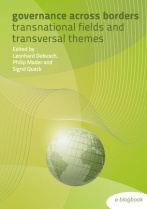
Governance across borders: transnational fields and transversal themes. Leonhard Dobusch, Philip Mader and Sigrid Quack (eds.), 2013, epubli publishers.
November 2026
M T W T F S S
 1
2345678
9101112131415
16171819202122
23242526272829
30  

Copyright Information

Creative Commons License
All texts on governance across borders are licensed under a Creative Commons Attribution-Share Alike 3.0 Germany License.