
Governance across borders or transnational governance looks at rule making, standard setting and institution building across borders. Empirically one can see the rise of a variety of patterns of regulatory governance. But transnational regulations are only one aspect of a whole field of transnational phenomena. Social life has always crossed, connected or transformed borders and boundaries.  Social processes have been transborder even before the spread of the nation-state system, as well as states also got shaped transnationally. Hirst and Thompson for example analyse different historical forms of transnational markets and long before the rise of the nation state.

Other transnational processes include transnational social movements, migration, communities, citizenship but also religion or various cultural practices (see for example Olgas entry on transnational ideas and local culture). In Europe, progress has been made specifically in regards to transnational phenomena within the European union, on debates about a European governance, public sphere or a collective identity (see for example also the new European Journal of Transnational Studies ) .

So far, there is no real discipline of transnational studies, but only a fragmented body of scholarship across sub-fields of sociology and other social science disciplines. To get into dialogue with and to learn from the insights of some of these studies, some general questions on transnationalism should be raised here, in a new series on transnational studies: What does it imply to analyze the global, national, local through transnational lenses for different approaches? Which phenomena are identified as transnational, how and why? How are the phenomena analyzed, how are flows or identities that cross certain spaces captured? How do transnational theories or theory building interact with traditional theories? And finally, what do all these different perspectives, including the governance research have in common, where are the biggest differences and what can we learn from each other? These are only some of the questions, which I think are important to discuss in order to be able to better understand transboundary social processes.

(sabrina)
Sigrid Quack and Leonhard Dobusch comment on the election results of the German “Piratenpartei” based on their research project “The Copyright Dispute”.

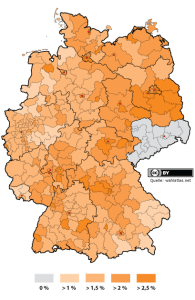
On Sunday, 27 September 2009, the Pirate Party running for the first time in German federal elections promptly won 2 percent of the votes. In some constituencies, particularly in university towns and urban centres, it gained up to 6 percent. In total, 850.000 voters cast their ballot for the Pirate Party (see official results and DW-World).

Piratenergebnisse-BRD-WebWhile this result does not bring the Pirate Party into the German parliament because of its 5 percent barring clause, this is nevertheless a quite impressive result for a young party which was founded only three years ago. Just to compare, the Green Party gained only 1.5 percent in its first run for German Federal elections in 1980, even though it had reunified a number of regional parties with experience in municipal councils and Länder parliaments. According to Forschungsgruppe Wahlen, an independent polling institute, the gains of the Pirate Party are part of a “historic gain’” of small parties in the last elections.

First signs of the Pirate Party gaining electoral support became visible in the elections for the European Parliament earlier on 7 June this year, where the Pirate Party obtained 0.9 percent (see also “Copyright Related Social Movements: Pirate Parties and the European Parliamentary Elections”). In the North Rhine-Westphalian communal elections on 30 August, members of the Pirate Party gained seats in the municipal councils of the cities of Münster and Aachen. In parallel to its public visibility and electoral support, the membership of the Pirate Party has been growing rapidly to currently close to 10,000 members, out of which about 8,000 joined the party during the last four months.

Still, this leaves interesting questions about what made nearly a million people vote for a relatively unknown and unestablished party, and what the perspectives of this party are for the next elections in North Rhine-Westphalia in 2010. Is the Pirate Party comparable to a “Biertrinker-Partei” (“beer drinker party”), as suggested by political scientist Oscar W. Gabriel (see pr-inside.com, German), and is therefore its success a short flash that will disappear as soon as it popped up?

In the following we will suggest that to be better understood, the development of the Pirate Party in Germany needs to be situated in a broader context: The gains of the Pirate Party build on both, a network of transnational activists criticising an, in their view, unbalanced extension of copyright protection and more localised social movements concerned with new data retention and surveillance plans. The internet is the place where these rather broad trends enter everyday life experience of people, and particularly those of having jobs in computing, software, creative industries, media, education, research, universities – not to speak of the palpable and rather concrete experiences of all those who wish to download music, share files and access open content in their free time. Read the rest of this entry »

This is the English version of “Quo Vadis, Wikipedia? Eindrücke von der Wikimania 2009 in Buenos Aires”, published at netzpolitik.org.

Logo of Wikimania 2009 in Buenos Aires

Stats.wikimedia.org counted 87.000 active Wikipdians – contributors with at least five Wikipedia edits in the respective month – in August 2008. Only a tiny fraction – about 300 to 400 – of this worldwide community meets once a year at Wikimania in “real life” to discuss all kinds Wikipedia issues.

The first Wikimania was held 2005 in Frankfurt/M., the most recent one last August in the Argentinian capital Buenos Aires. As there are videos of most of the talks available online in the conference program, I can skip detailed summaries of individual presentations and give some personal impressions of the conference. Wikimania in Buenos Aires not only was the first in the southern hemisphere, it also showed an enormous growth in terms of relevance and professionalization of Wikipedia and its sister projects such as Wikibooks or Wiktionary. The increase in relevance is probably best illustrated by an article in the New York Times print edition, which points to over 330 million monthly Wikipedia visitors.

This professionalization, in turn, could be experienced both organizationally and atmospherically in Buenos Aires: Wikimania 2009 had nothing to do with an improvised meet-up of Wikipedians but was instead a perfectly organized conference with finger food buffet and social program (Tango lessons!). Above all, the continuous reference given to the newly started “strategy process” demonstrated a new seriousness of self-reflection among at least the organized part of the Wikipedia community. Moreover, thanks to funding by the Omydar Network (link), the whole process is instructed and moderated by consultants of The Bridgespan Group – a consultancy specialized on NGOs. Read the rest of this entry »

Creative Commons offers a set of license modules such as “Attribution” or “ShareAlike” that can be recombined to different copyright licenses (see for an overview). One such license module is the “non-commercial”-module. From the very beginning of Creative Commons this module was at the center of most of the license related debates.

First of all, the non-commercial clause was an attempt to enable both sharing and remixing among users and commercialization for creators. Successful examples of hybrid business models such as Jamendo rely on this clause: at Jamendo, musicians receive 50 percent of all revenue generated by commercial use of their works – for example when used in commercials, played as background music in restaurants or in films – while at the same time users can freely download, share and remix those works.

Powerful critics like Wikimedia’s vice-executive director Erik Möller, however, fundamentally challenge the need for a non-commercial module. For him the diversity of incompatible open content licenses is a major barrier for remixing different works. In his 2006 piece “The Case for Free Use: Reasons Not to Use a Creative Commons-NC License” he instead advocates using the copyleft module “ShareAlike.” (It is this module that Wikimedia recently chose for re-licensing its content, see “Wikimania Preview #1“.)

But even adopters and users of the non-commercial clause face the non-trivial problem of defining commercial and non-commercial use. Is it commercial use, for example, if content is used on a webpage of a non-profit organization (for example, a research centre), which allows advertisement on this webpage? What if the content is used by a government or state-run entity? What if the work would be posted on an aggregator website which hosts millions of works (such as YouTube or MySpace), and which makes money from the advertising because of the high volume of traffic it attracts? Read the rest of this entry »

In this entry, I will report not on governance but on a book on governance from a neighbouring discipline that sociologists, organizational scholars and political scientists often ignore – social anthropology:

Sally Engle Merry, 2006. Human Rights and Gender Violence: Translating International Law into Local Justice. Chicago: University of Chicago Press

I found this book interesting and important for a number of reasons. First, I found many parallels to my own work. Second and more important, the book motivates reflecting on the concept of culture and its place in the transnational governance dynamics.

In her book, Sally Engle Merry explores how different actors – both state and nonstate, local and global – translate global norms associated with human rights and gender violence into practices in societies and communities where human rights are nonexistent as a concept and where gender violence is not defined in human rights terms, is considered a part of a national culture and protected as such. Read the rest of this entry »

This entry is part two of a mini-series dedicated to the fascinating institutional landscape found on the Eastern edge of the European Union. It deals with the dearth of the public sector and the rejuvenation of religion.

Someone must have built all this infrastructure which now lies decaying throughout Eastern Europe. It bears the signs of more than twenty years of decay, so almost certainly it was the governments of the Warsaw Pact which paved the roads to the majority of villages, laid tracks between cities, erected gargantuan grain silos and stamped huge factory complexes out of the ground.

Yet many of today’s Eastern European states have too few resources (or hardly any at all) to provide the public infrastructure necessary for success in the game of capitalist competition. And, as regards the private sector, the current mode of production knows no place for means of production accumulated under the Five-Year-Plans of yesteryear.

The new European Union member states Romania and Bulgaria show many signs that transnational institutions can catalyse the development of infrastructure; while Ukraine and Moldova demonstrate the counterpoint of the damage that lack of investment by the public sector can do. All the while, across the border between the two worlds – at least that is how the border between EU and non-EU can feel, and is locally perceived – the church consoles the post-socialist sorrows of the masses. Read the rest of this entry »

When we write about such phenomena as governance across borders, our conceptualisation always hinges on dividing lines, those borders which governance may span. Especially for a research group working on transnational institutions, it’s important to contemplate: What do borders really mean?

The reality of borders takes on a wholly different dimension when leaving the comfort of Western Europe, with its checkpoint-free border crossings. Travelling along Europe’s (still somewhat wild) Eastern frontier, the significance of national boundaries and the institutions that sometimes do, sometimes don’t span them, is illuminated starkly, highlighting what one takes for granted.

Here, I’ll be sharing some – hopefully not too wanton – snapshots and insights into the fascinating institutional landscape which I encountered during some recent travels. Read the rest of this entry »

Interestingly enough, two of the most visible current copyright related conflicts are in the realm of the most classic of all copyrighted media: books. On the one hand, Google books tries to digitize and eventually offer online nothing less then all books ever published. Aside the fundamental question, whether companies should be allowed doing this, the main controversy is around how to compensate authors and publishers of books that are out of stock and of orphan works (see “Google vs. Copyright Collectives“). On the other hand, the book as a medium itself may be changed by e-book reader such as Sony’s “Daily Edition” or Amazon’s “Kindle” (see “Sony’s E-Reader vs. Kindle“). Both allow direct wireless download of books directly to the reader via mobile phone networks. The latter raises a lot of controversy because of its restrictive digital rights management (“Kindle Controvery Continued: ‘Exit’ and ‘Voice’“) and Amazon’s ability to delete books from the reader even after their purchase (see NYT).

In spite of their common field of digital books and publishing, these two controversies evolved relatively independent from one another until very recently Amazon, Yahoo and Microsoft formed the “Open Book Alliance” (see CNET) to counter Google Books. Googles rejoinder was an alliance with Sony (see CBC). This merger of conflicts will, I predict, alter the dynamics in both controversies. Read the rest of this entry »

„Obama Lies, Grandma Dies“, „Obamahdinejad“  or „euthanasia bill“ are slogans you find on protest poster angry people hold up at town hall meetings, where the US health care reform is debated.  In general, everybody in a community is invited to attend Town Hall meetings to discuss political issues with elected officials. Such meetings are usually seen as a good way of giving voice to people in decision-making, therefore making politics more democratic by enhancing its input legitimacy. That is why social scientists like to take it as an example for studying public deliberation and discursive participation.  But in the current health care debate, there is not a lot of deliberation taking place. Instead, you see an explosion of emotions, fierce resistance and conflict. Mailing-lists and websites give advice on how to best disrupt those meetings. Here are some examples:

“The objective is to put the rep [representative] on the defensive with your question and follow-up. The rep should be made to feel that a majority, and if not, a significant portion of at least the audience, opposes the ‘Socialist agenda’ in Washington…If he blames Bush for something or offers other excuses – call him on it, yell back and have someone else follow-up with a shout-out.” (rightprinciples)

anti Health care reform protest

Read the rest of this entry »

More than seven years ago in 2002, Google launched its automated news aggregator “Google News”: Articles are selected and ranked by an algorithm according to characteristics such as issue frequency, freshness, location, relevance and diversity. On its front page Google News presents the headlines and about 200 characters of some articles together with links to the full texts where available online.

Not later than 2005 Google had to face the first law suits dealing with alleged copyright infringement filed by news agencies (e.g. Agence France Presse). Their claim: Google generates revenue using their content without proper compensation. But news agencies are not the only ones demanding their share from Google’s profits. Recently, the European Publisher Council (EPC) as well as the World Association of Newspapers and News Publishers (WAN-IFRA) and several of their member organizations signed the “Hamburg Declaration on Intellectual Property Rights” (see list of signatories) that bemoans too little protection and compensation of online content. In Germany, the Federation of German Newspaper Publishers (BDVZ) even calls for a new and all-embracing ancillary copyright with lump-sum payments as compensation for revenues third parties like Google make with their content.

Critics of these claims, however, accuse publishing houses of simply failing to develop new business models and therefore now trying to lobby for legally enforced compensation. One of these critics, blogger Malte Welding, compared the CEOs of publishing houses to zoo directors in a very entertaining piece (in Google-English) in the German online-only paper “netzzeitung”: Read the rest of this entry »

The Book

Governance across borders: transnational fields and transversal themes. Leonhard Dobusch, Philip Mader and Sigrid Quack (eds.), 2013, epubli publishers.
March 2026
M T W T F S S
 1
2345678
9101112131415
16171819202122
23242526272829
3031  

Copyright Information

Creative Commons License
All texts on governance across borders are licensed under a Creative Commons Attribution-Share Alike 3.0 Germany License.