
You are currently browsing leonidobusch’s articles.
Not so long ago I asked in this blog: “Is Google News Piracy?” when the European Publisher Council (EPC) as well as the World Association of Newspapers and News Publishers (WAN-IFRA) and many of their member organizations signed the “Hamburg Declaration on Intellectual Property Rights” (see list of signatories), which bemoans too little protection and compensation of online content.
Several months of lobbying from major media corporations such as the Axel Springer AG (publisher of the largest German boulevard paper “Bild“) or Burda and one federal election later, Germany seems to end up answering this question with “yes”. The new conservative German government plans to quickly introduce a new ancillary copyright bill, which shall protect publishers of being “expropriated” by new online news services, as Hubert Burda put it (German). According to Christoph Keese, chief lobbyist of Axel Springer, and Christoph Fiedler from VDZ, the umbrella organisation of German Magazine Publishers, this new legislation shall eventually lead to the formation of a new copyright collective for publishers and journalists (see the German video of a recent debate in Berlin).
As only little is known so far about the details in the upcoming bill, speculations regarding potential consequences of such an ancillary copyright spread. The Austrian IT-news portal futurezone, for example, paints the picture of upcoming “linking crimes” (“Link-Verbrechen”) and fears “worsenings for researchers, bloggers and journalists.” And while it seems pretty clear that publishing houses will profit most from the new ancillary copyright, the question “who pays the bill?” is still open for debate.
But the best summary of the current situation is again – for another example, see “Google Books and the Kindle Controversy” – provided by Scott Adam’s Dilbert, who needs only three small boxes to tell more than my entire description above did:

[update:]
Very interesting in this regard is a plenary session at the “Monaco Media Forum” featuring Arianna Huffington, founder of the news website Huffington Post, and Mathias Döpfner, CEO of the German Axel Springer AG:
Especially interesting is the part after about 17 minutes when Döpfner starts talking about “web communism”:
“I think this theory that only a free access to information is, I have to admit, one of the most absurd theories that I have heard. It is a very late ideological outcome of web communists.”
At this point Arianna Huffington jumps in with the question:
“Is Chris Anderson in the room?”
His book is called “Free. The Economics of Abundance and Why Zero Pricing Is Changing the Face of Business”. It is available for free online, as a PDF as well as an audio book (285MB).
(leonhard)
In spite of its regular portrayal as “anarchic”, “anything goes” was never true for Wikipedia. Beginning with the list of principles issued by its founder, Jimbo Wales, a continuously growing number of rules guides contributors to and hence development of Wikipedia. One of the most prominent rules is the aim of delivering a “Neutral Point of View” (NPOV). Other important rules deal with notability. While the NPOV is debated with regard to every single article, Wikipedia’s several “notability guidelines” try to resolve the question which information ought (not) to be included in the free online encyclopedia in the first place. Over the years, long lists of conventions have emerged for all kinds subjects. Regarding people, for example, the English Wikipedia lists in detail the notability criteria for members of different professional groups – ranging from Academics over Criminals and Diplomats to Entertainers (including actors, comedians, models, etc.).
But notability guidelines or, as they are called in the German Wikipedia “relevance criteria” (“Relevanzkriterien”), share the problem of all taxonomies, namely a certain degree of arbitrariness; an arbitrariness that makes them particularly prone to being criticized and challenged. In the English Wikipedia debates about notability even led to the formation of two antagonistic camps: The “Association of Deletionist Wikipedians” (ADW) sails under the banner of Antoine de Saint-Exupéry and his famous quote:
“Perfection is achieved, not when there is nothing more to add, but when there is nothing left to take away.”
The opposite camp assembles around the “Association of Inclusionist Wikipedians” (AIW), which goes even back to the old Romans for their motto:
“The motto of the AIW is Conservata veritate, which translates to, ‘with truth preserved.’ This motto reflects the inclusionist desire to change Wikipedia only when no knowledge would be lost as a result.”
While both “associations” exist since 2004 and their dispute seemed to be rather settled, recent controversies about “relevance” in the German Wikipedia demonstrate that and how such rules may still be re-negotiated: Read the rest of this entry »
According to the press release of the Nobel Foundation, Elinor Ostrom was awarded The Sveriges Riksbank Prize in Economic Sciences in Memory of Alfred Nobel aka Nobel Prize in Economics “for her analysis of economic governance, especially the commons”.
Both, economic governance and commons are recurrent themes in this blog. And while most of Ostrom’s works deal with traditional commons such as forests or fisheries, Creative Commons’ Vice President Mike Linksvayer was eager to point to an article on knowledge commons she co-authored with Charlotte Hess titled “Ideas, Artifacts, and Facilities: Information as a Common-Pool Resource”.
Nevertheless, I fear that applying Ostrom’s insights for transnational governance of transnational commons is far from trivial. This is emphasized in the very article mentioned above for the example of scholarly information:
“But analyzing the whole ecosystem of scholarly information is much more tenuous than in Governing the Commons, where (1) the boundaries were clear, (2) the resource systems studied were small and easy to observe, (3) solving problems was of high salience to appropriators, (4) institutions were long-enduring and had evolved over time, and (5) extensive field observation was available.
[…]
Information, on the other hand, often has complex tangible and intangible attributes: fuzzy boundaries, a diverse community of users on local, regional, national, and international levels, and multiple layers of rule-making institutions.” (p. 132)
And as Sean Safford at orgtheory states, Ostrom’s main conclusion for governing traditional commons is “that coordination happens through self-organization and local (very local) governance”.
Consequently, Ostrom herself makes a difference between local and global commons. Together with others, she lists the following “challenges to establish global institutions to manage biodiversity, climate change, and other ecosystem services” in a Science-article titled “Revisiting the Commons” (2007, p. 282 f.):
- Scaling-up problem. Large numbers of participants lead to greater “difficulty of organizing, agreeing on rules, and enforcing rules.”
- Cultural diversity challenge. While diversity can be an asset, Ostrom et al. fear that it also “can decrease the likelihood of finding shared interests and understandings.”
- Complications of interlinked common-pool-resources. Global issues have more interactions and, with increased specialization, become more interdependent, which also increases the difficulty of governance.
- Accelerating rates of change, which make, due to Ostrom et al., “’Learning by doing’ […] increasingly difficult, as past lessons are less and less applicable to current problems.”
- Requirement of unanimous agreement as a collective-choice rule for global resource management.
- We have only one globe with which to experiment, which leaves “less leeway less leeway for mistakes at the local level, while at the global level there is no place to move.”
To sum it up, as far as transnational governance of common pool resources are concerned, Elinor Ostrom’s work predominantly helps in identifying difficulties. For finding solutions, however, these works – according to herself and her colleagues – at best “provide starting points for addressing future challenges.” (p. 282)
(leonhard)
This is the English version of “Quo Vadis, Wikipedia? Eindrücke von der Wikimania 2009 in Buenos Aires”, published at netzpolitik.org.

Stats.wikimedia.org counted 87.000 active Wikipdians – contributors with at least five Wikipedia edits in the respective month – in August 2008. Only a tiny fraction – about 300 to 400 – of this worldwide community meets once a year at Wikimania in “real life” to discuss all kinds Wikipedia issues.
The first Wikimania was held 2005 in Frankfurt/M., the most recent one last August in the Argentinian capital Buenos Aires. As there are videos of most of the talks available online in the conference program, I can skip detailed summaries of individual presentations and give some personal impressions of the conference. Wikimania in Buenos Aires not only was the first in the southern hemisphere, it also showed an enormous growth in terms of relevance and professionalization of Wikipedia and its sister projects such as Wikibooks or Wiktionary. The increase in relevance is probably best illustrated by an article in the New York Times print edition, which points to over 330 million monthly Wikipedia visitors.
This professionalization, in turn, could be experienced both organizationally and atmospherically in Buenos Aires: Wikimania 2009 had nothing to do with an improvised meet-up of Wikipedians but was instead a perfectly organized conference with finger food buffet and social program (Tango lessons!). Above all, the continuous reference given to the newly started “strategy process” demonstrated a new seriousness of self-reflection among at least the organized part of the Wikipedia community. Moreover, thanks to funding by the Omydar Network (link), the whole process is instructed and moderated by consultants of The Bridgespan Group – a consultancy specialized on NGOs. Read the rest of this entry »
Creative Commons offers a set of license modules such as “Attribution” or “ShareAlike” that can be recombined to different copyright licenses (see for an overview). One such license module is the “non-commercial”-module. From the very beginning of Creative Commons this module was at the center of most of the license related debates.
First of all, the non-commercial clause was an attempt to enable both sharing and remixing among users and commercialization for creators. Successful examples of hybrid business models such as Jamendo rely on this clause: at Jamendo, musicians receive 50 percent of all revenue generated by commercial use of their works – for example when used in commercials, played as background music in restaurants or in films – while at the same time users can freely download, share and remix those works.
Powerful critics like Wikimedia’s vice-executive director Erik Möller, however, fundamentally challenge the need for a non-commercial module. For him the diversity of incompatible open content licenses is a major barrier for remixing different works. In his 2006 piece “The Case for Free Use: Reasons Not to Use a Creative Commons-NC License” he instead advocates using the copyleft module “ShareAlike.” (It is this module that Wikimedia recently chose for re-licensing its content, see “Wikimania Preview #1“.)
But even adopters and users of the non-commercial clause face the non-trivial problem of defining commercial and non-commercial use. Is it commercial use, for example, if content is used on a webpage of a non-profit organization (for example, a research centre), which allows advertisement on this webpage? What if the content is used by a government or state-run entity? What if the work would be posted on an aggregator website which hosts millions of works (such as YouTube or MySpace), and which makes money from the advertising because of the high volume of traffic it attracts? Read the rest of this entry »
Interestingly enough, two of the most visible current copyright related conflicts are in the realm of the most classic of all copyrighted media: books. On the one hand, Google books tries to digitize and eventually offer online nothing less then all books ever published. Aside the fundamental question, whether companies should be allowed doing this, the main controversy is around how to compensate authors and publishers of books that are out of stock and of orphan works (see “Google vs. Copyright Collectives“). On the other hand, the book as a medium itself may be changed by e-book reader such as Sony’s “Daily Edition” or Amazon’s “Kindle” (see “Sony’s E-Reader vs. Kindle“). Both allow direct wireless download of books directly to the reader via mobile phone networks. The latter raises a lot of controversy because of its restrictive digital rights management (“Kindle Controvery Continued: ‘Exit’ and ‘Voice’“) and Amazon’s ability to delete books from the reader even after their purchase (see NYT).
In spite of their common field of digital books and publishing, these two controversies evolved relatively independent from one another until very recently Amazon, Yahoo and Microsoft formed the “Open Book Alliance” (see CNET) to counter Google Books. Googles rejoinder was an alliance with Sony (see CBC). This merger of conflicts will, I predict, alter the dynamics in both controversies. Read the rest of this entry »
More than seven years ago in 2002, Google launched its automated news aggregator “Google News”: Articles are selected and ranked by an algorithm according to characteristics such as issue frequency, freshness, location, relevance and diversity. On its front page Google News presents the headlines and about 200 characters of some articles together with links to the full texts where available online.
Not later than 2005 Google had to face the first law suits dealing with alleged copyright infringement filed by news agencies (e.g. Agence France Presse). Their claim: Google generates revenue using their content without proper compensation. But news agencies are not the only ones demanding their share from Google’s profits. Recently, the European Publisher Council (EPC) as well as the World Association of Newspapers and News Publishers (WAN-IFRA) and several of their member organizations signed the “Hamburg Declaration on Intellectual Property Rights” (see list of signatories) that bemoans too little protection and compensation of online content. In Germany, the Federation of German Newspaper Publishers (BDVZ) even calls for a new and all-embracing ancillary copyright with lump-sum payments as compensation for revenues third parties like Google make with their content.
Critics of these claims, however, accuse publishing houses of simply failing to develop new business models and therefore now trying to lobby for legally enforced compensation. One of these critics, blogger Malte Welding, compared the CEOs of publishing houses to zoo directors in a very entertaining piece (in Google-English) in the German online-only paper “netzzeitung”: Read the rest of this entry »
Microsoft’s 1991 “Press Computer Dictionary” defined “Vaporware” as follows (taken from Bayus et al.):
“vaporware n. (1) a product that the vendor keeps promising is about to arrive ‘really soon now’, but it goes so long past its shipment date that no one believes it will ever really ship […] (2) slang for announced software that may never materialize […]; (3) a term used sarcastically for promised software that misses the announced release date, usually by a considerable length of time”
Into management language “vaporware” could probably best be translated as “strategic product pre-announcement”. Especially in technological network markets, corporations with strong market power pre-announce upcoming products and promise a wide range of features so that customers refrain from adopting or even switching to an already existing alternative solution. The rationale behind those strategies is relatively simple and it transcends network markets, reaching into the realm of standardization with network effects in general: “the standard that is expected to become the standard will become the standard”, as Shapiro and Varian put it in their seminal book “Information Rules” (1999, p. 13).
For decades, Microsoft was the uncrowned king of vaporware. (Actually, already in 1985 Bill Gates received the “Golden Vaporware Award” by Infoworld’s editor Stewart Alsop.) The long pre-announced introduction of Windows 95 is legendary and has just recently been topped by Microsoft starting to announce new features of Windows 7 immediately after the release of its unloved Windows Vista.
Seen in this light, the recent reactions of Microsoft officials to Google’s pre-announcement of “Chrome OS” (see “Microsoft vs. Google: New Fronts in a Paradigmatic Battle“) do not lack unintentional humor. Microsoft’s Senior Vice President, Bill Veghte, bemoaned in an interview that “so far Google’s Chrome OS is nothing more than a blog post.” Even more revealing is yesterday’s remark of Microsoft founder Bill Gates, as reported by CNET:
“Gates said it was hard to really say much about Chrome OS, since Google has said so little about how it will actually work. ‘The more vague they are, the more interesting it is,’ he said.”
Both critiques resemble accusations Microsoft regularly had to deal with in the past. But maybe Microsoft is right and Google will be its successor to the throne of vaporware. We will see.
(leonhard)
When the chief of Microsoft Germany, Achim Berg, predicted in an interview in the “Berliner Zeitung” that “the free-of-cost-culture on the Internet draws to a close” last Saturday, this happened not only weeks after Microsoft had started its own, free-of-charge search engine “bing” but also only days before Google’s announcement of “Chrome OS”: A new open source operating system on top of a Linux kernel and delivered, of course, for free. On the Official Google Blog Chrome OS was announced as follows:
“[T]he operating systems that browsers run on were designed in an era where there was no web. So today, we’re announcing a new project […] — the Google Chrome Operating System. It’s our attempt to re-think what operating systems should be. Google Chrome OS is an open source, lightweight operating system that will initially be targeted at netbooks. Later this year we will open-source its code, and netbooks running Google Chrome OS will be available for consumers in the second half of 2010. Because we’re already talking to partners about the project, and we’ll soon be working with the open source community, we wanted to share our vision now so everyone understands what we are trying to achieve.”
Is this re-opening the operating system wars of the 1980s? Is this the beginning of serious open source competition for Microsoft’s proprietary business model? In other words, are we witnessing a paradigmatic battle of open versus proprietary innovation regimes with Google and Microsoft as its most prominent antipodes? I am not so sure. But maybe the Pirate Party’s sole member in the European Parliament, Christian Engström, was right in his interesting op-ed in the Financial Times yesterday:
“The world is at a crossroads. The internet and new information technologies are so powerful that no matter what we do, society will change. But the direction has not been decided.”
(leonhard)
Together with our recent guest blogger Sebastian Botzem from the Social Science Research Center in Berlin I prepared a piece for this year’s EGOS Colloquium, which is taking place in wonderful Barcelona. In the sub-theme titled “The social dynamics of standardization” we are presenting our paper “The Rule of Standards: Codifying Power in the Transnational Arena” (PDF), in which we try a relatively unorthodox comparison: We contrast the case of Microsoft Windows as a technological market standard with non-technological and negotiated accounting standards in the realm of the International Accounting Standards Board (IASB).
Not least to our own surprise, both examples of standardization show many similarities that allow drawing conclusions for transnational governance by standard setting in general. Among these are the following:
- Due to coordination effects, in both cases an increase in the total number of adopters paves the way for – though not guaranteeing – one dominating standard.
- While having been developed differently (market competition vs. political negotiation), in both cases growing standard diffusion reduced the need for participatory or inclusive modes of standard-setting (see the figure below).
- Finally and again observable in both cases, growing adoption can trigger what we call the dialectics of power in standardization: The successful establishment of a standard redistributes benefits and power among affected actors and feeds back into the standard formation process.
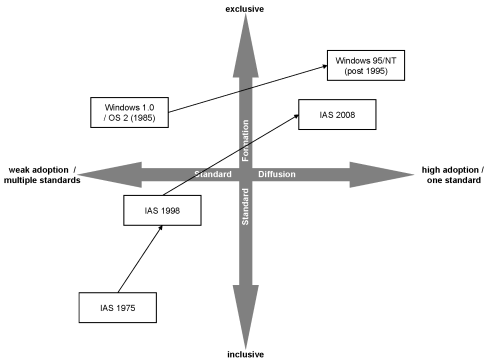
But aside from these conclusions, the paper may also illustrate why gathering seemingly very different empirical fields under the common umbrella of “governance across borders” in this blog might make sense after all.
(leonhard)


 governancexborders.com