
You are currently browsing Leonhard Dobusch’s articles.
When the chief of Microsoft Germany, Achim Berg, predicted in an interview in the “Berliner Zeitung” that “the free-of-cost-culture on the Internet draws to a close” last Saturday, this happened not only weeks after Microsoft had started its own, free-of-charge search engine “bing” but also only days before Google’s announcement of “Chrome OS”: A new open source operating system on top of a Linux kernel and delivered, of course, for free. On the Official Google Blog Chrome OS was announced as follows:
“[T]he operating systems that browsers run on were designed in an era where there was no web. So today, we’re announcing a new project […] — the Google Chrome Operating System. It’s our attempt to re-think what operating systems should be. Google Chrome OS is an open source, lightweight operating system that will initially be targeted at netbooks. Later this year we will open-source its code, and netbooks running Google Chrome OS will be available for consumers in the second half of 2010. Because we’re already talking to partners about the project, and we’ll soon be working with the open source community, we wanted to share our vision now so everyone understands what we are trying to achieve.”
Is this re-opening the operating system wars of the 1980s? Is this the beginning of serious open source competition for Microsoft’s proprietary business model? In other words, are we witnessing a paradigmatic battle of open versus proprietary innovation regimes with Google and Microsoft as its most prominent antipodes? I am not so sure. But maybe the Pirate Party’s sole member in the European Parliament, Christian Engström, was right in his interesting op-ed in the Financial Times yesterday:
“The world is at a crossroads. The internet and new information technologies are so powerful that no matter what we do, society will change. But the direction has not been decided.”
(leonhard)
Together with our recent guest blogger Sebastian Botzem from the Social Science Research Center in Berlin I prepared a piece for this year’s EGOS Colloquium, which is taking place in wonderful Barcelona. In the sub-theme titled “The social dynamics of standardization” we are presenting our paper “The Rule of Standards: Codifying Power in the Transnational Arena” (PDF), in which we try a relatively unorthodox comparison: We contrast the case of Microsoft Windows as a technological market standard with non-technological and negotiated accounting standards in the realm of the International Accounting Standards Board (IASB).
Not least to our own surprise, both examples of standardization show many similarities that allow drawing conclusions for transnational governance by standard setting in general. Among these are the following:
- Due to coordination effects, in both cases an increase in the total number of adopters paves the way for – though not guaranteeing – one dominating standard.
- While having been developed differently (market competition vs. political negotiation), in both cases growing standard diffusion reduced the need for participatory or inclusive modes of standard-setting (see the figure below).
- Finally and again observable in both cases, growing adoption can trigger what we call the dialectics of power in standardization: The successful establishment of a standard redistributes benefits and power among affected actors and feeds back into the standard formation process.
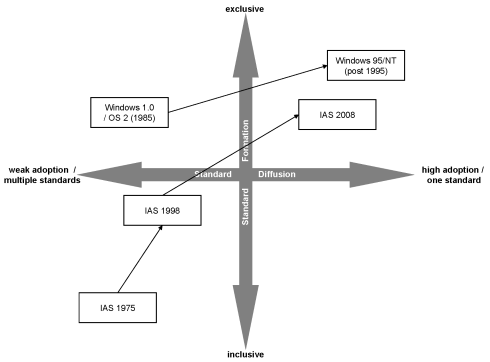
But aside from these conclusions, the paper may also illustrate why gathering seemingly very different empirical fields under the common umbrella of “governance across borders” in this blog might make sense after all.
(leonhard)
Yesterday the organizers of one of Europe’s largest music conferences “Popkomm” publicly announced its cancellation for 2009. Originally it was to take place in September at “Station Berlin”. In an official press statement Ralf Kleinhenz, Managing Director of Popkomm Gmbh gave the following reasons for cancelling this year’s event:
“A situation that was becoming clear early this year at Midem in Cannes also seems to be affecting Popkomm in Berlin. Despite positive reactions to the new event location and a satisfactory number of bookings by exhibitors, because of the economic situation we anticipate a considerable decline in trade visitor attendance. Out of responsibility towards the exhibitors we have therefore decided to postpone Popkomm for one year.”
While this reads like a reference to the overall economic crisis, Dieter Gorny, head of the Association of the German Music Industry, tried to reframe the cancellation into a political statement later that day:
“The digital crisis fully hits the music industry. Because of Internet piracy many companies cannot afford to take part at the Popkomm any longer. […] We want to point the way that politics finally must act to stop theft of intellectual property on the net.” (Handelsblatt, translation L.D.)
This strategy of blaming Internet piracy for all of the music industry’s problems is not new. For years this is the chorus sung by music industry representatives whenever there is bad news. But probably piracy is too good an excuse: if one has the impression that business models and strategies are only threatened by criminals and would work otherwise, this may not be the best starting point for (self-)critical reflexion and innovation. Couldn’t it be that the music industry fails in coping with digital challenges because its major proponents have a “perfect excuse” for their management failures? In a way, their defeatism might thus performatively cause their eventual defeat. Just consider this an alternative explanation.
(leonhard)
For this year’s Wikimania (26-28 August, Buenos Aires) I submitted an abstract of a paper comparing transnationalization processes and community relations of Creative Commons and Wikimedia. In this series I present some work in progress.
While the now famous online-encyclopedia Wikipedia was founded shortly before Creative Commons in 2001, its organizational carrier – the Wikimedia Foundation – was founded about half a year after Creative Commons had formally launched its first set of alternative copyright licenses in December 2002. Both organizations share the fundamental vision of creating and promoting a global “commons” of freely available digital goods. Wikimedia hosts a framework of hardware (webspace and bandwith), software (the wiki-engine “MediaWiki”) and legal rules (copyleft licenses) for several projects of commons-based peer production such as Wikipedia, Wikibooks or Wiktionary. Creative Commons, in turn, delivers a set of open content licenses to – not only, but also – legally enable and foster such commons-based peer production projects as put forward by Wikimedia.
Interestingly, independent from one another, both organizations very soon after their foundation started to transnationalize by developing a transnational network of locally rooted organizations. In a way, this strategic coordination of legally and financially independent organizations resembles what is called “strategic networks” in the realm of business research (see, for example, Gulati, Nohria and Zaheer 2000). Their strategies of building such an organizational network were however quite distinct. Read the rest of this entry »
For this year’s Wikimania (26-28 August, Buenos Aires) I submitted an abstract of a paper comparing transnationalization processes and community relations of Creative Commons and Wikimedia. In this series I present some work in progress.
A few days ago, Wikimedia, the organization behind Wikipedia and its sister projects, announced the results of its most recent community vote: All contributors who had made at least 25 edits to any Wikimedia project prior to March 15, 2009 were invited to vote on the proposal to license Wikimedia material so it is available under the Creative Commons Attribution-ShareAlike license (CC-BY-SA), while retaining dual licensing with the GNU Free Documentation License (GFDL). This proposal is in line with earlier statements of Wikipedia founder Jimmy Wales, who repeatedly stated that “Wikipedia, had it been founded after Creative Commons, would have certainly been under a Creative Commons license” (see, for example, his speech at an iSummit party in December 1 2007 in the video below) The proposal was accepted by a solid 75.8 % majority (see results page). Read the rest of this entry »
At the workshop „Mashing-up Culture: The Rise of User-generated Content“, which had been perfectly organized by Eva Hemmungs-Wirtén of Uppsala University in Sweden, Sigrid and I not only presented a paper on “The Copyright Dispute” (see resources page for paper and slides respectively), but I also had the great pleasure of meeting Niva Elkin-Koren. She is not only project lead of Creative Commons Israel but does very instructive research on copyright licensing and governance in the realm of digital communities (see SSRN-page for details).
One of her most recent papers, titled “Governing Access to User-Generated-Content: The Changing Nature of Private Ordering in Digital Networks”, is of particular relevance for scholars of transnational governance: Most of the new digital communities and their respective carrier platforms such as Facebook, YouTube or Wikipedia are “born globals”. Their regulation, be it (seemingly) unilateral via terms of service (see “Private Copyright Regimes: Facebook”) or multilateral via optional licensing (see, for example, Flickr), represents a form of transnational private ordering. At the same time, the pace of technological change and the blurring boundaries between the commercial and the non-commercial sphere make this field particularly promising for studying (collisions of) transnational governance regimes. Read the rest of this entry »
Three days ago, on May 5, the Economist started a week-long public debate under the headline “Copyright and wrongs: this house believes that existing copyright laws do more harm than good.” In his opening remarks, Kenneth Cukier gives the following rationale for hosting the debate:
Copyright strangles creativity. Copyright rewards originality. It is a nuisance to the public that unduly enriches a few people. It is the backbone of our knowledge economy that fuels progress. Hate it, love it, break it, protect it; few people lack strong opinions about copyright and its place in society.
As debaters, the Economist invited Harvard’s copyright critic William Fisher and Justin Hughes from Yeshiva University as an advocat of the prevalent copyright regime. While both present utilitarian arguments rooted in standard neoclassical economics for their oppositional claims – which, by the way, demonstrates how arbitrary mainstream economic reasoning can be -, the former also gives a short explanation for the, in his view, distorted development of copyright legislation in his first statement:
How did we get into this pickle? At least three intertwined causes seem to be at work. First, most recent adjustments in the copyright system have been spurred and shaped by interest groups that have stakes in expansion of copyright protection and that fail to take into account the interests of the public as a whole. Second, the multilateral intellectual-property treaties that now govern most countries establish floors, not ceilings. The result has been a ratchet: it is easy to increase the levels of legal protection, but hard to decrease them. Third, lawmakers are afflicted with the local maximum problem; they seek to alleviate problems by making modest improvements in the existing regime, unable to see across the valley to radically different approaches that would be much better. Read the rest of this entry »
One of the things that makes blogs particularly interesting are series. In this blog, for example, Phil features a series on “microcredit myths“. Today we are starting a series recommending series at related blogs. As an opener I present Digital Renaissance’s “Songs to the Music Business”.
The guys behind Digital Renaissance – two music label owners, a researcher and an expert on the movie business – describe the rationale for their blog as follows:
There need to be a Digital Renaissance. Renaissance is the french word for rebirth. It was a cultural movement that brought us out of the middle ages and into the future and then some with a vengeance 4.0 style. The world adjusted to this cultural movement. It is time for the world to start adjusting to the Digital Renaissance.
Yesterday, they started a series “with songs that can be translated as good stories of – or advice/mindsets to the music business”. The first entry of the series is devoted to Warren G and his piece “What’s love got to do with it?” (YouTube-Video) . There they are claiming that Warren G is “telling the whole truth” in the third verse, where he raps:
“Now for these labels tellin’ fables, makin’ the messed-up deals under the tables. You think that you smart, but, fool, I’m the smartest. You can’t make no money if you can’t keep an artist.” Read the rest of this entry »
In his recent article “Decoding Divergence in Software Regulation”* Thomas Eimer very convincingly demonstrates and explains differences in software patent regulation between the United States and the European Union. He basically distinguishes three “structural causes for the persisting divergence” (p. 276) – namely the US practice of patenting software versus the European reluctance of doing so: (1) incompatible underlying paradigms, (2) differentiated patterns of power structure, and (3) unsynchronized institutional arrangements.
Especially in dealing with the first cause, “paradigmatic cleavage”, Eimer argues rather broadly, embracing both patent and copyright law. And I completely agree, when he contrasts the strong “utilitarian” rationale of intellectual property rights in the US with European scepticism for such utilitarian reasoning. I am not so sure, however, that the partial rejection of utilitarian welfare assumptions automatically leads to a better balance between “public and private interests” in the field of intellectual property regulation in general, as implied by Eimer when he writes: “Opponents of strong intellectual property rights in Europe can refer to a long tradition of suspicion”. Read the rest of this entry »