
You are currently browsing leonidobusch’s articles.
In the series “algorithm regulation”, we discuss the implications of the growing importance of technological algorithms as a means of regulation in the digital realm.

Facebooks Edge Rank Algorithm (Source: http://goo.gl/zTrTbe)
In a recent issue of the Proceedings of the National Academy of Sciences of the USA (PNAS), Adam Kramer and others published an article on “Experimental evidence of massive-scale emotional contagion through social networks” with data derived from the world’s largest social network Facebook. The researchers was given the permission to manipulate the Facebook newsfeed in order to test how differences in terms of emotional direction of postings, i.e. more “happier” or more “sadder” updates, impact on people’s status updates. The study delivered two main results: First, emotions are “contagious” in that more happy postings inspired more happy postings and vice versa. Second, fewer emotional posts (in either direction) reduces posting frequency of Facebook users.
The publication of these results has incited furious debates with regard to research ethics, mainly criticizing that Facebook should have asked users to (more) explicitely consent in taking part in such an experiment. Susan Fiske, the Princeton University psychology professor who edited the study for publication, is quoted in an Atlantic article subtitled “It was probably legal. But was it ethical?” as follows:
“I was concerned,” Fiske told The Atlantic, “until I queried the authors and they said their local institutional review board had approved it—and apparently on the grounds that Facebook apparently manipulates people’s News Feeds all the time.”
Over at orgtheory, Elizabeth Popp Berman agrees that “the whole idea is creepy” but also argues that Read the rest of this entry »
The Council of Europe has invited me to contribute the following input paper (PDF) on “Need for New Regulation to Enhance Creativity in the Digital Age: The Cases of User-generated Content and Cultural Heritage Institutions” for the Conference on “Creating an enabling environment for digital culture and for empowering citizens”, taking place 4-5 July 2014, Baku, Azerbaijan.
 In the course of growing economic importance of knowledge and of technological change related with the Internet and digitization, regulations of knowledge and information goods have increasingly become an issue of transnational contestation. Particularly the role of copyright law has changed since virtually all forms of online communication and interaction requires copying and distributing content, thereby becoming copyright-related. In a way, copyright laws have become the core regulatory device for the digital information society in general and digital creative practices in particular.
At the same time, we can observe that regulatory struggles in the copyright realm date way back. Already Kant (1785) and Fichte (1793) distinguished between different functional groups affected by copyright laws, among which publisher/copyright owner, author/creator, and consumer/user represent the most important. These groups are still the ones most affected by copyright regulation, even though today copyright also covers cinematographic work and computer programs and it is possible to reproduce nearly all types of work in digital form. Balancing the interests of these groups is therefore still the main task for copyright regulators on the international and the national level.
And while technological change has always provided both opportunities for new forms of creativity and problems for pre-existing business models in the copyright realm (Wu 2010), the all-encompassing and highly dynamic impact of new digital technology on nearly all fields and types of creative activities brings with it enormous regulatory challenges. First, digitization makes it possible to distinguish between content and medium – a constellation that is of major importance for the copyrighted content industry since it sells CDs, DVDs, and books, not music, movies, or novels. From a regulation perspective, this means that new rules – be they publicly legislated or privately enforced via license agreements – tend to more directly address particular usage practices, affecting traditional knowledge brokers such as archives, libraries or museums. Second, loss- and lag-free copying of digital contents via personal computers and the Internet enable new forms of private copying and peer-to-peer distribution of content on a massive scale. The regulation challenge related to this issue is to allow for these new technologies to enfold while at the same time prevent a massive increase in copyright infringement due to piracy. Third, thanks to decreasing production and distribution costs, many more people actively engage in content creation and make their works accessible directly to the public (sometimes referred to as ‘user-generated content’), thereby often re-using and transforming pre-existing copyrighted works. How to regulate these new forms of derivative creativity and creative consumption is again a task for regulators to address. Read the rest of this entry »
In the series “algorithm regulation”, we discuss the implications of the growing importance of technological algorithms as a means of regulation in the digital realm.
 With a market share of over 90 percent in Europe, the Google search engine and its search algorithm respectively decide what is relevant on an issue and what not. Any information that is not placed on the first few pages of Google’s search results will hardly ever be found. On the other hand, personal information that is listed prominently in these results may haunt you forever. The latter issue was recently tried by the European Court of Justice (ECJ), who ruled (C-131/12) that
the activity of a search engine consisting in finding information published or placed on the internet by third parties, indexing it automatically, storing it temporarily and, finally, making it available to internet users according to a particular order of preference must be classified as ‘processing of personal data’
and that, under certain not very clearly spelled out conditions relating to the data subject’s rights to privacy,
the operator of a search engine is obliged to remove from the list of results displayed following a search made on the basis of a person’s name links to web pages, published by third parties and containing information relating to that person.
By crafting such a “right to be forgotten”, the ECJ effectively regulates Google’s search algorithms. In other words, we can observe the ECJ regulating Google’s algorithmic regulation. In response to the ruling, Google has already set up an online form for deletion requests, stating that Read the rest of this entry »
About half a year ago, the German Internet association D64 – Center for Digital Progress had launched an initiative to promote the use of Creative Commons licenses. I was one of the co-organizers. Last week, with the help of graphic designers Sara Lucena und Nico Roicke, we have put together a very nice infographic on “Creative Commons in Numbers”. Of course, some of the numbers are only estimates and not all are most recent, but taken together they give a good overall impression of Creative Commons usage on the internet. Enjoy & Share! Read the rest of this entry »
When Sigrid and I researched the organizational network orchestrated by the US non-profit Creative Commons (see our MPIfG Discussion Paper 08/8, PDF), one of the most interesting findings was the benefits of its transnationalization efforts. What initially appeared as a challenge – legal differences between jurisdictions and the perceived need to adapt its alternative copyright licenses accordingly – actually turned out to be a mobilizing and diffusion strategy. At least initially, porting the licenses to different jurisdictions provided a task for locally embedded copyright lawyers, who then became part of a transnational network of affiliate organizations helping to promote Creative Commons licenses. So, at least in this case of private regulation via standards distance between different actors became an asset.
In their most recent paper entitled “Distance as asset? Knowledge collaboration in hybrid virtual communities” (not open acces available yet), economic geographers Gernot Grabher and Oliver Ibert make a more general argument emphasizing the benefits of geographically dispersed communities. They define hybrid communities as “a specific kind of community, which encompasses on the one hand the sphere of professional expertise, and the mundane world of ordinary users, lay-persons, enthusiasts, and hobbyists, on the other” (p. 101). Empirically, the paper compares three types of communities with three cases each:
- Firm-hosted communities (Huggies Happy Babies Forum, Kraft Food Message Boards, Dell’s Ideastorm Forum)
- Firm-related communities (IKEA Fans, Nikonians, BMW Luxury Touring Forum)
- Independent communities (A Swarm of Angels Forum, Sandboarder Forum, DCA Forum)
Over at orgtheory.com, Brayden King pointed to two recent studies on online activism. In their study on “The Structure of Online Activism” (PDF), published in the newly founded Open Access journal Sociological Science, Kevin Lewis, Kurt Gray and Jens Meierhenrich investigate participation around a Facebook “Cause” on Darfur. “Causes” is a platform for online activism which is linked to and builds upon Facebook and the latter’s possibility to recruit your Facebook friends for a certain cause. The cause under study was a campaign on Darfur with over 1.2 million supporters. The authors had access to great longitudinal network data and investigated how the decision to publicly support the cause on Facebook had translated into further support later on. The disillusioning result (p. 2):
99.76 percent of members never donated[.]
To a certain degree, the results of the paper corroborate what is known as the 1% rule on the internet. The overly large majority of an online community contributes nothing, only one percent is responsible for nearly all of the content; in the Darfur case even fewer people (0.24 percent) contributed in form of donations. Compared to traditional forms of mobilizing this is a very poor conversion rate, as reported by Lewis et al. (p. 4):
Mail solicitations, meanwhile, typically generate rates of 2 percent to 8 percent of people donating $10 to $50 each[.]
Furthermore, activism levels decreased quickly over time (see Figure 1).
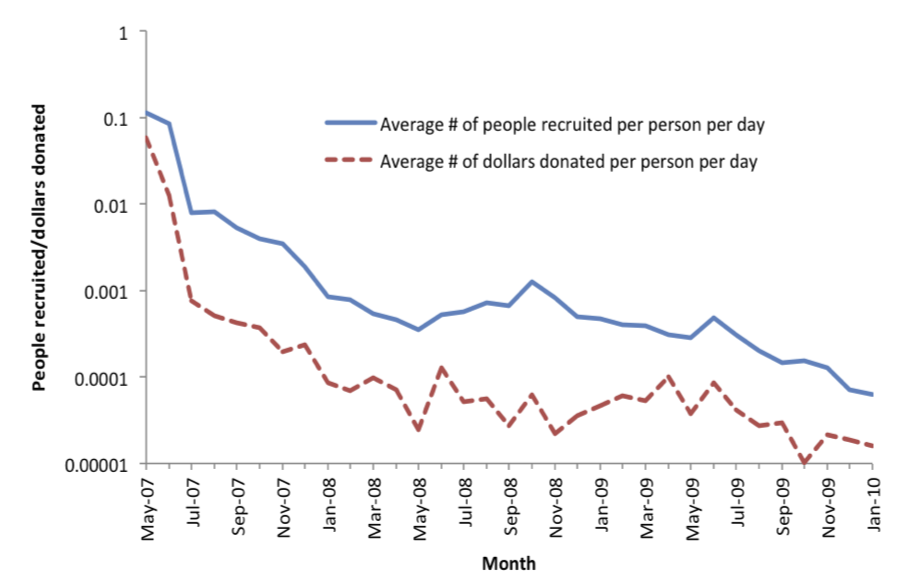
Figure 1: Decline of individual participation shown via a final portrait of the evolution of the Save Darfur Cause (taken from: Lewis et al. 2014, S. 6)
When we launched this blog about five years ago, blogging in academia was mostly a fringe phenomenon and mainly pursued by individual researchers. Today, although some scientific associations are seemingly still struggling with the idea (see “Are Blogs Inherently Unprofessional?“), blogging about research is widespread and has increasingly become the new normal. Even the venerable Administrative Science Quarterly has recently officially featured “The ASQ Blog“, which is run by a student community of scholars who conduct interviews with authors of recent articles. (A great idea, by the way.)

Logo of the AoM Interest Group Strategizing, Activities & Practices
Adding to the growing number of research related blogs, I am happy to announce that the Academy of Management Interest Group on Strategizing, Activities and Practice (SAP) has decided to also launch an official weblog at strategizingblog.com. The mission of the SAP Interest Group is to create a developmental community for academics and practitioners who wish to advance knowledge and understanding of strategy as something people do rather than something organizations have – some of my recent works on open strategizing in the cases of Creative Commons and Wikimedia fall into this category.
Currently, most of the content on the Strategizingblog are service posts such as calls for papers and articles of the bi-annual Interest Group newsletter. However, I am optimistic that we will be able to feature more original content in form of short opinion pieces in the near future. We are always open to article suggestions – just send an E-mail with your blog post to leonhard.dobusch@fu-berlin.de. For updates on new posts you can also follow on Twitter.
(leonhard)
About two and half years ago, I wrote a blog post on shifting baseline effects in assessing copyright regulation. My main argument was that a large proportion of researchers, practitioners and regulators cannot even envision how the much less restrictive intellectual property regimes of the past have worked because what we perceive to be a “natural level” of protection has changed.
Today, XKCD provides a great illustration of the concept of shifting baselines more generally by commenting on the recent debates on cold weather in spite of global warming:

(leonhard)
This year on August 27-29 the OpenSym conference on open collaboration will take place in Berlin:
The 10th International Symposium on Open Collaboration (OpenSym 2014) is the premier conference on open collaboration research and practice, including open access, open data, open educational resources, IT-driven open innovation, open source, wikis and related social media, and Wikipedia research and practice. Learn more about OpenSym 2014 and the OpenSym conference series.
The Call for Papers includes special calls for all these different areas. In addition, I have the honor to co-chair the the doctoral symposium together with Claudia Müller-Birn.
Each track has its own submission site, which you can find on EasyChair. Please select the appropriate track. Submission deadline is April 20th, 2014. The deadline for submitting to the doctoral symposium is June 1st, 2014.
(leonhard)
In a very recent study on “Paid vs. Volunteer Work in Open Source” (PDF), Dirk Riehle and others found that “about 50% of all open source software development has been paid work for many years now and that many small projects are fully paid for by companies.” However, in openly licensed projects outside of the software realm, the co-existance of paid and volunteer contributors is often considered problematic. For example, while paid coding is uncontested and vital for open source software, paid editing in Wikipedia is often seen as a danger to both the project’s neutral point of view and the motivation of unpaid contributors.
How serious the effects of Wikipedian’s skepticism towards paid editing can be was evidenced last week, when the Wikimedia Foundation dismissed Sarah Stierch, one of its most prominent employees, because of paid editing. The current issue of Wikipedia’s community newspaper Signpost is entirely devoted to
the dismissal of Sarah Stierch, whose paid-for editing activities were first revealed in a blog post. This included a screenshot of Stierch’s profile on oDesk, a global clearinghouse for the hiring and management of remote workers. The profile showed that she had been paid US$300 to author a Wikipedia page for an “individual”, along with two billed hours for a “Wikipedia Writer Editor” job that was “in progress”.
On a more general level, paid editing had already been an issue in the German Wikipedia community. Wikimedia Germany, the local Wikimedia chapter organization, had even funded a project on “Grenzen der Bezahlung” (literally: “Limits of Paying”) to discuss and evaluate issues around paid editing. The project was run by Dirk Franke, a long-standing member of the German editing community, who very recently has taken up a position with Wikimedia Germany (unrelated to paid editing). The following interview was conducted in German and Dirk Franke emphasized that he was speaking only for himself, not his new employer.

Dirk Franke (Foto: Tobias Schumann, CC-BY-SA-3.0)
You have been working on the limits of paid editing in Wikipedia in a project funded by the Wikimedia Foundation. What was your main question?
Dirk Franke: Actually, the project was funded by the German Wikimedia association, which is legally independent from the focal Wikimedia Foundation. In addition, I have not conducted the project for Wikimedia but rather in the course of a grant program, where members of the community could suggest different projects; I always understood it that way that I was conducting the project for the Wikipedia community and not so much for the chapter association.
The question was more a practical one. Paid editing is both a forseeable problem and a forseeable development. Thus, the question was, how can I encourage the community to think about the issue even before the problem is immediately around the corner and it is in fact to late?


 governancexborders.com
