
You are currently browsing leonidobusch’s articles.

The year 2013 has been our fifth year of blogging and its highlight was the publication of our blogbook “Governance across borders: transnational fields and transversal themes“. By selecting and thematically grouping the articles into an edited volume, we make it easier for potential readers to grasp lines of arguments and common themes that span single blog posts. We’ve also found that many of our posts had a more lasting effect than expected, evidently supplying information and insights worth preserving in a more structured format. The book is licenced under a Creative Commons Attribution-Share Alike 3.0 Germany license and available as an on-demand-printed edition, as a PDF (10.1 MB) and as an Epub (1.1 MB) file.
Of course, we also continued blogging and, as every year, we are happy to present some statistics:
Top 5 blog posts 2013 (in terms of visitors):
- Measuring the “Adoption” of International Financial Reporting Standards (IFRSs)
- In partial agreement with SKS on what caused the Indian Microfinance Crash
- The State of IFRS in Africa: Is IFRS in Disarray?*
- Copyright Implications of the Gangnam Style Phenomenon
- The “invisible epidemic”: non-communicable diseases
* also #1 in the Top 5 of 2012
Creative Commons licenses are essential to virtually all of the different “open movements”, which have emerged over the past two decades beyond open source software. In the realm of open education, open science and open access, Creative Commons licenses are the standard way to make content open to the wider public. Also in fields such as open data and open government Creative Commons licenses are widely used to make it easier for third parties to re-use publicly funded content.
In spite of this vital role in different fields of openness, not to speak of all the open Wikimedia projects, Creative Commons has long struggled with its role. During its first decade, Creative Commons nearly exclusively focused on its role as a license steward, carfully abstaining from political copyright activism typical for the open movements. Only very recently, following a speech by its founder Lawrence Lessig at the CC Global Summit 2013, Creative Commons has issued a policy statement on “Creative Commons and Copyright Reform” saying that “the CC vision — universal access to research and education and full participation in culture — will not be realized through licensing alone.”
About three months ago, I blogged about potential explanations for Wikipedia’s diversity problems (see “‘Middle-aged White Guys’“). Last weekend, a truly bordercrossing crowd gathered in Berlin to discuss strategies for addressing these problems at the first Wikimedia Diversity Conference. Due to other commitments I was not able to take part the whole time but I have enjoyed most of the sessions I was able to attend.
Since there is extensive documentation on most of the sessions available online, I will only highlight some of my personal insights:
- In her talk on “Diversifying India through outreach among women“, Netha Hussain emphasized the importance of Wikipedia Zero to increase participation in countries, where mere Internet access is not self-evident. Wikipedia Zero enables mobile access, free of data charges, to Wikipedia in developing countries via cooperations with local internet service providers. While some criticize the initiative because of it being a violation of net neutrality principles (see, for example, this mailing-list discussion), it really seems to be a great opportunity to lower access barriers in poorer countries.

As we have discussed repeatedly on this blog (e.g. “Middle-aged White Guys“), one of the most puzzling issues in analyzing Wikipedia is its continuous decline in active editors since 2007, shortly after a period of exponential growth:

Active editors (>=5 edits/month) in English language Wikipedia (Halfaker et al. 2013)
Aaron Halfaker, together with R. Stuart Geiger, Jonathan Morgan and John Riedl, has now published results of their research efforts to understand the reasons behind this editor decline in American Behavioral Scientist under the title “The Rise and Decline of an Open Collaboration Community: How Wikipedia’s reaction to sudden popularity is causing its decline” (see Preprint PDF).
One of Halfaker et al.’s core findings is that, while the proportion of desirable newcomers entering Wikipedia has not changed since 2006, the proportion of them being reverted in their first session has increased (“good_ faith & golden” refers to sub-groups of desirable newcomers): Read the rest of this entry »
It is well known that YouTube serves as a platform for a huge variety of educational material. Most prominently, Salman Kahn (“Khan Academy“) began his career as a provider of Massive Open Online Courses (MOOC) by posting teaching videos on YouTube.
In addition to educational material on all kinds of topics provided by third parties, Google increasingly engages in the production of its own educational content to improve the quality of user-generated content published on its platform. Google’s obvious calculation: better videos means more views means more ad revenue.
Initially, however, Google’s first educational videos were in mere self-defense against countervailing accusations with relation to copyright infringement on its platform. While rights holders complained and blocked unauthorised use of their content, users protested against respective deletion of their accounts (see “Private Negotiation of Public Goods: Collateral Damage(s)“) . In this situation, Google launched its “YouTube Copyright School”, which so-called “multiple infringers” have to watch to re-open their account (see “Crazy Copyright Cartoon: The YouTube Copyright School“).
After reaching between 10 and 13 percent in German national polls in mid-2012 (see “Around the German Pirate Party Convention 2012“), the actual election results of 2.2 percent for the Pirate Party – only 0.2 percent more than in 2009 – smashed all hopes of entering the German Bundestag. The plenty of explanations for the party’s demise, which was as quickly as its rise, include the following:

Election poster of the German Pirate Party 2013; translation: “Sorry, we had also thought it would be easier – but this does not mean that we give up”
- Public internal conflicts: as is often the case in new parties, initial success attracts a lot of different constituencies, all bringing in their own and often conflicting ideas and opinions. In finalizing positions, this diversity naturally leads to conflicts with some of the members leaving the party again. However, in the case of the Pirate Party, the self-imposed radical transparency put all of these conflicts out in the public for anyone to see – in all its nastiness.
- Change in media narratives: in the beginning, the media framed awkward statements or lack of political positions as “interesting”, “fresh” or “authentic” (see, for example, an article in the quality daily Sueddeutsche in November 2011). As some prominent members such as Marina Weisband stepped down and the party began to drop in the polls, this narrative turned 180 degrees. Authentic and honest admittance of nescience suddenly became incompetent ignorance. As was the case in overly positive reporting before, narrative and change in polls fed on each other.
- New protest party Alternative for Germany (AfD): part of the explantion of the Pirate Party’s success was their ability to collect protest votes (see also “German Pirates’ Winning Streak: More than Protest“). In this regard, the newly founded and Euro-critical AfD did a much better job this Sunday and nearly reached the five percent election threshold.
- Failure to deliver on promise of ‘liquid democracy‘: in addition to calls for copyright reform and government transparency, one of the core promises of the Pirate Party in Germany was to improve democratic participation with the help of new technological means. However, the party could not agree to implement a “permanent general assembly” with the help of its voting and discussion tool “liquid feedback“, thereby substantially undermining the credibility of calls for implementing similar tools elsewhere.
- Missed opportunity of the NSA scandal: even though the leaks by Edward Snowden directly addressed core issues of the Pirate Party movement such as privacy and anti-surveillance, the German Pirates were not able to capitalize on it. Different to the anti-ACTA protests (see “ACTA as a Case of Strategic Ambiguity“), where a clear goal (‘Stop ratification of ACTA!’) and a clear addressee (the European Parliament) helped to mobilize, the Pirate Party did not manage to identify an enemy or suggest measures.
Currently I am attending the Academy of Management Annual Meeting (AoM), which is located at Disney World Resort in Orlando this year and taking place at the same time as the Annual Meeting of the American Sociology Association (ASA) in New York. Christof Brandtner, an Austrian colleague working on his PhD in Stanford, commented on this fact on facebook as follows:
I suppose having a business school conference in a fantasy world is almost as ironic as a meeting on the sociology of inequality in a Hilton suite.
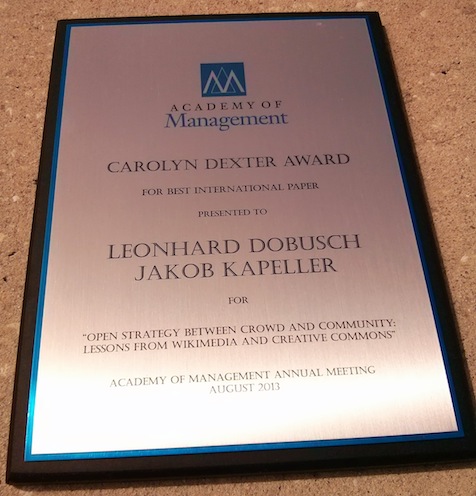
Plaque for 2013 Carolyn Dexter Best International Paper Award
While I could not agree more with him, I nevertheless would prefer being in New York like he is. On the bright side, yesterday I learnt that Jakob Kapeller and myself have received the Carolyn Dexter Best International Paper Award for our paper “Open Strategy between Crowd and Community: Lessons from Wikimedia and Creative Commons” (PDF). This is the abstract:
Based on a conception of strategy as a practice and theoretical arguments related to ‘open strategy’, this paper analyzes six cases of open strategy initiatives situated in two transnational non-profit organizations (Wikimedia and Creative Commons). With regard to openness, we look specifically at the inclusion of external actors in strategy-making. We differentiate between crowds, where external actors are isolated and dispersed, and communities, where related agents self-identify as members of the community. In all six cases, we identify the main strategic aims at stake, the scope of the open strategy tools utilized, the relevant reference groups, and the open strategy practices emerging from these setups. We thereby show how the open strategy initiatives exhibit different degrees of openness, where greater openness leads to a greater diversity of open strategy practices. Additionally, we evaluate the relation between the scope of different open strategy tools and the characteristics of the external reference group addressed by it.
The Carolyn Dexter Award is an all All-Academy-Award, which means that 24 divisions and Interest Groups nominated a paper and these papers were evaluated by three reviewers (primarily from outside the USA) with knowledge of the division domain areas. The four finalists were then comparatively assessed in a final round of blind reviews. You can imagine that Jakob and I feel quite honored. Not to speak of the great plaque we received.. ;-)
(leonhard)
„Welcome to Wikipedia, the free encyclopedia that anyone can edit.“ This inviting welcome message is placed right on top of the English Wikipedia’s main page. Similarly, the vision of the Wikimedia Foundation, the formal non-profit organization behind Wikipedia, reads as follows: „Imagine a World in which every single human being can freely share in the sum of all knowledge.“
Both these lines represent the utopia of digital inclusiveness. ‘Anyone’ should have the possibility to contribute to Wikipedia’s quest for collecting the world’s knowledge. ‘Every single human being’ shall take part in this digital knowledge exchange. In Wikipedia’s early years, critics questioned whether this radical openness allowed for a high-quality encyclopedia to emerge. The main concern was how quality and neutrality of the Wikipedia could be preserved when anyone can change, delete or amend anything at any time (in 2005, for example, the Guardian asked “Can you trust Wikipedia?“).
Responding to these questions, Jim Giles compared in a Nature article (2005) Wikipedia and the renowned Encyclopedia Britannica and found a similar number of errors in both encyclopedias; more recent studies confirm these results with different methodologies (see, for example, Rodrigues 2013). Furthermore, Wikipedia’s quality management became much more sophisticated over the years, for example by introducing “sighted versions” checked by experienced Wikipedians. And even though there are still regularly reports on manipulated or wrong articles in Wikipedia, the end of print encyclopedias nevertheless made it the undisputed winner in the battle of encyclopedias. Today it is hardly possible to make an online search without finding a Wikipedia reference prominently placed in the results list. Wikipedia has effectively become the central directory of world’s knowledge. Read the rest of this entry »
In about two weeks I will attend the 63rd Annual Conference of the International Communication Association to present a paper on the organizational identity of the hacker collective “Anonymous” (see also “Anonymous’ Boundaries: Expelling by Exposing“), which I have written together with Dennis Schoeneborn. The key the empirical puzzle in this case is how the organizational identity of Anonymous is constructed given the fact that individual membership is largely invisible.

Logo of YourAnonNews on Twitter
One of our findings is that Anonymous largely relies on the credibility of communication channels as a functional equivalent and substitute to member-based identity formation. Several Twitter accounts, Facebook pages or Tumblr blogs are controlled by members of Anonymous (“Anons”). Some of these accounts such as the YourAnonNews with over 1.1 million followers on Twitter or the OffiziellAnonymous Facebook page with over 1.2 million fans are able to reach large audiences.
The credibility of these communication channels depends on their respective communication history. Those accounts that have accurately announced – if not initiated – Anonymous activities gain credibility and thus the power to speak more or less on behalf of Anonymous.
The centrality of credible communication channels for the identity of Anonymous has recently been underscored by the first Anonymous crowdfunding campaign on Indiegogo. The goal of the initiative: fund a new home for the communication channel YourAnonNews (YAN), which is currently hosted at Tumblr: Read the rest of this entry »
The self-declared “open expert platform, internet policy incubator and multi-stakeholder think tank” co:llaboratory, which is mainly funded by Google Germany, has just announced the call for participation for its 9th initiative “Globalization and Internet” (German). Some of the issues such as the negotiations for the TAFTA treaty relate to several of the topics discussed on our blog such as intellectual property rights regulation. The Call mentions three main fields of interest under the general theme:
- The genesis and interpretation of international treaties
- Consumer protection and civil society participation.
- Borders within the internet as barriers to globalization
Online applications are possible by June 26, 2013; basic understanding of German is probably necessary.

 governancexborders.com