
You are currently browsing the category archive for the ‘Copyright Regulation’ category.
Recently Google announced an extension to its “Transparency Report“, which now also includes a section on requests to remove search results that link to material that allegedly infringes copyrights. Last month, Google processed 1,294,762 copyright removal requests by 1,109 reporting organizations, representing 1,325 copyright owners. The Figure below illustrates how the number of requests has increased between July 2011 to mid May 2012.

The growing number of removal requests points to the relevance of search technology as a means for copyright enforcement. Since for many Internet users what is not found by Google appears to be non-existent, removing search results from Google’s results lists is obviously a powerful tool for private copyright enforcement. However, several downsides are connected with such private copyright enforcement practices:
In European regulatory discourse as well as copyright research, there is a debate whether the US Fair Use model is better suited to deal with innovation in general and digital challenges in particular than the European system of exceptions. It makes sens to discuss the state of the art of research on Fair Use in the US and what we can learn in Europe.
In the course of a visit in Europe, Pamela Samuelson from UC Berkeley Law School & School of Information gave an interesting talk about “Fair Use in Europe? Lessons from the US and Open Questions”. Her main message could be summarized in two points: First, flexible regulation such as the US Fair Use clause is better suited to rapid technological changes than the comparably static system of exceptions and limitations in European copyright. To illustrate this point, Samuelson mentioned several innovations such as scholarly data-mining in Google Book Search (Ngram Viewer)* or Brewster Kale’s “Wayback Machine” that would have been much more difficult to realize without the Fair Use exemption.
Second, Samuelson explicitly did not recommend to get rid of or avoid specific exceptions all together; rather, keeping limitations and exceptions that provide legal certainty would be desirable even when introducing some form of fair-use-like clause into the European copyright system.
Let’s talk about Porn. According to Wikipedia, „[d]epictions of a sexual nature are as old as civilization“. And of course, paraphrasing Walter Benjamins famous essay, works of porn have changed in the age of mechanical reproduction. New means for (re-)producing works of art – printing press, photography, video, the Internet – have always and early on been used for producing and distributing pornographic works. And in the Internet age, porn has become more widespread than ever. Wondracek et al. (2010, PDF) report in their paper entitled “Is the Internet for Porn?” that 42,7% of all Internet users view pages with pornographic content. Also, popularity of peer-to-peer file-sharing technologies is connected to access to pornographic content (see Coopersmith 2006, PDF).
In spite of these well-known facts regarding the importance of pornography in the context of new copyright-related technologies, talking about the role of both producers and consumers of pornographic content in regulatory struggles is uncommon in journalistic and scholarly analyses alike. As a first step to acknowledging this role, I just want to list examples I can recall where porn producers and/or users have been influential in the field of copyright-related struggles: Read the rest of this entry »
Sigrid Quack and Leonhard Dobusch comment on the recent developments in the German “Piratenpartei” around the Pirate Party Convention 2012.
With the German Pirate Party continuously rising in national polls – currently ranging between 10 and 13 percent (see Figure below) – media attention on the party’s convention last weekend had reached a new height.
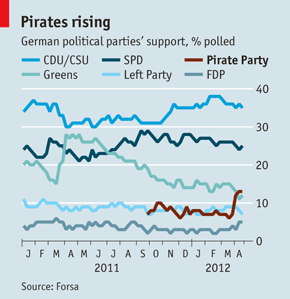
Source: Economist
And this media coverage is increasingly becoming transnational. Germany’s largest weekly Der Spiegel devoted an extensive feature article in English to the phenomenon, trying to explain questions such as “Why the Pirates Are Successful”:
“This is precisely the Pirates’ biggest attraction: transparency and participation, as well as a healthy dose of freshness and otherness. This sometimes makes the Pirates seem childishly naïve and chaotic, and yet they seek to make do without back-room backslapping and conventional political smoothness.”
But also criticsm is voiced in the recent coverage. The Economist, for example, calls Pirates in its recent printed edition “slightly barmy” and the Sueddeutsche Zeitung published a series of articles on unfortunate comparisons of the Pirate Party’s rise with that of the NSDAP by the secretary of the Berlin Pirate caucus (German article) and some right wingnuts in the party who among other statements denied the Holocaust (German article). Read the rest of this entry »
This post is provided by our guest blogger Moritz Heumer.
The winning streak of the German Pirate Party is continuing with the latest success of entering the Saarland parliament. Recent polls for the national election suggest that the pirates might reach 11 percent of votes. The continued success of the pirates raises doubts about claims of their gains being entirely based on protest voters. What are the supporters of the Pirate Party then voting for? In this blog I will argue that the Pirates are addressing highly topical issues that are not dealt with by other parties. By doing so they appeal to primarily young voters, especially the digital natives. Based on an analysis of the German Pirate Party’s wikis, I was able to trace its links to other actors which are part of a social movement with transnational scope. This social movement is aiming for policy changes in different fields that are connected with issues arising from the digital revolution. The formation of parties is one element of the mobilization repertoire of this movement. The rise and diffusion of Pirate Parties, itself a transnational phenomenon, therefore cannot be understood without connecting to the frame of reference that was created by other actors who previously dealt with similar issues.
In the academic world, the conflict between research institutions and publishers about the latter’s reluctance to embrace open access strategies has been looming for years. While the Internet makes distribution of research much cheaper and easier, subscription fees for the most important journals kept rising. Already in 2009, the MIT Faculty had unanimously adopted a university-wide Open Access rule (“Universities as Copyright Regulators: Power and Example“). In 2012, we can finally observe open battles on the issue.

Reading Room at Harvard (Faolin42, CC-BY)
After earlier this year more than 10.000 researchers had joined the boycott of Elsevier (see also “Elsevier Withdraws Support for Research Works Act, Continues Fight Against Open Access“), last week Harvard University issued an official “Memorandum on Journal Pricing“. After criticizing the “untenable situation” that “many large journal publishers have made the scholarly communication environment fiscally unsustainable and academically restrictive”, the memorandum suggests the following 9 points to faculty and students (F) and the Library (L): Read the rest of this entry »
This is the third and final part of a small series of blog posts presenting the empirical findings of a study about the Pirate Party movement, which Leonhard and I carried out in January 2012. In particular, we aimed at exploring the transnational context of the German pirate party. Previous posts dealt with the State of the Pirate Party Movement and Issues and Campaigning. This time we are dealing with local organizational ties of Pirate Parties.
Local embeddedness of Pirate Parties is not only important in terms of issues and campaigning but also with respect to (inter-)organizational relations. In our brief survey, almost every registered Pirate Party (13 of 14) reported ties to partner organizations at the local or regional level. Together with lower barriers to entry in local representative bodies, this localization strategy also tends to result in better election results at lower political levels (see Figures 1 and 2).
Figure 1: Average election result in % of registered Pirate Parties by level (2006 – 2011)

Sources: http://www.kommunalpiraten.de/ ; http://wiki.pp-international.net/Main_Page [retrieved Feb. 10, 2012]
Figure 2: Number of elected officials by level (2006 – 2011)
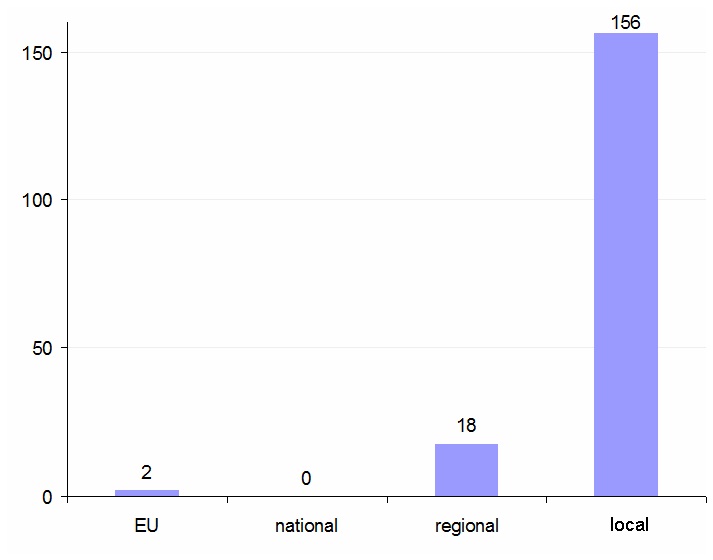
Sources: http://www.kommunalpiraten.de/ ; http://wiki.pp-international.net/Main_Page [retrieved Feb. 10, 2012]
In addition to the development of local branches, the sampled parties mostly operate within a local network of organizational supporters and partners. The majority of registered parties named local branches of active NGOs, including organizations operating transnationally such as Wikimedia and the Electronic Frontier Foundation as well as local activist groups as well as think tanks (see Figure 3). Read the rest of this entry »

 governancexborders.com