
You are currently browsing the category archive for the ‘Copyright Regulation’ category.
While the big win of the German Pirate Party in Berlin was big news, reported even by the New York Times (see also “Boarding Berlin“), yesterday’s win in the state of Saarland had already been expected and thus received less international attention. However, the success is remarkable. With 7,4 percent of the votes, the Pirate Party will receive twice as many seats in Saarland’s state parliament than the Greens. Even more importantly, the Saarland results refute two common explanations of the Berlin victory. First, the success in Berlin was no one shot wonder. Second, Pirates can also win in more rural areas outside of city states .
As a result, media commentators turned to another narrative, attributing the Pirate Party’s success mainly to collecting protest votes. I think this is wrong. While protest does play a role, several indicators suggest that this is not the dominant one.
Strong membership base: Fueled by local election successes, the German Pirate Party reports growing membership numbers all over the country (see Figure below). However, becoming a member can be interpreted as a sign of identification with an organization and differs from mere protest that is directed against the so-called “established parties”.
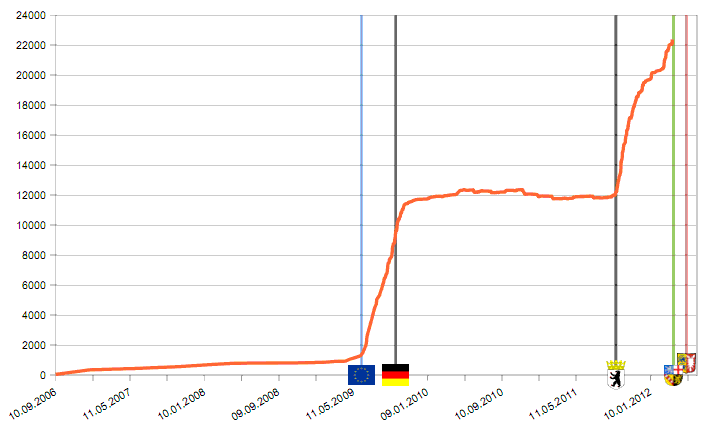
Membership trend of the German Pirate Party (Source: http://wiki.piratenpartei.de/Mitglieder)
Earlier this year, Wikimedia executive director Sue Gardner proposed to centralize fundraising activities and to move beyond geography-based chapter associations as the primary means of organizing (see “Redrawing the Borders of Wikimedia Governance: Turning the Money Screw“). Her move has inspired severe criticism and respective responses by prominent chapter organizations such as Germany, Italy and several chapters of Spanish-speaking countries. Specifically Wikimedia Germany, the largest chapter in terms of both members and fundraising, invested heavily in a detailed counterproposal entitled “Wikimedia’s culture of sharing: Remarks on common goals, localized fundraising and global action“.
A good impression of the intensity and the front lines of this debate is provided by the comments on a blog post by Wikimedia board member Stu West, where he explained “Why [he] supported the Board letter on fundraising“. The discussion thread also nicely illustrates the challenge of transnational governance, when West is accused of being US-centric:
There is a world outside the U.S. where people act according to different standards and think and decide differently. Our movement has to pay tribute to this fact.
After two months of discussion, Gardner has recently presented a revised version of her recommendations and asked the Foundation’s board to decide on it. The most controversial clause of her initial proposal is still part of her final list of recommendations: Read the rest of this entry »
About one month ago, Fields Medalist Tim Gowers complained in a blog post about Elsevier’s publication practices, which inspired the mathematics PhD student Tyler Neylon to launch the campaign “The Cost of Knowledge“. The website makes three main accusations against Elsevier:
- They charge exorbitantly high prices for subscriptions to individual journals.
- In the light of these high prices, the only realistic option for many libraries is to agree to buy very large “bundles”, which will include many journals that those libraries do not actually want. Elsevier thus makes huge profits by exploiting the fact that some of their journals are essential.
- They support measures such as SOPA, PIPA and the Research Works Act, that aim to restrict the free exchange of information.
So far, 7434 researchers have signed a petition to publicly declare that they will not support any Elsevier journal unless they radically change how they operate. Most of the signers even specified that they “won’t publish, won’t referee, and won’t do editorial work” for Elsevier any more. And Elsevier, one of the largest and most profitable publishing houses of the world, seems to begin to falter.
While the dust of the SOPA and PIPA battle in the US has not settled yet, we quickly approach the next showdown around an acronym in the realm of intellectual property regulation. This time the main battleground is Europe, the acronym is ACTA. The “Anti-Counterfeiting Trade Agreement” had been negotiated secretly for years until in early 2010 a draft of the agreement was leaked (see Michael Geist; for a critical and more up to date overview see the ACTA info portal of La Quadrature du Net (LQDN)). Since this leak, the draft had been substantially reworked and, last week, the treaty was signed by representatives of the European Commission and 22 member states in an official signing ceremony.
However, the political controversy is far from being over. For one, the treaty needs to be approved by the European Parliament, which is now the main target for mobilization of both supporters and opponents. For another, the signing of ACTA has sparked surprisingly strong protests in some EU member states, above all in Poland (see video below). The intensity of the Polish opposition has in turn raised attention in neighboring states, most importantly in Germany, as well.
We are late with posts on the issue that dominated the web over the last couple weeks, namely the two bills in the U.S. congress on SOPA and PIPA. Even Wikipedia, for the first time in its history, decided to join the protest blackout on January 18 to protest against the bills. (Which was, by the way, also exemplifying the difficulties of Wikimedia making decisions involving the community due to the absence of accepted and routinized participation structures within Wikimedia governance, see also “Redrawing the Borders of Wikimedia Governance“).
Nevertheless, this might not be all that much of a problem. Because if NYU’s Clay Shirky is right, SOPA and PIPA will come back with new acronyms but similar content. But see for yourself in Shirky’s 15 minute TED talk on the issue:
(leonhard)
In the history of copyright law, legislation in Europe and the US have wound each other up more and more. Everytime when there was a copyright term extension on one side of the ocean, lobbyists on the other side started finger pointing, demanding the same rights to protect artists and the industry. A recent example for such regulatory inspiration has been the EU database directive, which created a sui generis right for the creators of databases which do not qualify for copyright. Ever since this directive had been passed in Europe, lobbyists in the US have tried to introduce a similar provision into US copyright law (see Boyle 2008: 207 ff.). Such regulatory inspiration is neither new nor surprising nor restricted to the domain of copyright.
However, what has been leaked in the Wikileaks cables on the influence of the US on the new Spanish copyright law is way beyond mere inspiration for lobbyists. As reported by the Guardian, in this case the lobbyist has been the US government itself:
The US ambassador in Madrid threatened Spain with “retaliation actions” if the country did not pass tough new internet piracy laws, according to leaked documents. […] In his letter, Solomont [i.e. the US ambassedor] issued veiled threats, reminding its recipients that Spain is on the Special 301, the US trade representatives’ list of countries that do not provide “adequate and effective” protection of intellectual property rights. Spain risks having its position on the list “degraded”, and could join the real blacklist of “the worst violators of global intellectual property rights.”
After their surprising election success in the German capital Berlin, the pirate party continues to surge in the polls. In all recent federal polls the German pirates have been above the 5 percent election threshold and there is no end in sight.
When a TV crew from Russia Today had visited Berlin to film a short report on the pirate phenomenon, they also approached me as a “talking (research) head” on the issue. Unsurprisingly, only one sentence of the half an hour long interview made it into the segment featured below.
The reason the Russian TV crew had found me was this post-election blog post.
(leonhard)
One of the things that make blogs particularly interesting are series. The “series” series recommends series at related blogs. This time I am recommending the series “12 for 2012” over at the 1709 blog, whose name refers to the first purpose-built copyright law, i.e. the Statute of Anne of 1709.
In spite of several term extensions over the last century, copyright law is still temporally limited. After the copyright protection term expires, works enter into the public domain (see “The Digital Public Domain: Relevance and Regulation“). In Europe, copyright protections terms are very long, lasting 70 years after the death of the creator. When a work finally enters the public domain, anyone is free to reproduce, distribute and remix it without asking for permission.
Celebrating prominent bodies of works that fall into the public domain on January 1 2012, fellow blogger Miriam Levenson has recently started the series “12 for 2012“:
During each of the twelve days of Christmas, the 1709 Blog is bringing readers some information concerning an author, composer, artist or creator who died in 1941 and whose works fall into the public domain in 2012 in countries which operate a “life plus seventy years” term for copyright in authors’ works.
Today, for example, Miriam Levenson features Virginia Woolf: Read the rest of this entry »
Wikipedia provides an extensive list of plagiarism controversies, with examples ranging from Ciceros speeches against Mark Antony (1st century BCE) to Dan Brown’s The Da Vinci Code (see also: “Some Reflexions on Originality, Plagiarism, Intertextuality, and Remix“). What is still missing is a list of self-plagiarism controversies. In academia, the most recent self-plagiarism incident that received substantial attention was the case of the economist Bruno Frey (University of Zurich). The case has been meticulously documented by Olaf Storbeck, International Economics Correspondent with the German business daily Handelsblatt.
Today, I stumbled upon an article in the Austrian weekly profil, dealing with another field of alleged ‘self-plagiarism’: architecture. They juxtapose several buildings by famous architects such as Frank Gehry, Daniel Libeskind or Zaha Hadid. Due to copyright issues I cannot simply provide all the examples below, but with the help of Wikimedia commons I managed to reproduce two examples of alleged ‘self-plagiarism’ and one of mere ‘plagiarism’ presented in the Article:
Frank Gehry

Disney Concert Hall in Los Angeles

Guggenheim Museum Bilbao

 governancexborders.com