
You are currently browsing the category archive for the ‘Microfinance’ category.
A colleague forwarded an excellent article by Peter Buffett (son of the “Oracle of Omaha” but also someone with his own list of impressive achievements) in the New York Times. Peter Buffett critiques what he calls the “Charitable-Industrial Complex”: a global feel-good industry in the business of alleviating guilt.

Ironic illustration from the op-ed
©2013 The New York Times Company
The failures of present day large, organised philanthropy, Buffett argues, extend beyond just naively transplanting unsuitable ideas (“philanthropic colonialism”) to new places. Particularly the business-infused variant of philanthropy feeds a desire for cheap “conscience laundering”, making the rich and powerful complacent about their own part in creating social problems. Analogously to medieval indulgences, the Charitable-Industrial Complex promises easy absolution from wrongs committed in the pursuit of profits:
As more lives and communities are destroyed by the system that creates vast amounts of wealth for the few, the more heroic it sounds to “give back.” It’s what I would call “conscience laundering” — feeling better about accumulating more than any one person could possibly need to live on by sprinkling a little around as an act of charity.
The Buffetts aren’t exactly known for mincing their words. Warren (the investor and father) is known for his television statement “there’s been class warfare going on for the last 20 years, and my class has won.” (See also: the Daily Show’s take.) “Derivatives are financial weapons of mass destruction” – also Warren B.
This guest post is provided by Milford Bateman who is a Visiting Professor of Economics at Juraj Dobrila University of Pula in Croatia and a development consultant. He recently accepted a two-month position as Distinguished Visiting Professor of Development Studies at St Mary’s University in Nova Scotia, Canada, to be taken up in late 2013.
Four of the most high-profile research teams have in recent months released papers summarising the results of multi-year projects that aimed to assess the impact of microcredit. All of these projects claim to have found some small residual value in the increasingly de-bunked concept of microcredit which, the authors quickly go on to say, suggests to them that it is too early to agree with the growing number of nay-sayers and abandon the microcredit model in favour of other local development models. The four papers I refer to are:
- (most recently) ‘Win Some Lose Some? Evidence from a Randomized Microcredit Program Placement Experiment by Compartamos Banco’ by Manuela Angelucci, Dean Karlan, and Jonathan Zinman (hereafter AKZ
- ‘Microfinance at the Margin: Experimental Evidence from Bosnia and Herzegovina’ by Britta Augsburg, Ralph De Haas, Heike Harmgart and Costas Meghir (hereafter AHHM)
- ‘The Miracle of Microfinance? Evidence from a Randomized Evaluation’ by Esther Duflo, Abhijit Banerjee, Rachel Glennerster and Cynthia G. Kinnan (hereafter DBGK)
- ‘Are microcredit participants in Bangladesh trapped in poverty and debt?’ by Shahidur R. Khandker and Hussain A. Samad (hereafter KS).
Dazzling econometrics and pioneering impact methodologies aside, the most important thing these four papers all have in common is actually something else: they all go to great lengths to avoid exploring the most awkward downside issues that lie at the heart of microcredit and, to do so, they choose to deploy some faulty logic along the way. Read the rest of this entry »
Another witty animation by the RSA, this time featuring everyone’s favourite misanthrope. Slavoj Žižek’s provocative thesis is that attempts to weave ethics into consumption – for instance with the Fairtrade label – merely serve to make the inbuilt injustices more durable: “The proper aim is to try and reconstruct society on such a basis that poverty will be impossible, and the altruistic virtues have really prevented the carrying out of this aim.”
We can buy exploitative and corporate items, and the anti-exploitative anti-corporate antidote is already included in the product, like ethical coffee at Starbucks. We can increase our wealth while pursuing sustainability or equity, like SRI. We can lend money for profit and promote virtues like entrepreneurship or “financial inclusion”, as in microfinance.
One of the things that make blogs particularly interesting are series. The “series” series recommends series at related blogs.
When Daniel Rozas warns, I listen. Rozas forecasted the crisis of microfinance which broke out in India in late 2010, warning as early as November 2009 that Andhra Pradesh was the most saturated microfinance market in the world alongside Bangladesh, and mass defaults could begin any time.
2009:
I can’t predict whether the microfinance bubble I believe exists and continues to grow in Andhra Pradesh and other south Indian states will deflate quietly or burst spectacularly. […] In their pursuit of growth, many MFIs have continued to add large numbers of new customers in Andhra Pradesh and other highly saturated regions – I believe that is irresponsible. […] The spark that sets off a large-scale delinquency crisis can be anything and could come at any time – a rapid drop in economic growth, a populist political movement, a religious decree, or a collections effort gone bad. One can’t control the spark, but one can control how much fuel that spark can ignite.
Since this February, Rozas has been outlining the scenario of a possible further repayment crisis in a series of posts (links to parts 2 & 3) on the Financial Access Initiative Blog. He says self-regulatory efforts over the past years have been important, but perhaps not enough to stem lending excesses in certain countries (I would agree). Looking at indebtedness and lending at the sub-national level, Rozas reveals a fairly alarming picture in the Mexican state Chiapas, which shows similar patterns to Andhra Pradesh in 2009.
But it is Rozas’ attunement to the political economy of microlending which sets him apart from most sector consultants. Read the rest of this entry »
Suddenly, out of the blue, a debate about microfinance and child labour has erupted. Why?
Underage work caused by microloans is an uncomfortable topic for the microfinance sector, given the moral panic easily associated with child labour. It’s nearly impossible for the industry to publicly make dismissive or nuanced statements on the issue. David Roodman (self-styled “impertinent inquirer“) has now stepped up to the plate, publishing a thought-provoking short essay on his blog which critiques recent moves towards – or rather: rumours of some consideration being given to the idea of – enshrining policies against child labour in the microfinance sector’s transnational self-certification schemes.

Yes indeed, what are we going to do about it?
Photo: Children’s Bureau Centennial, Creative Commons Attribution 2.0 Generic
Roodman assumes Hugh Sinclair (self-styled “microfinance heretic“) to be a driving force behind this. While I have my doubts about it being that simple, I do think that, while not a driving force, Sinclair could be a contributing factor.
Which, incidentally, brings me to my hypothesis about the actual issue of child labour. Is microfinance a driving force? Hell no. Could it be a countributing factor? Logically yes. Consider these two very simplified causal chains:
The Andhra Pradesh crisis has been something of a turning point in public assessment of microfinance, with a suicide wave caused by widespread overindebtedness badly tarnishing the sector’s image in India as well as abroad. Some Indian politicians are now beginning to identify the idea of alleviating poverty with microfinance as “crap“.
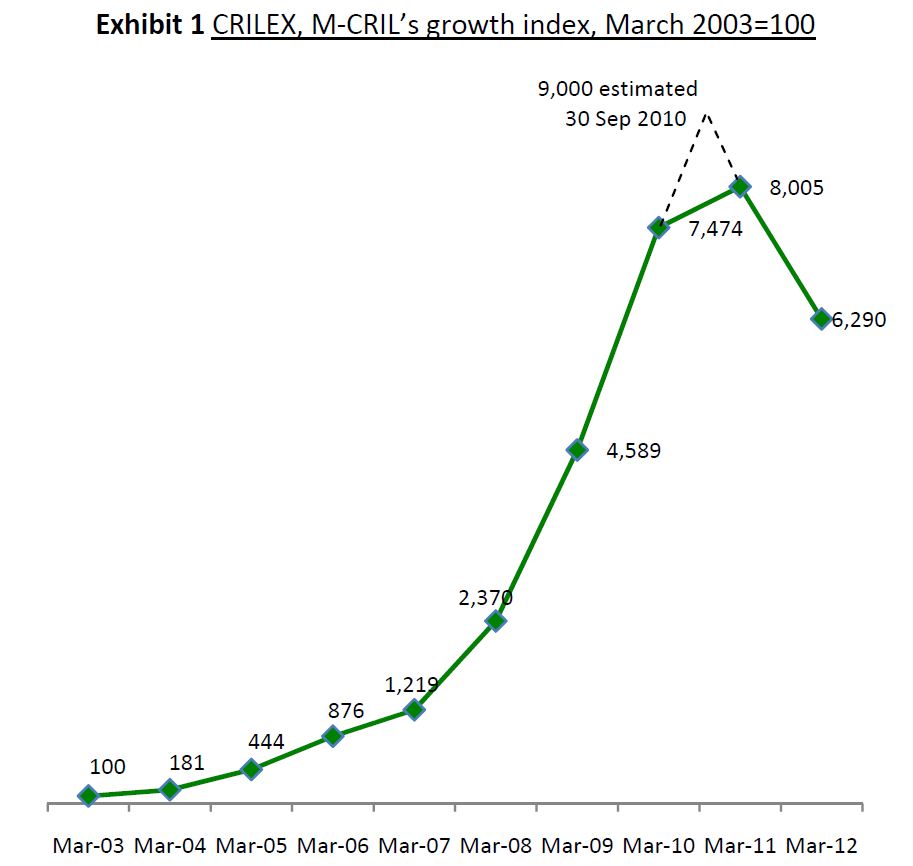
Source: M‐CRIL Microfinance Review 2012 (vii)
Microfinance in India remains in protracted decline since 2010 (see graph), although talk of “green shoots” and catharsis after “near-death experience” has been around for some time. The industry’s stance for the past two years has been to deny responsibility for any wrongdoings, downplay its role in precipitating the dozens of suicides, and claim that the AP government’s October 2010 legislation was a surprising and unjust crackdown on healthy practices. I have claimed otherwise.
Yet, fairly surprisingly, my new paper investigating the causes of the crisis, and a recent interview with SKS Microfinance senior managers come to some similar conclusions about the causes. In particular, both versions see the unregulated hyper-competitive market as a significant cause of the tragedy which led to microfinanciers’ troubles. How can this be?
This post is provided by guest blogger Domen Bajde of the University of Southern Denmark.
As evidenced by inventive movements and campaigns (for a future example see Half the Sky Movement: The Game), the field of charity is undergoing considerable dynamics. As a skeptically-optimistic observer, I am happy to see research that explores such developments against the backdrop of broader material and social change, appreciating their innovativeness and critically questioning the suppositions, mechanics and stakes at play.
I recently stumbled upon a book sharing my skeptical optimism. Surveying historical change in Amnesty International and Oxfam advertising, Chouliaraki argues that poverty is increasingly instrumentalized, setting the focus on the “self” (of the Western donor), turning charity into an ironic spectacle largely shaped by “compassion fatigue” (a.k.a. avoiding stuff that is unpleasant). Rather than amplifying the voice of those in need, many charities end up prioritizing the interests/pleasures of donors.
Hugh Sinclair is a (self-described) whistleblower who recently published a book coming clean with the microfinance industry. Paul Lagneau-Ymonet and Phil Mader had the privilege to ask him how microfinance went astray and “betrayed” the poor, and why the public and donors are being deceived. His book “Confessions of a Microfinance Heretic: How Microlending Lost its Way and Betrayed the Poor” has been widely noted by international media and his blog follows the day-to-day antics of the microfinance industry.
Hugh, you worked in microfinance for 10 years, so you must have at least for some time believed in this as a tool for reducing poverty. When did you become disillusioned, and why?
I can’t say there was one moment of revelation. The first concerns started on my very first project. I was working in Mexico with a Grameen replica institution, and right from the beginning I noticed many of these people aren’t using the money for a productive use, and many of them aren’t actually very poor at all. But I told myself maybe I’m just in a bad institution.
I worked in Mexico for a couple of years, then I moved to Mozambique. There I discovered an even worse situation. Not only was microfinance not having much impact, but the institution that I was working at was misappropriating the savings of the clients. They were forcing the clients to make a savings deposit, and then they were using that deposit to subsidise their own operating costs, which generally involved paying high salaries to ineffective expat senior managers to fly business class and drive around in fancy 4x4s, which to me didn’t seem like a particularly good use of the client savings. It’s theft – I mean, you can’t just take people’s savings and spend them on your salary.So I thought: wow, this is a terrible institution. But maybe I’ve just been unlucky that I’ve stumbled into a few bad ones. Why don’t I go over to Europe and work at a microfinance fund, and my knowledge about the difference between a good and a bad microfinance institution will be useful to direct their money towards good microfinance.
“The problem is that [microfinance funds] have a weird set of incentives that aren’t aligned with their own investors, and also aren’t aligned with the interests of the poor.”
Over on his blog and on Indian financial news site Moneylife, microfinance expert Ramesh Arunachalam has started an interesting series of posts. They investigate the charges levied by Hugh Sinclair against microfinance investment vehicles (MIVs; or microfinance investment funds) in his recently published book, Confessions of a Microfinance Heretic. Arunachalam is approaching the questions raised by the book with his characteristic meticulous diligence; very data-driven. As usual, he raises poignant questions rather than easy answers, and I strongly suspect his detective work will remain a delight to follow.
Incidentally, some of the points raised by Sinclair’s book are very close to Arunachalam’s fascinating causal reconstruction of the Indian microfinance crisis. The two most obvious ones are: (1) lack of transparency and meaningful regulation in the microfinance industry, in Indian microfinance as well as in the global microfinance investment sphere. (2) The pressures of capital, in that agents bestowed with large amounts of easy money under these circumstances are unlikely to make wise decisions (let alone decisions truly benefitting their stakeholders). These are Indian MFIs who lend as if throwing money from helicopters, or global MIVs investing in low-quality-high-profitability MFIs because they need an easy outlet for their money.
Particularly interesting is that Arunachalam asked investors for statements or rebuttals to Sinclair’s allegations, apparently to no avail or evasive answers. Also, reports promised by the microfinance transpareny/labeling initiative LuxFLAG were not available. So it will be interesting to see if Arunachalam finds out what some investors’ explanations are for having continually invested in the evidently non-law-abiding Nigerian MFI LAPO.
Also, David Roodman at the Centre for Global Development has reviewed the book, his main contribution being to “add nuance”. He too sees the key message of “Confessions…” in its exposition of the uniquely problematic role played by MIVs in the microfinance money chain, even though he criticises it for its critical tone. No comment on Roodman’s discussion of different people’s character traits (at bottom).
Last-minue addition: Sam Mendelson, co-author of the Microfinance Banana Skins reports, concludes “Ultimately, Confessions is frustrating and fascinating in equal measure” in a similarly even-handed but more personal review on microfinance focus.
(phil)
This is a book review I wrote for the microfinance news site microDINERO about Hugh Sinclair’s controversial new insider/whistleblower account of the microfinance industry.
 Hugh Sinclair, 2012: Confessions of a Microfinance Heretic: How Microlending Lost Its Way and Betrayed the Poor. San Francisco, CA: Berrett-Koehler Publishers.
Outside of the mainstream and microfinance’s promotional campaigns, many academics, NGOs, critical journalists and also former microfinanciers have quietly criticised microfinance for years – only to be ignored or dismissed as lunatics or ideologues. The problems in microfinance, however, are very real, and Hugh Sinclair’s controversial new book “Confessions of a Microfinance Heretic” makes them impossible to ignore.
For the few independent researchers, fortunately able to study microfinance without reporting to microfinance-supporting bodies or the major research groups (which happen to be mostly funded by the same organisations which fund microfinance), the problems of microfinance are not news. They include that microfinance, by its very nature, supports only the simplest, least-productive and lowest growth-potential activities, as Milford Bateman argues. They also include the fact that most loans are simply used for consumption, which even CGAP recognises in its attempts to redefine microfinance in terms of “financial inclusion”, ignoring the problem of these loans’ unsustainability. This is linked to the risk of overindebtedness and debt traps researched bravely by Jessica Schicks, and evidenced most gruesomely in the Indian microfinance crisis. There is also the problem of microfinance building on and employing immense power asymmetries, particularly between men and women, as Lamia Karim has shown, rather than removing these asymmetries through actual processes of empowerment. These are just a few issues.
With Hugh Sinclair along comes someone who has extensive real-life experience, a fascinating story to tell – from his original belief in microfinance to his disillusionment and ultimate heresy against it – and a knack for writing. His book, as devastating as it is entertaining to read, presents a serious challenge to large elements of the microfinance industry. Sinclair adds a new problem to the list of reasons why microfinance cannot keep its promise of poverty reduction, showing that the incentives within the microfinance industry are structured in such a way that positive developmental outcomes can – at best – occur as an accidental by-product; and mostly won’t occur at all. Read the rest of this entry »


 governancexborders.com