In a very recent study on “Paid vs. Volunteer Work in Open Source” (PDF), Dirk Riehle and others found that “about 50% of all open source software development has been paid work for many years now and that many small projects are fully paid for by companies.” However, in openly licensed projects outside of the software realm, the co-existance of paid and volunteer contributors is often considered problematic. For example, while paid coding is uncontested and vital for open source software, paid editing in Wikipedia is often seen as a danger to both the project’s neutral point of view and the motivation of unpaid contributors.

How serious the effects of Wikipedian’s skepticism towards paid editing can be was evidenced last week, when the Wikimedia Foundation dismissed Sarah Stierch, one of its most prominent employees, because of paid editing. The current issue of Wikipedia’s community newspaper Signpost is entirely devoted to

the dismissal of Sarah Stierch, whose paid-for editing activities were first revealed in a blog post. This included a screenshot of Stierch’s profile on oDesk, a global clearinghouse for the hiring and management of remote workers. The profile showed that she had been paid US$300 to author a Wikipedia page for an “individual”, along with two billed hours for a “Wikipedia Writer Editor” job that was “in progress”.

On a more general level, paid editing had already been an issue in the German Wikipedia community. Wikimedia Germany, the local Wikimedia chapter organization, had even funded a project on “Grenzen der Bezahlung” (literally: “Limits of Paying”) to discuss and evaluate issues around paid editing. The project was run by Dirk Franke, a long-standing member of the German editing community, who very recently has taken up a position with Wikimedia Germany (unrelated to paid editing). The following interview was conducted in German and Dirk Franke emphasized that he was speaking only for himself, not his new employer.

Dirk Franke (Foto: Tobias Schumann, CC-BY-SA-3.0)

Dirk Franke (Foto: Tobias Schumann, CC-BY-SA-3.0)

You have been working on the limits of paid editing in Wikipedia in a project funded by the Wikimedia Foundation. What was your main question? 

Dirk Franke: Actually, the project was funded by the German Wikimedia association, which is legally independent from the focal Wikimedia Foundation. In addition, I have not conducted the project for Wikimedia but rather in the course of a grant program, where members of the community could suggest different projects; I always understood it that way that I was conducting the project for the Wikipedia community and not so much for the chapter association.

The question was more a practical one. Paid editing is both a forseeable problem and a forseeable development. Thus, the question was, how can I encourage the community to think about the issue even before the problem is immediately around the corner and it is in fact to late?

Read the rest of this entry »

This blog is provided by our guest blogger Kristen Hopewell. Kristen Hopewell is an Assistant Professor at the University of British Columbia, Canada and has been a visitor of the Max Planck Institute for the Study of Societies in 2013.

After protracted and contentious negotiations among trade ministers in Bali last month, the WTO announced agreement on a new global trade deal.  The so-called “Bali package” is being touted as an historic achievement and a victory for the WTO.

However, such claims should be met with considerable skepticism.  In reality, the deal stuck at Bali is of limited consequence and the hype surrounding it is intended to mask the deeper failure of the Doha Round. Read the rest of this entry »

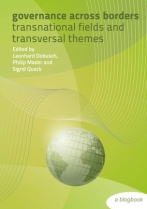
gxb-cover-klein

The year 2013 has been our fifth year of blogging and its highlight was the publication of our blogbook “Governance across borders: transnational fields and transversal themes“. By selecting and thematically grouping the articles into an edited volume, we make it easier for potential readers to grasp lines of arguments and common themes that span single blog posts. We’ve also found that many of our posts had a more lasting effect than expected, evidently supplying information and insights worth preserving in a more structured format. The book is licenced under a Creative Commons Attribution-Share Alike 3.0 Germany license and available as an on-demand-printed edition, as a PDF (10.1 MB) and as an Epub (1.1 MB) file.

Of course, we also continued blogging and, as every year, we are happy to present some statistics:

Top 5 blog posts 2013 (in terms of visitors):

  1. Measuring the “Adoption” of International Financial Reporting Standards (IFRSs)
  2. In partial agreement with SKS on what caused the Indian Microfinance Crash
  3. The State of IFRS in Africa: Is IFRS in Disarray?*
  4. Copyright Implications of the Gangnam Style Phenomenon
  5. The “invisible epidemic”: non-communicable diseases

* also #1 in the Top 5 of 2012

Read the rest of this entry »

Update (8.1.2014): The court case against the Moroccan anti-microcredit activists is postponed again until 28 January 2014, because a new judge is being sent from the capital, Rabat.

Update (18.12.2013): The verdict was postponed yesterday until 6 January 2014, due to nine prosecution witnesses not showing up. A demonstration was held in front of the courthouse.

A woman and a man who led protests against microfinance institutions in Morocco are on trial. They risk of five years prison sentence without a chance of parole.

Amina Mourad and Benasser Ismaili, this communiqué (via ATTAC Morocco) reports, are leaders of the Association de Protection Populaire pour le Développement Social, an organisation of roughly 4,500 women who have been rallying against the policies, practices and interest rates of MFIs in Morocco since 2011. Four MFIs took Mourad and and Ismaili to court on counts of libel and threats. After the activists were found “not guilty” in the first instance, a new organisation backed by Planet Finance went into appeal, threatening them again with imprisonment. The verdict is expected on 17 December at the courthouse of the desert city Ouarzazate.

Morocco was the site of a microfinance crisis in 2008, caused by ever-larger loans to groups of borrowers, leading to 10 percent of clients not repaying (or not being able to repay) their loans by June 2009. The central bank estimated that 40 percent of borrowers had loans from more than one MFI just as the repayment crisis began (source). Even the always-positive ACCION Centre for Financial Inclusion admits that there is no effective client protection in Morocco: “Measures have been put in place to advance the adherence to the principles of client protection. While much has been achieved to date, there remains much more yet to be accomplished.”

The World Bank is a major backer of microfinance expansion in Morocco, hoping to show that microfinance markets can recover from the repayment crises they generate. The two largest MFIs in Morocco (Al Amana and FBPMC) earned a rate of profit of 45 and 28 percent, respectively, in the second quarter of this year (Mixmarket).

Jailing the protestors will certainly not improve the reputation of MFIs in Morocco, and may lead to violence. ATTAC have called upon the court to release the accused, asking for an international demonstration of solidarity via letters like this: Read the rest of this entry »

(*don’t know your customer)

Truth in advertising has never been very highly valued in the microfinance sector. Know-your-customer (KYC) sadly is also a much-espoused but rarely-heeded principle. The current promotional video for on-line lending platform Kiva shows that Kiva cares about neither.

This most widely known online microlending platform once claimed it facilitated person-to-person (P2P) microending. After the New York Times debunked that as a deceptive illusion in 2009, Kiva had to retract the claim, now fielding the (far clearer?) promise to “connect people through lending to alleviate poverty”. In fact, what Kiva does is merely lend your money for free to microfinance institutions (MFIs), which can then on-lend the money in whichever way they see fit, at interest rates somewhere between 20% and 100% APR. The joyful little cartoon video about “Pedro, a farmer who gets a loan through Kiva.org and transforms his business” doesn’t exactly make this clear.

But the main problem with Kiva’s video How Kiva Works is that the claimed impact of microloans is so absurd, it prompts serious questions about who at Kiva actually knows anything about what microfinance does. Let’s briefly look behind the cutesy imagery.

Read the rest of this entry »

Creative Commons licenses are essential to virtually all of the different “open movements”, which have emerged over the past two decades beyond open source software. In the realm of open education, open science and open access, Creative Commons licenses are the standard way to make content open to the wider public. Also in fields such as open data and open government Creative Commons licenses are widely used to make it easier for third parties to re-use publicly funded content.

In spite of this vital role in different fields of openness, not to speak of all the open Wikimedia projects, Creative Commons has long struggled with its role. During its first decade, Creative Commons nearly exclusively focused on its role as a license steward, carfully abstaining from political copyright activism typical for the open movements. Only very recently, following a speech by its founder Lawrence Lessig at the CC Global Summit 2013, Creative Commons has issued a policy statement on “Creative Commons and Copyright Reform” saying that “the CC vision — universal access to research and education and full participation in culture — will not be realized through licensing alone.”

Read the rest of this entry »

It is assumed that the rise of CSR and the private regulation of labor rights in global supply chains help to improve working conditions in supplying factories. Incidences such as factory burning in Bangladeshis garment industry (one of which killed more than 1100 people) or suicides in China’s electronic industry seem to contradict such assumptions. But also scientific research portrays mixed results on how monitoring and certification impacts working conditions inside factories. This article takes a slightly different approach by asking on how the rise of CSR influences the development of domestic labor rights organizations in the People’s Republic of China. Read the rest of this entry »

The Brock Review – an online, open-access, interdisciplinary, peer-reviewed journal – has extended the deadline for academic articles and creative contributions engaging with “Sovereignty, Transnationalism, (Im)Mobility, and Desire”. The corresponding issue is going to address

the excesses, assemblages, resistances, and desires that circulate, coagulate, and shatter in the current global climate in which sovereign power (re)emerges in the fields of the biopolitical (CfP)

or, in my words: how (national) borders are constructed and challenged in light of current discourses of migration. While the call draws on a feminist vocabulary, it also invites proposals which take other theoretical positions or which oppose the perpective taken in the CfP.

The new deadline is 15 December, 2013. Manuscripts shall be complemented by an abstract and a short biography of the author.

(jiska)

About three months ago, I blogged about potential explanations for Wikipedia’s diversity problems (see “‘Middle-aged White Guys’“). Last weekend, a truly bordercrossing crowd gathered in Berlin to discuss strategies for addressing these problems at the first Wikimedia Diversity Conference. Due to other commitments I was not able to take part the whole time but I have enjoyed most of the sessions I was able to attend.

Since there is extensive documentation on most of the sessions available online, I will only highlight some of my personal insights:

  • In her talk on “Diversifying India through outreach among women“, Netha Hussain emphasized the importance of Wikipedia Zero to increase participation in countries, where mere Internet access is not self-evident. Wikipedia Zero enables mobile access, free of data charges, to Wikipedia in developing countries via cooperations with local internet service providers. While some criticize the initiative because of it being a violation of net neutrality principles (see, for example, this mailing-list discussion), it really seems to be a great opportunity to lower access barriers in poorer countries.

Wikipedia_Zero_Logo_and_photo Read the rest of this entry »

Next week, 14-25 November 2013, there will be a workshop on transnational participation and social movement activism hosted by the Innovation in Governance Research Group /CESNOVA and the Centre for Research and Studies in Sociology, University of Lisbon

The workshop looks at the global spread of new action forms, practices, and the social construction and making of public participation. It asks what research on transnational participation can learn from insights of social movement studies and vice versa. As a presenter, I take the opportunity to call upon scientists to contribute to the construction of a transnational political sociology, were the division between research on participation and mobilization is overcome. I argue, that the field transnational political sociology is prone to overcome the barriers for the following reasons.

Read the rest of this entry »

The Book

Governance across borders: transnational fields and transversal themes. Leonhard Dobusch, Philip Mader and Sigrid Quack (eds.), 2013, epubli publishers.
February 2026
M T W T F S S
 1
2345678
9101112131415
16171819202122
232425262728  

Copyright Information

Creative Commons License
All texts on governance across borders are licensed under a Creative Commons Attribution-Share Alike 3.0 Germany License.