This article first appeared in the Paris newspaper La Tribune on February 9, 2010, and is translated and adapted here with permission of the authors. Paul Lagneau-Ymonet is a member of the Research Group Institution Building Across Borders at the MPIfG.

To date, the organization of securities markets has not yet benefited from the feigned attempts of reform presented by authorities since the outbreak of the current crisis. However, speculative opportunities like the risks incurred also depend on the markets on which one operates. It is for this reason that the coming revision of the European Markets in Financial Instruments Directive (MiFID), which came into effect on November 1st, 2007, is such a considerable challenge.

This Directive reflected an incredible faith in the coordinating virtues of the market – the central idea being that competition between exchanges and other trading venues would reduce transaction costs, increase trading volume and, as a result, lower the cost of capital for issuers. The MiFID notably abolished the ‘concentration rule’, which, in a number of countries (i.a. France), imposed intermediaries to carry out most of their transactions on a single regulated market, so as to concentrate the liquidity and to establish, for each security, a “fair price” known to all. Eventually, the directive has made possible the emergence of various opaque trading venues that challenge more transparent regulated markets.

Reports from the Committee of European Securities Regulators (CESR) and from the French Association of Financial Markets (AMAFI) reveal the extent of the disillusionment. The lower fees that resulted from unleashed competition have only benefited to a few internationally operating banks, namely about ten institutions that are responsible for three-quarters of the financial transactions in Europe. But the end clients – private individuals, in particular – do not fare as well. Read the rest of this entry »

This post is provided by our guest blogger Peggy Levitt. Peggy Levitt is Professor of Sociology at Wellesley College and a Research Fellow at The Weatherhead Center for International Affairs at Harvard University where she co-directs The Transnational Studies Initiative. Together with by Sanjeev Khagram she has published the transnational studies reader, in which they among other things criticize methodological nationalism and present different ways on how to conceptualize transnational phenomena. Her entry is part of a series in which we discuss concepts and phenomena in the field of transnational studies and follows previous discussions we had on transnationalism and methodological nationalism.

Methodological nationalism is the tendency to accept the nation-state and its boundaries as a given in social analysis. Because many social science theories equate society with the boundaries of a particular nation state, researchers often take rootedness and incorporation in the nation as the norm, and social identities and practices enacted across state boundaries as the exception.  But while nation-states are still extremely important, social life does not obey national boundaries.  Social and religious movements, criminal and professional networks, and governance regimes, to name just a few, regularly operate across borders.

In a 2004 article, Nina Glick Schiller and I proposed a notion of society based on the concept of social field and drew a distinction between ways of being and ways of belonging.  Social fields are multi-dimensional and encompass structured interactions of differing forms, depth, and breadth that are differentiated in social theory by terms like “organization,” “institution,” “networks,” and “social movement.”  National social fields are those that remain within national boundaries, while transnational social fields connect actors, through direct and indirect relations, across borders.  Neither domain automatically takes precedence; rather determining the relative importance of nationally restricted and transnational social fields is an empirical question.

Read the rest of this entry »

Book review:

Milford Bateman, 2010: Why Doesn’t Microfinance Work? The destructive rise of local neoliberalism. London: Zed Books.

Since the inception of this blog, one issue which has been critically explored again and again is the dominant position of microfinance in the field of international development. For instance, a series of blog posts in early 2009 was aimed at unmasking the popular myths spun by microcredit’s advocates, from presumed gender empowerment to the purported win-win situation in which profits would go hand-in-hand with social impacts. More recently, we followed how, in the wake of two high-profile randomised studies which failed to show increases in poor people’s income, even some mainstream media have begun taking a more critical view of microfinance.

Indeed, 2009 and 2010 may have brought some disillusionment to many who believed that small loans would create “a world without poverty”. But still the microfinance industry and its epistemic community remain fiercely defensive of the reputation as a solution to poverty; still the international donor community unquestioningly pours money into a concept with much promise but little proof; and still Muhammad Yunus’ award shelf continues to fill up with precious metal as the hype around microfinance continues to enthrall the socially-concerned masses.

A few full-fledged books critiquing present microfinance practices may have been published to date, but these have addressed themselves mainly to microfinance insiders and development experts. Milford Bateman’s brand-new book (released this summer) however is the first critical book capable of crossing the border between academia and the lay world; it reaches out to convince a wider audience of questioning those accepted wisdoms which underlie the first big development hype of the 21st century. Read the rest of this entry »

This post is provided by our “guest blogger” Bernhard Brand. Bernhard Brand works as research assistant at the Institute of Energy Economics at the University of Cologne. This contribution is the first of a series of critical reviews of transnational economic governance arrangements, based on an analysis of policy reports undertaken by graduate students of Sigrid Quack’s seminar on Transnational Economic Governance during the summer term 2010.

The Siemens corruption scandal of the year 2007 was one of the largest bribery cases in the economic history of Germany. It ended with a number of (suspended) jail sentences for high-ranking executives and a painful €2.5 billion penalty to be paid by Siemens for running an extensive worldwide bribery system which helped the Munich-based company to win business contracts in many foreign countries, as for example in Russia, Nigeria or Greece. Interestingly, if the bribery case just had happened a few years before, there wouldn’t have been any sentence at all for Siemens: Until 1999, the practice of bribing officials and decision makers in foreign countries was not considered a crime in Germany. And even worse: The German law allowed companies to deduct bribes from their tax declarations – under a tax law provision ironically termed “useful payments” (in German: “nützliche Aufwendungen”). This incentive for the German industry to perform corruption in the international business became abolished under the pressure of the OECD Anti-Bribery Convention. The convention criminalizes the so-called ‘foreign bribery’, the act where a company from one country bribes officials of a ‘foreign’ country.  Germany, as well as the other OECD members had to align their legislation to the new OECD standards, enabling their courts to punish the person or entity who offers the bribe – even if the bribing action originally took place somewhere else in the world. Read the rest of this entry »

Standards have two major functionalities: for one, they coordinate and – depending on their stickiness due to network effects – regulate human behavior. For another, they function as signaling devices. Which of the two functionalities is dominant and how these two are interrelated are of course empirical questions. In the case of certain private labelling standards, for example,  a broad bundle of rules and minimum standards are condensed into one label or brand, whose premium value in turn shall attract both (additional) producers and consumers to adhere to the standard (see also “FCE goes Fair Trade“).

In the case of Creative Commons‘s alternative copyright licensing standards, James Boyle explicitly referred to this important (albeit unintended) signaling role of licensing standards on a discussion panel at Harvard’s Berkman Center (after 42:50):

“What we didn`t understand was the most important thing about the licence was not that they were licences, it was that they created space, a focal point around which people would make communities.”

Markus Lang, research student in our research group not only pointed me to this quotation of James Boyle but also put it in the broader context of Julia Black’s (2002, jstor) notion of “regulatory conversations”. In applying a discourse theoretical perspective on both public and private regulation, she delineates how coordination of practices is achieved via communicative interactions. Read the rest of this entry »

“First they ignore you, then they laugh at you, then they fight you, then you win.”

If Mahatma Ghandi’s famous this description of political struggles applies to Creative Commons’ quest for an alternative copyright, then the American Society of Composers, Authors and Publishers (ASCAP) has just entered stage three: open battle.

In a letter to members (see Part 1, Part 2) ASCAP asks for donations with the following rationale (see BoingBoing):

“At this moment, we are facing our biggest challenge ever. Many forces including Creative Commons, Public Knowledge, Electronic Frontier Foundation and technology companies with deep pockets are mobilizing to promote ‘Copyleft’ in order to undermine our ‘Copyright.’ They say they are advocates of consumer rights, but the truth is these groups simply do not want to pay for the use of our music. Their mission is to spread the word that our music should be free.”

According to this statement, the biggest enemies of copyright holders are no longer “pirates” and respective platforms such as “The Pirate Bay” (see also “Framing Piracy“) but rather NGO’s and unnamed corporations pursuing a copyright reform agenda. Read the rest of this entry »

Environmental groups and the public worldwide are seriously concerned about the oil spill in the Gulf of Mexico after the explosion of the BP’s Deepwater Horizon oil-drilling rig. The disaster has turned into a catastrophe and is likely to affect the environmental, social and economic condition of the Gulf of Mexico’s shore in years and decades to come. Neither the BP nor the U.S. Government really knows what to do to stop the oil leak. The U.S. Government blames the oil multinational. The BP seems to be unable to deal with the situation. Moreover, other oil companies do not seem to possess any adequate means to deal with similar situations. The BP’s stock price has gown down dramatically. It postponed dividend payments to its shareholders. Thousands of people, e.g. fishermen, have lost the source of income. What are people going to learn from this story? What are the probable scenarios of further developments and what are the likely consequences for the oil industry? Read the rest of this entry »

One of the things that make blogs particularly interesting are series. The “series” series recommends series at related blogs. This time, Phil takes up the initiative and introduces a series he has particularly enjoyed: the book chapter releases on David Roodman’s Microfinance Open Book Blog.

Okay, maybe technically this isn’t really a series. But since February 2009, when David Roodman (who is a senior fellow at the Center for Global Development CGDEV and also the father of the fascinating “Committment to Development Index”, CDI) began sharing the progress he was making on his new book, his blog has become one of the most prolific and insightful blogs about microfinance. And on that blog, the central recurring theme has been the book chapters which David has incrementally released.

David’s book (which, it seems, is now finished to a draft level) was presented via occasional single-chapter releases. These frequently produced interesting discussions among the blog’s growing readership, which notably includes an array of high-profile development intelligentsia members like Harvard Professor Lant Pritchett, senior cooperative banking expert Hans-Dieter Seibel, and development über-academic Bill Easterly.

Perhaps it is less the book and more the wide range of controversial issues covered – from double-borrowing and microfinance bubbles to the heavy-hitting disappointing RCT impact studies (and the industry’s disappointing reaction to them) – processed through Roodman’s brilliant analysis, which have led his readership to read his take again and again.

Most laudably, this blog also gives outspoken microfinance critics like Milford Bateman an open forum to engage in cultured discussion with microfinance’s supporter community away from the less tolerant industry-operated “discussion” forums. I too don’t see eye-to-eye with David on many issues concerning microfinance, and would often consider a more critical tone to be justified. But his blog and the upcoming book definitely provide some of the sharpest and most thoughtful discussions of those questions which currently shake and shape the microfinance industry (against its will), and make microfinance the controversial subject which it is. Big props.

(phil)

This post is provided by our “guest blogger” Elke Schüßler. Elke Schüßler is postdoctoral fellow at the Department of Management at Freie Universität Berlin.

As part of a larger research program on so-called field configuring events (FCEs) in the German music industry, Leonhard Dobusch and I took a closer look at the question of how the issue of copyright is represented at – and in turn framed by – music festivals, fairs, and conferences where the issue of copyright (or, more generally, the question of the future of the music industry in its multiple forms) is discussed by a diversity of field actors (see working paper). The concept of FCEs comes from organization theory (see Garud 2008 for a scholarly example) and refers to events as temporally and spatially bounded arenas for networking, sensemaking, and debate with a potentially larger impact. We consider such FCEs as a discursive focusing lens hosting different “discourse coalitions” and their respective “story lines” (see Hajer 1993) and argue that the way the event landscape evolves can be taken as a representation of how the field evolves with respect to certain issues.

Empirically, we first analyzed at the evolution of the event landscape in the pre- and post-Napster period (1995-2001 and 2001-2009, respectively). We identified 27 events in the German music industry that fulfilled our selection criteria and that we classified as conservationist, reformist, radicalist, or neutral with respect to copyright. We observe a steady rise in the number of events, from only 3 in the year 1997 to 20 in the year 2009 (see Figure 1).  There is now a larger number of radicalist and reformist than conservationist events and, accordingly, the majority of newly founded events had either a radicalist (5 events) or a reformist (7 events) orientation.

We further conducted a comparative in-depth discourse analysis of three selected events in the year 2009, a critical year for the German music event landscape: the traditional main industry event, the “Popkomm”, sponsored predominantly by the major labels and canceled in 2009 with reference to “illegal downloads”; the all2gethernow (a2n), an impromptu collective act of the independent players in the industry to fill the gap and to counter the claims of the Popkomm; and the c/o pop festival founded in Cologne in 2004 associated with the digital music business. Our aim was to identify compatible and incompatible story lines, associate them with certain actor groups (not) participating at these events, and link them to the related event- and field-level practices. In a comprehensive media analysis we identified 34 different claims with respect to copyright made in the context of these events and, again, classified them as conservationist, reformist, radicalist, or neutral.

Read the rest of this entry »

Last week consumers around world learned about the place our mobile phones, ipods, iPads and PlayStations are produced: In production facilities in China, owned by a Taiwanese company called Foxconn, which produces for brands such as Apple, Hewlett-Packard, Samsung and Dell. Consumers learned that Foxconn is the biggest producer of electronic goods, employs over 400.000 workers in the Shenzhen province, 11 workers committed suicide this year. Consumers also learned that the official annual suicide rate in China is 13 per 100,000 workers. And Terry Gou, the founder of Foxconn recapitulates that his factory is below the official norm.

The rising protest inside China but also abroad which followed these tragic incidents, reveal a lot about the new dynamics in the fight for improvements of working conditions in Chinese factories: a dynamic which combines strong local critique, which does not leave the government untouched, with international outrage against the major customers.

Read the rest of this entry »

The Book

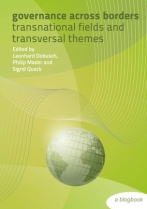
Governance across borders: transnational fields and transversal themes. Leonhard Dobusch, Philip Mader and Sigrid Quack (eds.), 2013, epubli publishers.
March 2026
M T W T F S S
 1
2345678
9101112131415
16171819202122
23242526272829
3031  

Copyright Information

Creative Commons License
All texts on governance across borders are licensed under a Creative Commons Attribution-Share Alike 3.0 Germany License.