
The diamond trade hasn’t exactly enjoyed a great reputation over the past years. Not least thanks to Hollywood movies like Blood Diamond, these gems are inextricably percieved as covered with the blood spilt in civil wars all over Africa.

But diamonds are also a key export of many poor African nations.

Despite some initial progress being achieved by the Kimberly Process certification scheme, diamonds’ persisting bloody reputation isn’t exactly undeserved. Many still find their way into the world market, dominated by De Beers, from appalling sources.

Groups like Amnesty International and One Sky have criticised the certification scheme as lacking impartial, obligatory monitoring. Global Witness, an NGO specialising on the link between natural resource exploitation and violence reported the scheme to be failing to address issues of non-compliance, smuggling, money laundering and human rights: “The clock is running out on Kimberley Process credibility.”

Other problems include that diamonds from conflict-ridden Zimbabwe are still considered legitimate under the Kimberly Process; and the mind boggles as to what real effects membership of countries like the Democratic Republic of Congo may have on the ground. Several civil wars currently rage within the Congo’s boundaries.
Read the rest of this entry »

Microsoft’s 1991 “Press Computer Dictionary” defined “Vaporware” as follows (taken from Bayus et al.):

“vaporware n.  (1) a product that the vendor keeps promising is about to arrive ‘really soon now’, but it goes so long past its shipment date that no one believes it will ever really ship […] (2) slang for announced software that may never materialize […]; (3) a term used sarcastically for promised software that misses the announced release date, usually by a considerable length of time”

Into management language “vaporware” could probably best be translated as “strategic product pre-announcement”. Especially in technological network markets, corporations with strong market power pre-announce upcoming products and promise a wide range of features so that customers refrain from adopting or even switching to an already existing alternative solution. The rationale behind those strategies is relatively simple and it transcends network markets, reaching into the realm of standardization with network effects in general: “the standard that is expected to become the standard will become the standard”, as Shapiro and Varian put it in their seminal book “Information Rules” (1999, p. 13).

For decades, Microsoft was the uncrowned king of vaporware. (Actually, already in 1985 Bill Gates received the “Golden Vaporware Award” by Infoworld’s editor Stewart Alsop.) The long pre-announced introduction of Windows 95 is legendary and has just recently been topped by Microsoft starting to announce new features of Windows 7 immediately after the release of its unloved Windows Vista.

Seen in this light, the recent reactions of Microsoft officials to Google’s pre-announcement of “Chrome OS” (see “Microsoft vs. Google: New Fronts in a Paradigmatic Battle“) do not lack unintentional humor. Microsoft’s Senior Vice President, Bill Veghte, bemoaned in an interview that “so far Google’s Chrome OS is nothing more than a blog post.” Even more revealing is yesterday’s remark of Microsoft founder Bill Gates, as reported by CNET:

“Gates said it was hard to really say much about Chrome OS, since Google has said so little about how it will actually work. ‘The more vague they are, the more interesting it is,’ he said.”

Both critiques resemble accusations Microsoft regularly had to deal with in the past. But maybe Microsoft is right and Google will be its successor to the throne of vaporware. We will see.

(leonhard)

When the chief of Microsoft Germany, Achim Berg, predicted in an interview in the “Berliner Zeitung” that “the free-of-cost-culture on the Internet draws to a close” last Saturday, this happened not only weeks after Microsoft had started its own, free-of-charge search engine “bing” but also only days before Google’s announcement of “Chrome OS”: A new open source operating system on top of a Linux kernel and delivered, of course, for free. On the Official Google Blog Chrome OS was announced as follows:

“[T]he operating systems that browsers run on were designed in an era where there was no web. So today, we’re announcing a new project […] — the Google Chrome Operating System. It’s our attempt to re-think what operating systems should be. Google Chrome OS is an open source, lightweight operating system that will initially be targeted at netbooks. Later this year we will open-source its code, and netbooks running Google Chrome OS will be available for consumers in the second half of 2010. Because we’re already talking to partners about the project, and we’ll soon be working with the open source community, we wanted to share our vision now so everyone understands what we are trying to achieve.”

Is this re-opening the operating system wars of the 1980s? Is this the beginning of serious open source competition for Microsoft’s proprietary business model? In other words, are we witnessing a paradigmatic battle of open versus proprietary innovation regimes with Google and Microsoft as its most prominent antipodes? I am not so sure. But maybe the Pirate Party’s sole member in the European Parliament, Christian Engström, was right in his interesting op-ed in the Financial Times yesterday:

“The world is at a crossroads. The internet and new information technologies are so powerful that no matter what we do, society will change. But the direction has not been decided.”

(leonhard)

Sounds ridiculous? Yet, it is becoming possible. The Programme for Endorsement of Forest Certification schemes (PEFC) announced last week that the Italian brewery Gino Perisutti now offers two types of beer that carry a PEFC logo. PEFC offers certification services to forest operations practicing responsible forest management in accordance with the PEFC principles and criteria of good forest management, as well as to producers using certified material in their final products. Its logo enables buyers and consumers to identify products coming from well-managed forests.

The two types of beer are brewed on the ingredients coming from PEFC-certified forests: spruce bark, mountain pine buds and Scotch pine needles from PEFC-certified forests in north-eastern Italy. In addition to the PEFC-certified ingredients and classical beer components, Gino Perisutti’s beer also contains fair-trade species.

Although it may sound funny, such events may be interpreted as evidence of the increasing scope of forest certification as a form of governance and of the growing market visibility of products that have been certified as meeting the standards of responsible management of natural resources. In turn, the growing visibility helps consumers identify and recognize more responsibly produced products and purchase them and thereby support systems of governance aiming at promoting the sustainable use of nature. No doubt, as consumers, stakeholders and researchers we should also be aware of what is behind the logo but even the very fact that such logos are becoming increasingly important in the market can become one of the crucial drops in the ocean of local and global politics of nature.

(olga)

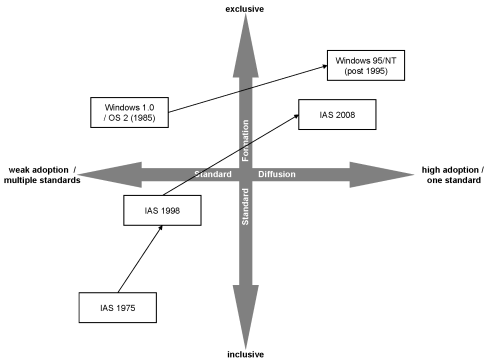
Together with our recent guest blogger Sebastian Botzem from the Social Science Research Center in Berlin I prepared a piece for this year’s EGOS Colloquium, which is taking place in wonderful Barcelona. In the sub-theme titled “The social dynamics of standardization” we are presenting our paper “The Rule of Standards: Codifying Power in the Transnational Arena” (PDF), in which we try a relatively unorthodox comparison: We contrast the case of Microsoft Windows as a technological market standard with non-technological and negotiated accounting standards in the realm of the International Accounting Standards Board (IASB).

Not least to our own surprise, both examples of standardization show many similarities that allow drawing conclusions for transnational governance by standard setting in general. Among these are the following:

  • Due to coordination effects, in both cases an increase in the total number of adopters paves the way for – though not guaranteeing – one dominating standard.
  • While having been developed differently (market competition vs. political negotiation), in both cases growing standard diffusion reduced the need for participatory or inclusive modes of standard-setting (see the figure below).
  • Finally and again observable in both cases, growing adoption can trigger what we call the dialectics of power in standardization: The successful establishment of a standard redistributes benefits and power among affected actors and feeds back into the standard formation process.

Comparing Standardization Processes

But aside from these conclusions, the paper may also illustrate why gathering seemingly very different empirical fields under the common umbrella of “governance across borders” in this blog might make sense after all.

(leonhard)

Yesterday the organizers of one of Europe’s largest music conferences “Popkomm” publicly announced its cancellation for 2009. Originally it was to take place in September at “Station Berlin”. In an official press statement Ralf Kleinhenz, Managing Director of Popkomm Gmbh gave the following reasons for cancelling this year’s event:

“A situation that was becoming clear early this year at Midem in Cannes also seems to be affecting Popkomm in Berlin. Despite positive reactions to the new event location and a satisfactory number of bookings by exhibitors, because of the economic situation we anticipate a considerable decline in trade visitor attendance. Out of responsibility towards the exhibitors we have therefore decided to postpone Popkomm for one year.”

While this reads like a reference to the overall economic crisis, Dieter Gorny, head of the Association of the German Music Industry, tried to reframe the cancellation into a political statement later that day:

“The digital crisis fully hits the music industry. Because of Internet piracy many companies cannot afford to take part at the Popkomm any longer. […] We want to point the way that politics finally must act to stop theft of intellectual property on the net.” (Handelsblatt,  translation L.D.)

This strategy of blaming Internet piracy for all of the music industry’s problems is not new. For years this is the chorus sung by music industry representatives whenever there is bad news. But probably piracy is too good an excuse: if one has the impression that business models and strategies are only threatened by criminals and would work otherwise, this may not be the best starting point for (self-)critical reflexion and innovation. Couldn’t it be that the music industry fails in coping with digital challenges because its major proponents have a “perfect excuse” for their management failures? In a way, their defeatism might thus performatively cause their eventual defeat. Just consider this an alternative explanation.

(leonhard)

The property rights structure over the forest in nowadays Romania looks as follows: approximately 50% state property, 50% private property, out of which 58% is commonly owned (aprox.1.5 million hectares) and 42% individual owned forests. In absolute terms the state property is 3.5 million hectares, out of which 450.000 are still to be restituted to the former owners (Romanian Forestry Department data 2007). A commonly owned private forest means the following – a village owns up 20 000 ha of forests and is entitled with one property title (http://dlc.dlib.indiana.edu/archive/00001750/00/Mantescu-Vasile.pdf). Romanian law of property restitution 1/2000 forbids the selling of property rights in the case of commonly owned private forests. Lately, two legislative initiatives were pushing towards the changing of this uncomfortable legislative foresight.

If one wants to buy forest in Romania, there is one advantage – the price is ridiculous, only 2000 euros per ha, but, according to the law, there is only one quarter available for sale, the individual private forests. Nevertheless, this part is brooked-up in very little lots and still with litigious problems over the property rights. Read the rest of this entry »

On May 22, 2008 the U.S. Congress passed amendments to the Lacey Act of 1900 that make it unlawful to import, export, sell, purchase or transport in interstate or international commerce any plants or products made of plants harvested or traded in violation of domestic and international laws, including timber and timber products. These amendments may open a new era in the development of global forest governance.

For one thing, this is a U.S. law that not only bans domestic trade in goods that were produced in violation of domestic laws of the United States, U.S. States and foreign countries but also attempts to indirectly regulate the production in foreign countries. At the same time, the Lacey Act itself does not violate international free trade regulations. The Lacey Act therefore brings public forms of forest governance back in the transnational space. Another interesting thing about it is that public and private actors reactivate an old piece of legislation to address a current issue. The case of the amended Lacey Act demonstrates that actors can effectively export dormant or taken-for-granted rules from one issue domain to another to achieve their goals. Finally, the Lacey Act opens up new opportunities for a public-private cooperation: if public authorities recognize certificates issued by nonstate certification programs similar to the Forest Stewardship Council forest certification as a sufficient proof of legality of timber, this may become an incentive for producers to certify their forest management. Nonstate actors can therefore use the Lacey Act as a leverage to promote better standards of forest management among or to reward well-performing producers. Read the rest of this entry »

For this year’s Wikimania (26-28 August, Buenos Aires) I submitted an abstract of a paper comparing transnationalization processes and community relations of Creative Commons and Wikimedia. In this series I present some work in progress.

While the now famous online-encyclopedia Wikipedia was founded shortly before Creative Commons in 2001, its organizational carrier – the Wikimedia Foundation – was founded about half a year after Creative Commons had formally launched its first set of alternative copyright licenses in December 2002. Both organizations share the fundamental vision of creating and promoting a global “commons” of freely available digital goods. Wikimedia hosts a framework of hardware (webspace and bandwith), software (the wiki-engine “MediaWiki”) and legal rules (copyleft licenses) for several projects of commons-based peer production such as Wikipedia, Wikibooks or Wiktionary. Creative Commons, in turn, delivers a set of open content licenses to – not only, but also – legally enable and foster such commons-based peer production projects as put forward by Wikimedia.

Interestingly, independent from one another, both organizations very soon after their foundation started to transnationalize by developing a transnational network of locally rooted organizations. In a way, this strategic coordination of legally and financially independent organizations resembles what is called “strategic networks” in the realm of business research (see, for example, Gulati, Nohria and Zaheer 2000). Their strategies of building such an organizational network were however quite distinct. Read the rest of this entry »

Yesterday the Swedish “Pirat Partiet” (“Pirate Party”) actually made it into the European Parliament with 7.1 percent of the vote (see press release). According to exit polls, the Pirat Partiet got 19 percent of the votes cast by young voters (18-30 years of age). This is remarkable for a single-issue party. But while the Swedish results can to a large degree be explained by the enormous attention for copyright issues around the Pirate Bay trial, the German “Piratenpartei” got nearly 1 percent (about 230.000 votes), as well. There, the pirate party reached its best results in urban areas with large universities such as Bremen, Frankfurt or Gießen (read about the results of the German pirate party at heise.de (German) or in Google English).

Given the fact that the Swedish Pirat Partiet as the first pirate party was founded not before 2006, the global proliferation of pirate parties is impressive: Currently, the international pirate party site (pp-international.net) lists 23 countries “where you can find a Pirate Party, or where one is starting up”. All pirate parties share a principle opposition towards the prevalent copyright regime in general and criminalization of peer-to-peer file-sharing in particular. Read the rest of this entry »

The Book

Governance across borders: transnational fields and transversal themes. Leonhard Dobusch, Philip Mader and Sigrid Quack (eds.), 2013, epubli publishers.
March 2026
M T W T F S S
 1
2345678
9101112131415
16171819202122
23242526272829
3031  

Copyright Information

Creative Commons License
All texts on governance across borders are licensed under a Creative Commons Attribution-Share Alike 3.0 Germany License.