
You are currently browsing the tag archive for the ‘Creative Commons’ tag.
The series “Tagged Tabs” is short list of commented links in a recurrent attempt to clean my browser from open tabs containing interesting articles on governance across borders in the field of copyright regulation published elsewhere.
- “International Communia Association“: the EU-funded thematic network on the digital public domain “Communia” evolved into the NGO “International Communia Association”, which is officially launched today. Among the members of the Communia network are most of the European partner organizations of Creative Commons.
- “Sharing License Library“: Volker Grassmuck, among the most prominent advocates for a cultural flatrate (see “Extending Private Copying Levies: Approaching a Culture Flat-rate?“), put together an extensive collection of works on the issue.
- Debate on Open Educational Resources: Reacting to an article in the Chronicle of Higher Education entitled “Publishers Criticize Federal Investment in Open Educational Resources“, Creative Commons’s Cable Green issued an extensive “Response“, defending the requirement of CC BY licensing for certain grants by the U.S. government.
- Europeana v1.0 Draft for a Data Exchange Agreement: Europeana v1.0 is a project funded by the European Commission’s eContentplus programme, which strives to transform the Europeana.eu portal from a prototype into a fully operational site.
- The inaugural issue of the new journal “Critical Studies in Peer Production” features a short report by Michelle Thorne and myself with some reflections about the “Free Culture Research Conference” that took place at Freie Universität Berlin in October last year (see also #FCRC).
Today YouTube announced on its official blog the introduction of Creative Commons support:
Have you ever been in the process of creating a video and just needed that one perfect clip to make it pop? Maybe you were creating your own music video and needed an aerial video of Los Angeles at night to spice it up. Unless you had a helicopter, a pretty powerful camera and some fierce editing skills, this would have been a big challenge. Now, look no further than the Creative Commons library accessible through YouTube Video Editor to make this happen. Creative Commons provides a simple way to license and use creative works.
Actually, YouTube had tested the implementation of Creative Commons licenses already more than two years ago (see Creative Commons blog) but has shied away from introducing it as a general feature until today. That this has now finally happened is celebrated by many Creative Commons sympathizers in the blogosphere under headings such as “Why YouTube Adopting Creative Commons Is a Big Deal” and, of course, Creative Commons officials. Read the rest of this entry »
Markus Beckedahl, blogger, digital rights activist and one of the representatives of Creative Commons Germany, inspired a raging controversy within the German blogosphere with the following simple statement:
“Anyone, who actively uses the Internet and shows media literacy, constantly infringes copyright.”
(German original: “Jeder, der das Internet aktiv nutzt und Medienkompetenz zeigt, begeht die ganze Zeit Urheberrechtsverletzungen.”)
David Ziegelmayer, lawyer at CMS Hasche Sigle, immediately cast doubt whether Beckedahl were serious and admits to be swept off his feet by that statement. He claims that, on the contrary, uneducated users are responsible for copyright infringments such as unauthorized copying of pictures and texts, not the media literate ones.
Simon Möller, law blogger at Telemedicus, however supports Beckedahl’s claim and gives the following five examples:
- Commented links in blogs: the media literate blogger copies passages of texts, includes the links and a short comment. such a behavior is not covered by the citation exemption of copyright due to the unqeual ratio between cited text and comment.
- Embedding videos in blogs, since this would often require a license.
- Using ID pictures: the rights for publishing ID pictures online is normally not acquired from the photographer.
- Unclear terms in open content licenses such as, for example, the Creative Commons NonCommercial clause (see also “Standardizing via Polling” on this blog).
- Using cloud services, which are not necessarily covered by extant copyright exemptions, at least in Europe. Read the rest of this entry »
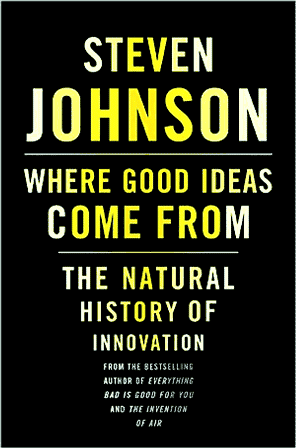 Steven Johnson, 2010: Where Good Ideas Come From: The Natural History of Innovation. New York: Riverhead Books.
Steven Johnson is all about crossing borders. His books deal with a great variety of topics, ranging from London’s most terrifying cholera epidemic (“The Ghost Map“) to a praise of popular culture (“Everything Bad is Good for You“). And also in his most recent book, Steven Johnson crosses disciplinary and historical borders, when he, in his own words, “analyzed 300 of the most influential innovations in science, commerce and technology — from the discovery of vacuums to the vacuum tube to the vacuum cleaner”.
The list of reviews and summaries of the book availble online is endless, including a TED talk given by the author himself and a great video summary featured above. So I am not going to reproduce any of these but very selectively refer to one of the examples presented in the book that relates most to the issues discussed in this blog. This example is the web-based patent marketplace GreenXChange, where Nike publicly released more than 400 of its patents that involve environmentally friendly materials or technologies. Johnson discribes rationale and realization of the project as follows (p. 125):
“By keeping its eco-friendly ideas behind a veil of secrecy, Nike was holding back – without any real commercial justification – ideas that might, in another context, contribute to a sustainable future. In collaboration with Creative Commons, Nike released its patents under a modified license permitting use in ‘non-competitive’ fields. (They also created a standardized, pre-negotiated contract for patents, thereby reducing the transaction costs of haggling over each patent license individually.)”
This is the first example, at least to my knowledge, where Creative Commons was active in standardizing licenses outside of the field of copyright regulation (see the respective announcement on its blog). Moreover, it demonstrates how similar problems and solutions in both so-called “hemispheres” of intellectual proporty – patents and copyright – might be after all. Hopefully, I will soon find the time to do some comparative studies on private regulation in both these fields.
(leonhard)
License proliferation – the development and use of different and incompatible licenses – has always been an issue in the field of open content licensing. As in any process of standardization, the utility of a certain standard depends on its diffusion. Open content licensing regimes thus become a viable alternative to the prevalent all-rights-reserved copyright regime only insofar as a critical mass of works is licensed under compatible licensing standards.
In the field of free/open source software the GNU General Public Licens (GPL) has more and more become the de-facto standard. The Black Duck Open Source Resource Center reports that about 65 percent of all software packages released under free software/open source licenses use the GPL or one of its deratives.
One of the two major innovations* brought by Creative Commons to the realm of open content licensing was the modularity of its licenses: probably inspired by libertarian ideals of maximizing individual choice (see Elkin-Koren 2005), Creative Commons allows combining different license modules such as “share-alike” or “non-commercial” (see also “Iconic Standards: Regulating and Signaling“) and thus ends up with actuall 6 different and partially incompatible licenses. Initially, Creative Commons had even allowed five more combinations and developed several special purpose licenses such as the “Sampling licenses” or the short-lived “Developing Nations License”. Recognizing that this increase of license choice led to a fragmentation instead of a maximization of the aspired commons of digital works, Creative Commons now struggles to solve a problem it partially helped to create in the first place. Read the rest of this entry »
“First they ignore you, then they laugh at you, then they fight you, then you win.”
If Mahatma Ghandi’s famous this description of political struggles applies to Creative Commons’ quest for an alternative copyright, then the American Society of Composers, Authors and Publishers (ASCAP) has just entered stage three: open battle.
In a letter to members (see Part 1, Part 2) ASCAP asks for donations with the following rationale (see BoingBoing):
“At this moment, we are facing our biggest challenge ever. Many forces including Creative Commons, Public Knowledge, Electronic Frontier Foundation and technology companies with deep pockets are mobilizing to promote ‘Copyleft’ in order to undermine our ‘Copyright.’ They say they are advocates of consumer rights, but the truth is these groups simply do not want to pay for the use of our music. Their mission is to spread the word that our music should be free.”
According to this statement, the biggest enemies of copyright holders are no longer “pirates” and respective platforms such as “The Pirate Bay” (see also “Framing Piracy“) but rather NGO’s and unnamed corporations pursuing a copyright reform agenda. Read the rest of this entry »
One famous quote of Creative Commons founder Lawrence Lessig claims that “[t]here is no art that doesn’t re-use.” In research, this principle is called “standing on the shoulders of giants” and meant to acknowledge that even the most original article largely builds upon previous achievements by numerous predecessors; a fact evidenced by an ever growing number of citations in current journal articles.
But what holds for the most pedantic researcher, namely that it is impossible to accurately give credit to all intellectual influences leading to an article, is even more true for novelists and musicians. In case of the former this regularly leads to heated debates about whether “borrowing” ideas or even passages from other books is mere plagiarism or some form of “intertextuality“. In Europe, for example, the Independent recapitulates at length the recent discussion whether the debut novel by German writer Helene Hegemann was plagiarism or “intertextual mixing“; in the second edition of her novel “Axolotl Roadkill”, Hegemann responded to critics by listing all her sources in an appendix.
Could it be that giving credit becomes more important when obviously building upon others’ works becomes both more common and more explicit? Developed particularly to allow mash-ups and remixing, all the different Creative Commons licenses, for instance, include the “attribution”-clause, which requires to give credit. In the realm of music, hip hop is probably best known for re-using – “sampling” – portions of existing sound recordings in creating new works. And again, giving credit is an essential part of hip hop culture, as was demonstrated by Eminem in his 2003 Grammy Award speech: Read the rest of this entry »
In its recent „Special Report“ on copyright protection and enforcement (498 pages, PDF) to the US Trade Representative, the International Intellectual Property Alliance (IIPA) recommeded keeping Indonesia on the „watch list“. One of the major reasons given for this recommendation (PDF) was the following:
„Worse yet, instead of focusing attention on piracy and solutions to the problem, the government retained onerous market access barriers […] and added new restrictions. For example, in March 2009, the Ministry of Administrative Reform (MenPAN) issued Circular Letter No. 1 of 2009 to all central and provincial government offices including State-owned enterprises, endorsing the use and adoption of open source software within government organizations. While the government issued this circular in part with the stated goal to “reduc[e] software copyright violation[s],” in fact, by denying technology choice, the measure will create additional trade barriers and deny fair and equitable market access to software companies.“
In what follows, the paper argues that endorsing the adoption of open source software „fails to build respect for intellectual property rights“. While this opposition towards open source software can be explained by the fact that the Business Software Alliance, which is dominated by proprietary software vendors such as Microsoft, is among the most influential IIPA member organizations, others share the basic concern. The Austrian researcher Stefan Weber, for example, similarly decries a declining respect for intellectual property and a rise of plagiarism – something he refers to as the „Google-Copy-Paste-Syndrome“; he also links alternative licensing such as Creative Commons with an allegedly dropping respect for authors’ copyrights (see pp. 34-35 in Maurer et al. 2007, PDF). Read the rest of this entry »
Creative Commons offers a set of license modules such as “Attribution” or “ShareAlike” that can be recombined to different copyright licenses (see for an overview). One such license module is the “non-commercial”-module. From the very beginning of Creative Commons this module was at the center of most of the license related debates.
First of all, the non-commercial clause was an attempt to enable both sharing and remixing among users and commercialization for creators. Successful examples of hybrid business models such as Jamendo rely on this clause: at Jamendo, musicians receive 50 percent of all revenue generated by commercial use of their works – for example when used in commercials, played as background music in restaurants or in films – while at the same time users can freely download, share and remix those works.
Powerful critics like Wikimedia’s vice-executive director Erik Möller, however, fundamentally challenge the need for a non-commercial module. For him the diversity of incompatible open content licenses is a major barrier for remixing different works. In his 2006 piece “The Case for Free Use: Reasons Not to Use a Creative Commons-NC License” he instead advocates using the copyleft module “ShareAlike.” (It is this module that Wikimedia recently chose for re-licensing its content, see “Wikimania Preview #1“.)
But even adopters and users of the non-commercial clause face the non-trivial problem of defining commercial and non-commercial use. Is it commercial use, for example, if content is used on a webpage of a non-profit organization (for example, a research centre), which allows advertisement on this webpage? What if the content is used by a government or state-run entity? What if the work would be posted on an aggregator website which hosts millions of works (such as YouTube or MySpace), and which makes money from the advertising because of the high volume of traffic it attracts? Read the rest of this entry »


 governancexborders.com