
You are currently browsing leonidobusch’s articles.
We are late with posts on the issue that dominated the web over the last couple weeks, namely the two bills in the U.S. congress on SOPA and PIPA. Even Wikipedia, for the first time in its history, decided to join the protest blackout on January 18 to protest against the bills. (Which was, by the way, also exemplifying the difficulties of Wikimedia making decisions involving the community due to the absence of accepted and routinized participation structures within Wikimedia governance, see also “Redrawing the Borders of Wikimedia Governance“).
Nevertheless, this might not be all that much of a problem. Because if NYU’s Clay Shirky is right, SOPA and PIPA will come back with new acronyms but similar content. But see for yourself in Shirky’s 15 minute TED talk on the issue:
(leonhard)
Two days ago, Sigrid and I have submitted a paper on community governance in the realm of Creative Commons and Wikimedia to this year’s Academy of Management Annual Meeting. Today, I have learnt about major upcoming changes in governance of the latter of our two cases. Wikimedia is at the brink of abandoning its decentralized and geography-based network of Wikimedia chapters and replace it with a much more centralized network of different types of movement organizations.

Logo of the Wikimedia Foundation
The current governance structure of Wikimedia, the formal organization behind the global community of volunteers responsible for Wikipedia, had emerged comparably unplanned. The focal Wikimedia Foundation itself was founded two years after Wikipedia had been launched as a side-project of the quality-controlled “Nupedia“. And while Wikipedia had been transnational from the very start with versions in German, Catalan, Japanese, French and Spanish only two months after its launch, the Foundation was not. The first local Wikimedia branch in Germany was founded independently from Wikimedia headquarters and only formally recognized as a formal Wikimedia chapter after the fact. Following the German example, so far 38 membership-based chapter associations have been founded and formally recognized. Together, these chapters nominate two members to the Foundation’s Board of Trustees.
With the exception of two US chapters in New York City and in the District of Columbia, all these chapters are related to countries. One of the main reasons for tying local chapter organizations to countries is a financial one. Many Wikimedia chapter organizations such as the German, the Polish or the Swiss chapter receive tax exempted donations. This is one of the big advantages of local chapter organizations and even a rationale for founding them as grassroots organizations in the first place. The same time, however, this also restricts the flow of funds within the organizational network. Donations to the German Wikimedia chapter, for example, cannot easily be transferred to the focal Wikimedia Foundation in the US due to legal restraints.
In the history of copyright law, legislation in Europe and the US have wound each other up more and more. Everytime when there was a copyright term extension on one side of the ocean, lobbyists on the other side started finger pointing, demanding the same rights to protect artists and the industry. A recent example for such regulatory inspiration has been the EU database directive, which created a sui generis right for the creators of databases which do not qualify for copyright. Ever since this directive had been passed in Europe, lobbyists in the US have tried to introduce a similar provision into US copyright law (see Boyle 2008: 207 ff.). Such regulatory inspiration is neither new nor surprising nor restricted to the domain of copyright.
However, what has been leaked in the Wikileaks cables on the influence of the US on the new Spanish copyright law is way beyond mere inspiration for lobbyists. As reported by the Guardian, in this case the lobbyist has been the US government itself:
The US ambassador in Madrid threatened Spain with “retaliation actions” if the country did not pass tough new internet piracy laws, according to leaked documents. […] In his letter, Solomont [i.e. the US ambassedor] issued veiled threats, reminding its recipients that Spain is on the Special 301, the US trade representatives’ list of countries that do not provide “adequate and effective” protection of intellectual property rights. Spain risks having its position on the list “degraded”, and could join the real blacklist of “the worst violators of global intellectual property rights.”
After their surprising election success in the German capital Berlin, the pirate party continues to surge in the polls. In all recent federal polls the German pirates have been above the 5 percent election threshold and there is no end in sight.
When a TV crew from Russia Today had visited Berlin to film a short report on the pirate phenomenon, they also approached me as a “talking (research) head” on the issue. Unsurprisingly, only one sentence of the half an hour long interview made it into the segment featured below.
The reason the Russian TV crew had found me was this post-election blog post.
(leonhard)
One of the things that make blogs particularly interesting are series. The “series” series recommends series at related blogs. This time I am recommending the series “12 for 2012” over at the 1709 blog, whose name refers to the first purpose-built copyright law, i.e. the Statute of Anne of 1709.
In spite of several term extensions over the last century, copyright law is still temporally limited. After the copyright protection term expires, works enter into the public domain (see “The Digital Public Domain: Relevance and Regulation“). In Europe, copyright protections terms are very long, lasting 70 years after the death of the creator. When a work finally enters the public domain, anyone is free to reproduce, distribute and remix it without asking for permission.
Celebrating prominent bodies of works that fall into the public domain on January 1 2012, fellow blogger Miriam Levenson has recently started the series “12 for 2012“:
During each of the twelve days of Christmas, the 1709 Blog is bringing readers some information concerning an author, composer, artist or creator who died in 1941 and whose works fall into the public domain in 2012 in countries which operate a “life plus seventy years” term for copyright in authors’ works.
Today, for example, Miriam Levenson features Virginia Woolf: Read the rest of this entry »
Wikipedia provides an extensive list of plagiarism controversies, with examples ranging from Ciceros speeches against Mark Antony (1st century BCE) to Dan Brown’s The Da Vinci Code (see also: “Some Reflexions on Originality, Plagiarism, Intertextuality, and Remix“). What is still missing is a list of self-plagiarism controversies. In academia, the most recent self-plagiarism incident that received substantial attention was the case of the economist Bruno Frey (University of Zurich). The case has been meticulously documented by Olaf Storbeck, International Economics Correspondent with the German business daily Handelsblatt.
Today, I stumbled upon an article in the Austrian weekly profil, dealing with another field of alleged ‘self-plagiarism’: architecture. They juxtapose several buildings by famous architects such as Frank Gehry, Daniel Libeskind or Zaha Hadid. Due to copyright issues I cannot simply provide all the examples below, but with the help of Wikimedia commons I managed to reproduce two examples of alleged ‘self-plagiarism’ and one of mere ‘plagiarism’ presented in the Article:
Frank Gehry

Disney Concert Hall in Los Angeles

Guggenheim Museum Bilbao
Recently, together with Jeanette Hofmann, I have been discussing a research proposal on sharing cultures. In this context, we were asking ourselves whether the notion of “sharing” has shifted in the digital realm. Sharing knowledge is different from sharing a cake. George Bernard Shaw is ascribed the following quote, illustrating this difference:
“If you have an apple and I have an apple and we exchange apples then you and I will still each have one apple. But if you have an idea and I have an idea and we exchange these ideas, then each of us will have two ideas.”
This leads to the conventional wisdom that sharing immaterial goods is different from material goods. In the digital age, more and more goods can be easily shared in form of perfect copies. And even when the economic value of a digital good might depreciate if it is shared freely, sharing can at the same time generate indirect returns (for examples see Anderson 2009). Consequently, authors such as Lawrence Lessig paint the picture of a “hybrid” or “sharing economy“, which they deem to be beneficial for all parties involved. Prerequisite for such a sharing economy to work is a sharing culture, which includes practices such as giving attribution or using open formats and licenses. Read the rest of this entry »
Two weeks ago the First Berlin Symposium on Internet and Society took place in Berlin, celebrating the opening of the Alexander von Humboldt Institute for Internet and Society. Specifically for this event I had prepared a paper on “The Digital Public Domain: Relevance and Regulation” (SSRN), which was presented and then commented upon by Juan Carlos de Martin and Felix Stalder. Both provided very thoughtful criticsm and extensions to the paper, introducing an overall discussion that was very constructive and focused on the issues tackled in the paper.
While I have not managed to blog about the workshop so far, Anne-Catherine Lorrain from the COMMUNIA Association has now provided an extensive summary. There she documents why mapping the public domain empirically is a worthwhile exercise:
The empirical mapping of the public domain should help identifying more precisely the economic relevance of the public domain. The regulation framework applying to the public domain can produce some direct effects on the economy, and more particularly on innovation. As a matter of fact, businesses can suffer genuine legal uncertainty when it comes to identify what is protected by IP rights and what is not. The positive economic impact of content being in the public domain is sometimes already acknowledged in practice. For instance, some patent rights holders can decide to donate patentable inventions in order to create a pre-competitive market. Like the “adjustment process” (Schumpeter), the utility of the public domain to improve competition should be demonstrated, although the question about how this aspect should be echoed within legislation remains.
Besides, her summary features the pink sky over Berlin towards the end of the workshop:
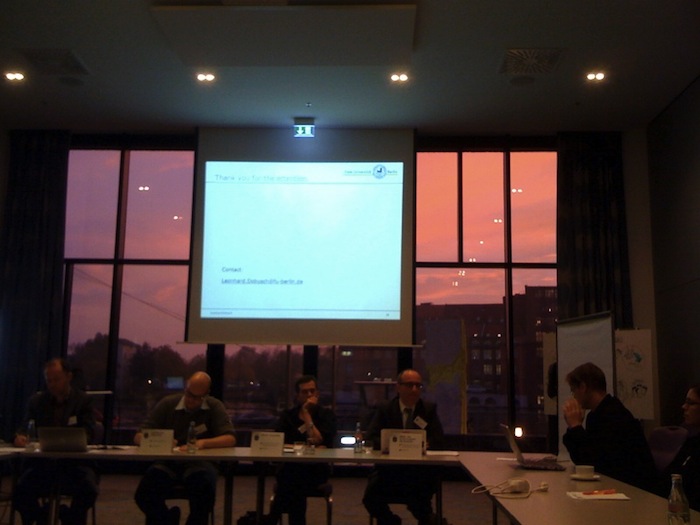
Pink sunset on the Spree behind the Public Domain session speakers from left to right Martin Kretschmer, Leonhard Dobusch, Felix Stadler, Juan Carlos De Martin; picture: Anne-Catherine Lorrain
I can only thank Anne-Catherine very much for providing this great summary and endorse reading the whole transcript.
(leonhard)

 governancexborders.com