
You are currently browsing leonidobusch’s articles.
Yesterday the German comedian Jan Böhmerman claimed responsibility for a YouTube video where Yanis Varoufakis, the current Finance Minister of Greece, had allegedly stuck the finger to Germany. The video had been featured in Germany’s most popular Sunday evening talk show “Günther Jauch“. Confronted with this video as a guest of the show, Yanis Varoufakis denied the accuracy of the footage and instead claimed that the video had been “doctored”. However, most of the German media were convinced by the video, the German tabloid “Bild” even explicitly called Varoufakis a “Lügner” (“liar”):
Von wegen #varoufake… pic.twitter.com/apZPtFyrir
— Kai Diekmann (@KaiDiekmann) 18. März 2015
In the video below (English subtitles start at 3:00 min), Böhmermann now describes in a very detailed manner how he and his team (allegedly?) had faked the segment of the video where Varoufakis shows his middle finger and claims that he had conspired with the organizers of the Croation conference where the video had been made to spread the fake version of the video.
After we had published the edited volume “Governance across borders: transnational fields and transversal themes“ based on a selection of blog posts in 2013 (the CC-licensed book is available as an on-demand-printed edition, as a PDF and as an Epub), we returned to blogging as usual in 2014. Please find our traditional end-of-year statistics below.
Top 5 blog posts 2014 (in terms of visitors):
- Measuring the “Adoption” of International Financial Reporting Standards (IFRSs)*
- EU Commission’s Consultation Report Shows: Current Copyright is Unbalanced
- The State of IFRS in Africa: Is IFRS in Disarray?*
- The “invisible epidemic”: non-communicable diseases*
- In partial agreement with SKS on what caused the Indian Microfinance Crash
* also in the Top 5 of 2013
Top 5 search terms guiding visitors to our blog in 2014:
- Andhra Pradesh microfinance crisis (also #1 in 2011 & 2012, #2 in 2013)
- methodological nationalism
- feudal society trade map
- securitization (also #4 in 2013)
- google transnational
Top 5 countries our visitors came from in 2014 (last year’s position in brackets):
- United States (1)
- India (2)
- Germany (3)
- United Kingdom (4)
- Canada (5)
Top series in 2014:
- Algorithm Regulation (5 out of 10 posts in 2014)
- The Series Series (1/9)
- Wise Cartoons (1/6)
In total we published 30 new posts in 2014, which is only half of last year’s 61 and below our self-set goal of blogging about once a week on average. Seemingly, Phil completing his PhD (followed by an offline trecking tour) and myself becoming a father hurt our blogging statistics. Accordingly, we also received fewer comments and visitor numbers dropped, as well, but not too sharply, from over 40,000 in 2013 to about 34,000 in 2014. Our new year’s resolution is therefore to at least beat our 2014 numbers in 2015.

(leonhard)
In the series “algorithm regulation”, we discuss the implications of the growing importance of technological algorithms as a means of regulation in the digital realm.
In the last entry of this series I have described how YouTube’s Content ID system effectively re-introduces registration requirements into copyright, even though international treaties such as the Berne Convention forbid such requirements. With its most recent additions to YouTube’s rights management infrastructure, YouTube owner Google brings the former’s rights clearing services to a whole new level.
Previously, creators using copyrighted material such as contemporary pop music in one of their videos could only try to upload their videos and hope for the best (i.e. no recognition by the Content ID algorithm) or the second best (i.e. recognition by the Content ID algorithm but acceptance/monetization by rights holders). In any case, creators could only definitely know after making and uploading a video whether and how YouTube’s algorithms would react.
In a recent blog post, YouTube has announced substantial changes to this system:
But until now there was no way to know what would happen if you used a specific track until after you hit upload. Starting today, you can search the YouTube Audio Library to determine how using a particular track in your video will affect it on YouTube, specifically if it will stay live on YouTube or if any restrictions apply. You can uncross those uploading fingers now!
The slides and text below were prepared for a public hearing of the European Parliament’s Committee on Legal Affairs and the Committee on Culture and Education
on “The Future Development of Copyright in Europe”, November 11, 2014, in Brussels (see PDF of the program). It builds on an analysis of the European Commission’s report on on the responses to the Public Consultation on the Review of the EU Copyright Rules.
Over at the Strategizingblog, I have blogged about a current pardigmatic struggle in the realm of organizational strategy research. In a recent article in the Strategic Management Journal, Bromiley and Rau (2014, Preprint-PDF) suggest to adopt a “Practice-based View” (PBV) on strategy. What sounds very similar to approaches labelled strategy-as-a-practice, is actually merely a rhetorical assimilation tactic:
Effectively, all this renders the PBV practice-based in name only. Neither is the PBV rooted in practice theory nor does it propose a methodological approach equipped to empirically capture practices. Rather, the PBV as outlined by Bormiley and Rau treats practices more or less as variables.
Read the full article.
(leonhard)
In the series “algorithm regulation”, we discuss the implications of the growing importance of technological algorithms as a means of regulation in the digital realm.
The most important international copyright treaty, the Berne Convention for the Protection of Literary and Artistic Works, is quite clear with regard to registration requirements for copyright protection in its Article 5 (2)
“The enjoyment and the exercise of these rights shall not be subject to any formality”

The copyright symbol in Arial
In other words, for the 168 countries covered by the Berne Convention, registration provisions are not an option.* In the digital era, this ban is unfortunate for a number of reasons: Read the rest of this entry »
Over at his Open Enterprise Blog, Glyn Moody explains “Why Open Source is Replacing Open Standards” by quoting Linux Foundation’s Executive Director, Jim Zemlin, as follows:

Logo of the Linux Foundation
The largest form of collaboration in the tech industry for 20 years was at standards development organisations – IEEE, ISO, W3C, these things – where in order for companies to interoperate, which was a requirement in tech, they would create a specification, and everyone would implement that. The tech sector is moving on to a world where, in the Internet of things [for example], do you want to have a 500-page specification that you hand to a light bulb manufacturer, or do you want source code that you can hand to that manufacturer that enables interoperability? I think that’s a permanent fixture. People have figured out for a particular non-differentiating infrastucture they want to work on that through open source, rather than creating a spec.
For Moody, replacing open standards with an open source approach brings two “huge advantages”, namely that (1) “compatibility is baked in” and that it (2) “not only saves money, it speeds up development and the pace of innovation”. Functionally, as Moody emphasizes, open source software still represents a standard, whose source code “both defines that standard, and does 99% of the work of implementing it.”
 About two years ago I blogged about zombie provisions of the failed ACTA treaty, which resurfaced in other treaties such the the“Comprehensive Economic and Trade Agreement” (CETA). In the new multingual Eutopia magazine I have now published an article on the currently debated Transatlantic Trade and Investment Partnership (TTIP):
The dispute over the planned TTIP transatlantic free trade agreement between the European Union and the United States goes far beyond the treaty itself, the reason being the tradition in which TTIP is grounded.
It is merely the most recent acronym in a constantly expanding family of abbreviations, its best known members including GATT, TRIPS, GATS, MAI, ACTA, CETA and TPP*.
[…]
The 31st EGOS Colloquium will take place from July 2–4, 2015 in Athens, Greece, and together with Georg von Krogh (ETH Zürich) and Richard Whittington (Oxford University) I will be convenor of a sub-theme on “Open Organizations for an Open Society? Practicing Openness in Innovation, Strategy and Beyond“. Please find the Call for Short Papers below, submission deadline is January 12, 2015:
 Over the past decade, ‘openness’ has become one of the most imperative virtues of modern organizations. Originating in the field of open source software development (Raymond, 2001), we can observe increasing demands for all kinds of openness in fields such as open innovation (Chesbrough, 2006), open strategy (Whittington et al., 2011), open science (David, 1998) or open government (Janssen et al., 2012).
All these different ‘open paradigms’ share – and fuel – hopes of combining greater efficiency with more inclusive and transparent forms of organizing. In the context of open innovation, for instance, the literature anticipates technological (e.g. reduced production costs) and marketing (e.g. positive effects on reputation) benefits (Henkel et al., 2014). Open strategy, in turn, promises access to dispersed knowledge, with some even speaking of “democratizing strategy” (Stieger et al., 2013). In the realm of open government and open science, expected benefits are often connected with access to all kinds of open data (e.g. Molloy, 2011).
However, studies of openness in organizations also point to a number of potential weaknesses and pitfalls such as loss of knowledge and intellectual property (e.g. Henkel 2006; von Hippel & von Krogh, 2003). So, on the level of organizational practices, we need more research that addresses the challenges implied by greater openness in terms of organizational structures, boundaries and culture. And on a broader level, the boom of openness, as recently pointed out by Nathaniel Tkacz (2012), is curious within a supposedly already-open society (Popper, 1971). Why is there such a demand for openness and what does this tell us about society at large?
This week the EU Commission published its report (PDF) on responses to the public consultation on EU copyright held earlier this year. The consultation had drawn a comparably high number of responses with a total of about 11,000 messages, not least due to initiatives such as fixcopyright.eu (targeting end users) and creatorsforeurope.eu (targeting authors and performers). While over at IPKat copyright buffs are already delving into the details of the report, I tried to have a look at the bigger picture here: what do we learn about the state of copyright at large? And what overall direction should copyright reform take? With regard to both questions the report is quite instructive because of its clear and straightforward structure.
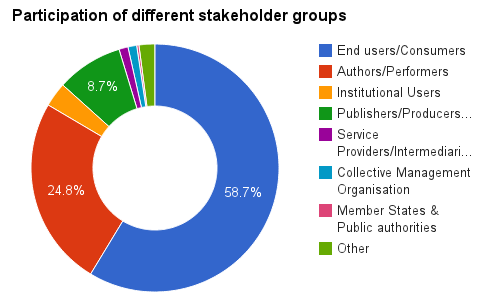
The report is structured along the 80 questions of the consultation, which are distributed across 24 issue sections. Within each of these issue sections, the report distinguishes between the different stakeholder groups that took part in the consultation (see chart below).

 governancexborders.com