
About half a year ago, the German Internet association D64 – Center for Digital Progress had launched an initiative to promote the use of Creative Commons licenses. I was one of the co-organizers. Last week, with the help of graphic designers Sara Lucena und Nico Roicke, we have put together a very nice infographic on “Creative Commons in Numbers”. Of course, some of the numbers are only estimates and not all are most recent, but taken together they give a good overall impression of Creative Commons usage on the internet. Enjoy & Share! Read the rest of this entry »
This post is provided by our regular guest blogger Elke Schüßler. Elke Schüßler is Assistant Professor of Organization Theory at the Management Departement at Freie Universität Berlin.

Daniel Henninger (Foto: DJEvents, CC-BY-ND)
Yesterday, the article „Why Can’t the Left Govern?“ written by Daniel Henninger, deputy editor of The Wall Street Journal’s editorial page and a former Pulitzer Price finalist, made it to the Wall Street Journal’s most popular article within a few hours. At the time of writing this post, the article received over 1000 comments.
I would not have stumbled across this piece of journalism had it not been based on a study by Charles-Clemens Rüling, Bettina Wittneben and myself recently published in the Academy of Management Journal on the problems of UN climate conferences in advancing transnational climate change policy. In an adventurous logical jump, Henninger links our analysis of the field maintenance mechanisms that have eaten their way into the transnational climate policy process to a worldwide crisis of the Left generally and US president Obama’s reform of the US healthcare system through what is known as „Obamacare“ specifically.
While indeed the reform of the US healthcare system has been a daunting struggle for almost a century and, as such, may exhibit some parallels to the task of mitigating climate change, there are several reasons for considering this jump as adventurous.
When Sigrid and I researched the organizational network orchestrated by the US non-profit Creative Commons (see our MPIfG Discussion Paper 08/8, PDF), one of the most interesting findings was the benefits of its transnationalization efforts. What initially appeared as a challenge – legal differences between jurisdictions and the perceived need to adapt its alternative copyright licenses accordingly – actually turned out to be a mobilizing and diffusion strategy. At least initially, porting the licenses to different jurisdictions provided a task for locally embedded copyright lawyers, who then became part of a transnational network of affiliate organizations helping to promote Creative Commons licenses. So, at least in this case of private regulation via standards distance between different actors became an asset.
In their most recent paper entitled “Distance as asset? Knowledge collaboration in hybrid virtual communities” (not open acces available yet), economic geographers Gernot Grabher and Oliver Ibert make a more general argument emphasizing the benefits of geographically dispersed communities. They define hybrid communities as “a specific kind of community, which encompasses on the one hand the sphere of professional expertise, and the mundane world of ordinary users, lay-persons, enthusiasts, and hobbyists, on the other” (p. 101). Empirically, the paper compares three types of communities with three cases each:
- Firm-hosted communities (Huggies Happy Babies Forum, Kraft Food Message Boards, Dell’s Ideastorm Forum)
- Firm-related communities (IKEA Fans, Nikonians, BMW Luxury Touring Forum)
- Independent communities (A Swarm of Angels Forum, Sandboarder Forum, DCA Forum)
Over at orgtheory.com, Brayden King pointed to two recent studies on online activism. In their study on “The Structure of Online Activism” (PDF), published in the newly founded Open Access journal Sociological Science, Kevin Lewis, Kurt Gray and Jens Meierhenrich investigate participation around a Facebook “Cause” on Darfur. “Causes” is a platform for online activism which is linked to and builds upon Facebook and the latter’s possibility to recruit your Facebook friends for a certain cause. The cause under study was a campaign on Darfur with over 1.2 million supporters. The authors had access to great longitudinal network data and investigated how the decision to publicly support the cause on Facebook had translated into further support later on. The disillusioning result (p. 2):
99.76 percent of members never donated[.]
To a certain degree, the results of the paper corroborate what is known as the 1% rule on the internet. The overly large majority of an online community contributes nothing, only one percent is responsible for nearly all of the content; in the Darfur case even fewer people (0.24 percent) contributed in form of donations. Compared to traditional forms of mobilizing this is a very poor conversion rate, as reported by Lewis et al. (p. 4):
Mail solicitations, meanwhile, typically generate rates of 2 percent to 8 percent of people donating $10 to $50 each[.]
Furthermore, activism levels decreased quickly over time (see Figure 1).
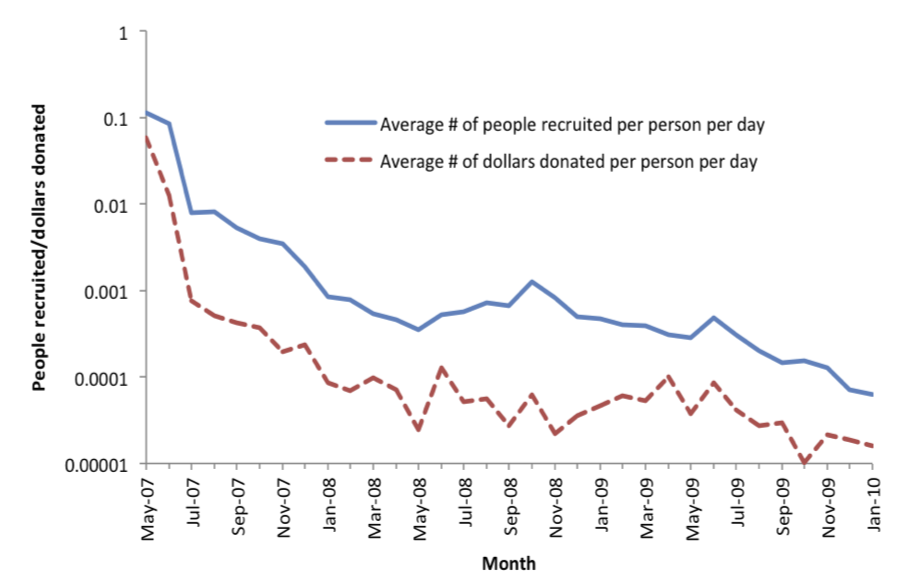
Figure 1: Decline of individual participation shown via a final portrait of the evolution of the Save Darfur Cause (taken from: Lewis et al. 2014, S. 6)
Two leaders of protests against microfinance institutions in Morocco have been sentenced to one year of prison each. In addition, they are to pay fines amounting to nearly 5,000 US Dollars, a judge ruled in Ouarzazate on 11 February. The defence complained about a number of irregularities during the trial.
Amina Morad and Benacer Ismaïni, activists of the Association for Defending Victims of microcredit in Ouarzazate, were given ten days to submit appeals to the court. The two activists had earlier been found not guilty in a previous trial, but were taken to court again by INMAA, a microfinance association linked to PlaNet Finance.
The Georg-August-University of Göttingen, Germany, invites PhD candidates and Postdoc scholars to discuss the idea of “multiple modernities” based on course literature, morning lectures by accomplished scholars, as well as participants’ papers in Göttingen from September 1 to 5, 2014.
When we launched this blog about five years ago, blogging in academia was mostly a fringe phenomenon and mainly pursued by individual researchers. Today, although some scientific associations are seemingly still struggling with the idea (see “Are Blogs Inherently Unprofessional?“), blogging about research is widespread and has increasingly become the new normal. Even the venerable Administrative Science Quarterly has recently officially featured “The ASQ Blog“, which is run by a student community of scholars who conduct interviews with authors of recent articles. (A great idea, by the way.)

Logo of the AoM Interest Group Strategizing, Activities & Practices
Adding to the growing number of research related blogs, I am happy to announce that the Academy of Management Interest Group on Strategizing, Activities and Practice (SAP) has decided to also launch an official weblog at strategizingblog.com. The mission of the SAP Interest Group is to create a developmental community for academics and practitioners who wish to advance knowledge and understanding of strategy as something people do rather than something organizations have – some of my recent works on open strategizing in the cases of Creative Commons and Wikimedia fall into this category.
Currently, most of the content on the Strategizingblog are service posts such as calls for papers and articles of the bi-annual Interest Group newsletter. However, I am optimistic that we will be able to feature more original content in form of short opinion pieces in the near future. We are always open to article suggestions – just send an E-mail with your blog post to leonhard.dobusch@fu-berlin.de. For updates on new posts you can also follow on Twitter.
(leonhard)
About two and half years ago, I wrote a blog post on shifting baseline effects in assessing copyright regulation. My main argument was that a large proportion of researchers, practitioners and regulators cannot even envision how the much less restrictive intellectual property regimes of the past have worked because what we perceive to be a “natural level” of protection has changed.
Today, XKCD provides a great illustration of the concept of shifting baselines more generally by commenting on the recent debates on cold weather in spite of global warming:

(leonhard)
This year on August 27-29 the OpenSym conference on open collaboration will take place in Berlin:
The 10th International Symposium on Open Collaboration (OpenSym 2014) is the premier conference on open collaboration research and practice, including open access, open data, open educational resources, IT-driven open innovation, open source, wikis and related social media, and Wikipedia research and practice. Learn more about OpenSym 2014 and the OpenSym conference series.
The Call for Papers includes special calls for all these different areas. In addition, I have the honor to co-chair the the doctoral symposium together with Claudia Müller-Birn.
Each track has its own submission site, which you can find on EasyChair. Please select the appropriate track. Submission deadline is April 20th, 2014. The deadline for submitting to the doctoral symposium is June 1st, 2014.
(leonhard)


 governancexborders.com