Currently I am attending the Academy of Management Annual Meeting (AoM), which is located at Disney World Resort in Orlando this year and taking place at the same time as the Annual Meeting of the American Sociology Association (ASA) in New York. Christof Brandtner, an Austrian colleague working on his PhD in Stanford, commented on this fact on facebook as follows:

I suppose having a business school conference in a fantasy world is almost as ironic as a meeting on the sociology of inequality in a Hilton suite.
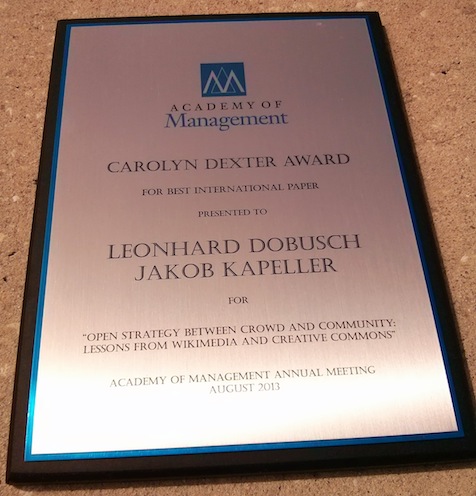
Dexter-Award-Plakette2013(small)

Plaque for 2013 Carolyn Dexter Best International Paper Award

While I could not agree more with him, I nevertheless would prefer being in New York like he is. On the bright side, yesterday I learnt that Jakob Kapeller and myself have received the Carolyn Dexter Best International Paper Award for our paper “Open Strategy between Crowd and Community: Lessons from Wikimedia and Creative Commons” (PDF). This is the abstract:

Based on a conception of strategy as a practice and theoretical arguments related to ‘open strategy’, this paper analyzes six cases of open strategy initiatives situated in two transnational non-profit organizations (Wikimedia and Creative Commons). With regard to openness, we look specifically at the inclusion of external actors in strategy-making. We differentiate between crowds, where external actors are isolated and dispersed, and communities, where related agents self-identify as members of the community. In all six cases, we identify the main strategic aims at stake, the scope of the open strategy tools utilized, the relevant reference groups, and the open strategy practices emerging from these setups. We thereby show how the open strategy initiatives exhibit different degrees of openness, where greater openness leads to a greater diversity of open strategy practices. Additionally, we evaluate the relation between the scope of different open strategy tools and the characteristics of the external reference group addressed by it.

The Carolyn Dexter Award is an all All-Academy-Award, which means that 24 divisions and Interest Groups nominated a paper and these papers were evaluated by three reviewers (primarily from outside the USA) with knowledge of the division domain areas. The four finalists were then comparatively assessed in a final round of blind reviews. You can imagine that Jakob and I feel quite honored. Not to speak of the great plaque we received.. ;-)

(leonhard)

In in Harrisburg, Pennsylvania, USA, Susquehanna University hosts the Northeast Modern Language Association’s 45th annual convention. The panel on Cinema and Migration in the cluster about Cultural Studies and Film caught my interest as it “aims to explore cinema across borders and in comparative perspective” (cfp).

Maria Catrickes welcomes applications for presentations by September 30, 2013. It is a tempting opportunity to cross disciplinary borders – if anyone would notice a social scientist slipping in?

The date of the event is April 3-6, 2014.

(jiska)

„Welcome to Wikipedia, the free encyclopedia that anyone can edit.“ This inviting welcome message is placed right on top of the English Wikipedia’s main page. Similarly, the vision of the Wikimedia Foundation, the formal non-profit organization behind Wikipedia, reads as follows: „Imagine a World in which every single human being can freely share in the sum of all knowledge.“

Both these lines represent the utopia of digital inclusiveness. ‘Anyone’ should have the possibility to contribute to Wikipedia’s quest for collecting the world’s knowledge. ‘Every single human being’ shall take part in this digital knowledge exchange. In Wikipedia’s early years, critics questioned whether this radical openness allowed for a high-quality encyclopedia to emerge. The main concern was how quality and neutrality of the Wikipedia could be preserved when anyone can change, delete or amend anything at any time (in 2005, for example, the Guardian asked “Can you trust Wikipedia?“).

Responding to these questions, Jim Giles compared in a Nature article (2005) Wikipedia and the renowned Encyclopedia Britannica and found a similar number of errors in both encyclopedias; more recent studies confirm these results with different methodologies (see, for example, Rodrigues 2013). Furthermore, Wikipedia’s quality management became much more sophisticated over the years, for example by introducing “sighted versions” checked by experienced Wikipedians. And even though there are still regularly reports on manipulated or wrong articles in Wikipedia, the end of print encyclopedias nevertheless made it the undisputed winner in the battle of encyclopedias. Today it is hardly possible to make an online search without finding a Wikipedia reference prominently placed in the results list. Wikipedia has effectively become the central directory of world’s knowledge. Read the rest of this entry »

A colleague forwarded an excellent article by Peter Buffett (son of the “Oracle of Omaha” but also someone with his own list of impressive achievements) in the New York Times. Peter Buffett critiques what he calls the “Charitable-Industrial Complex”: a global feel-good industry in the business of alleviating guilt.

New York Times: The Charitable-Industrial Complex

Ironic illustration from the op-ed

©2013 The New York Times Company

The failures of present day large, organised philanthropy, Buffett argues, extend beyond just naively transplanting unsuitable ideas (“philanthropic colonialism”) to new places. Particularly the business-infused variant of philanthropy feeds a desire for cheap “conscience laundering”, making the rich and powerful complacent about their own part in creating social problems. Analogously to medieval indulgences, the Charitable-Industrial Complex promises easy absolution from wrongs committed in the pursuit of profits:

As more lives and communities are destroyed by the system that creates vast amounts of wealth for the few, the more heroic it sounds to “give back.” It’s what I would call “conscience laundering” — feeling better about accumulating more than any one person could possibly need to live on by sprinkling a little around as an act of charity.

The Buffetts aren’t exactly known for mincing their words. Warren (the investor and father) is known for his television statement “there’s been class warfare going on for the last 20 years, and my class has won.” (See also: the Daily Show’s take.) “Derivatives are financial weapons of mass destruction” – also Warren B.

Read the rest of this entry »

How can we organize for alternative social, economic, and ecological balance?” is the overriding question of the 2014 LAEMOS Meeting on “Constructing Alternatives”. The organisers of the conference are particularly soliciting papers with an interdisciplinary perspective on dynamics of change, innovation, power and resistance, as well as theoretical and empirical papers looking at alternative forms of social, economic, and ecological development from an organizational perspective.

LAEMOS, the Latin American and European Meeting on Organization Studies, organises a conference every two years, acting as a bridge from the European Group for Organisational Studies (EGOS) to Latin America. The 2014 conference will be held in Havana, Cuba – an interesting venue for discussing alternatives, given Cuba’s turbulent history and present challenges of political and economic change.

  • Type: Conference call for papers.
  • Deadline: 15 November 2013.
  • Event date: 2-5 April 2014.
  • Location: La Habana, Cuba.

(phil)


How did tobacco and smoking become a global health policy issue? This article – the third in our series (1, 2) on non-communicable diseases (NCDs) – examines the critical juncture at which new information, new information technology and an emergent transnational activism combined to produce a new agenda for reducing the impact of NCDs.

Corinthian steamers

Health hazards of smoking in 1824: the flaming moustache

(Detail from “Corinthian Steamers”. Source: Wikimedia Commons)

Once upon the time, the multi-billion dollar tobacco industry appeared legally impregnable, and held enough sway to turn United Nations (UN) organisations against the World Health Organisation (WHO) to neutralise global tobacco control efforts.

A 1999 World Bank report estimated that four million people died annually from tobacco-related illnesses and predicted the number to rise to ten million by 2030, with 70% of these deaths occurring in “developing” countries. According to Taylor and Bettcher, 800 million of the 1.25 billion smokers worldwide lived in developing countries in 2000.

However, within the emerging global health community, a transnational anti-tobacco movement was gaining momentum by the late 1990s. One major shift in approach by the WHO was the development of a new anti-smoking initiative within its new commitment to non-communicable diseases (NCDs). NCDs increasingly became a legitimate area of WHO involvement, which was concerned about tobacco as the second leading NCD risk factor, causing 9% of mortality worldwide.

Read the rest of this entry »

Last Friday, European Union (EU) Commissioner for Internal Market and Services Michel Barnier announced the decision to exclude water and sanitation services from a planned Directive on concessions (contracts with private companies over the provision of public services). Water will be exempt, not because the EU believes it was a mistake to include it in its plans for private provision, but because the citizenry misunderstood the EU’s intentions.

Shining example of market-based water supply (with unclear prospects in Europe)

(Source: Stougard. CC Attribution-Share Alike 3.0)

The announcement came against a backdrop of protests in several countries against the privatisation of water, and the first “European Citizens’ Initiative” to reach quorum. Nearly 1.5 million EU citizens signed the petition (still open) to exclude water and sanitation from internal market rules and ensure the universal right to water; though participation was massively skewed towards one country, Germany.

Read the rest of this entry »

Thirteen years ago the largest-ever gathering of world leaders took place on 8 September 2000 at the United Nations (UN) General Assembly in New York, where the UN Millennium Declaration was made. The Declaration was the most supported, ambitious and specific list of global development goals agreed upon to date, and established a list of commitments to reduce extreme poverty by 2015 which became known as the Millennium Development Goals (MDGs).

The Millennium Development Goals set in 2000

Source: United Nations

The MDGs were significant for global development cooperation due to their ability to stimulate global support, specifically financial resources. Many aid agencies and donors used them to direct their funding projects, and several governments also largely founded their health strategies upon them to receive external funding, which could comprise over 50 per cent of the state’s health budget. The MDGs thereby created a specific global development agenda, which some critics however now argue was not entirely in tune with the real needs of development of low- and middle-income countries. For example, proponents of a greater focus on non-communicable diseases (NCD) criticise that despite NCDs are now the leading cause of death worldwide, they did not receive a single mention in the 2000 MDGs.

The open-access, peer-reviewed Journal of the Sociology and Theory of Religion asks for contributions for the first issue in 2014. The call aims at papers dealing with religion, environment, diversity and/or justice based on comparative, empirical research.

The papers can be submitted until October 1, 2013, to the special editor Michael Agliardo, SJ, Ph.D. The journal is published in English, Spanish and Chinese.

(Jiska)

In about two weeks I will attend the 63rd Annual Conference of the International Communication Association to present a paper on the organizational identity of the hacker collective “Anonymous” (see also “Anonymous’ Boundaries: Expelling by Exposing“), which I have written together with Dennis Schoeneborn. The key the empirical puzzle in this case is how the organizational identity of Anonymous is constructed given the fact that individual membership is largely invisible.

gxb-logo-youranonnews

Logo of YourAnonNews on Twitter

One of our findings is that Anonymous largely relies on the credibility of communication channels as a functional equivalent and substitute to member-based identity formation. Several Twitter accounts, Facebook pages or Tumblr blogs are controlled by members of Anonymous (“Anons”). Some of these accounts such as the YourAnonNews with over 1.1 million followers on Twitter or the OffiziellAnonymous Facebook page with over 1.2 million fans are able to reach large audiences.

The credibility of these communication channels depends on their respective communication history. Those accounts that have accurately announced – if not initiated – Anonymous activities gain credibility and thus the power to speak more or less on behalf of Anonymous.

The centrality of credible communication channels for the identity of Anonymous has recently been underscored by the first Anonymous crowdfunding campaign on Indiegogo. The goal of the initiative: fund a new home for the communication channel YourAnonNews (YAN), which is currently hosted at Tumblr: Read the rest of this entry »

The Book

Governance across borders: transnational fields and transversal themes. Leonhard Dobusch, Philip Mader and Sigrid Quack (eds.), 2013, epubli publishers.
February 2026
M T W T F S S
 1
2345678
9101112131415
16171819202122
232425262728  

Copyright Information

Creative Commons License
All texts on governance across borders are licensed under a Creative Commons Attribution-Share Alike 3.0 Germany License.