This post is provided by our guest blogger Ingo Nordmann. Having gained his Master’s degree in Global Studies in Leipzig, Poland, and South Africa, Ingo has worked at the German embassy in Ghana and in intercultural management consulting.

If you’re 28 years old, with two university degrees, and your parents have invested all their money in your education, and you’ve done everything that was expected of you: if society then tells you, ‘sorry, we don’t have a job for you’, then it’s easy to understand why people revolt. We have to give young people hope. In Europe, the world’s richest continent, there has to be a place for young people, damn it!

With these words, Martin Schulz, President of the European Parliament, describes the heart of the problem. Most young, unemployed Europeans are not marginalized, deprived, and lazy, but they live in the centre of society – a society that seems to have no use for them. This is particularly the case in some Soutern European countries such as Greece and Spain where unemployemnt rates for young people are over 50% as compared to currently 8% in Germany. Youngsters from countries outside of the EU face even more severe challenges on the job market.

Recently, I went to the Balkans to gather some impressions from the beautiful, but often-neglected Former Yugoslav Republic of Macedonia. In the country’s second-largest city, Bitola, situated close to the Greek border on the foots of Pelister National Park, I talked to young people, to officials at the municipality, and to activists at the Business Start-up Centre Bitola, to find out how young people in this region evaluate the situation and what the government and NGOs are doing to change it.

Bitola’s main street – a popular meeting place for young people

Bitola’s main street – a popular meeting place for young people

During a training course supported by the EU’s Youth in Action Programme and YMCA Bitola, I had the chance to interview 22 young activists, volunteers, youth workers, and students between the ages of 21 and 28 from 10 countries. They mainly came from countries outside of the EU, namely Albania (3), Bosnia and Herzegovina (2), Kosovo (2), Macedonia (3), Serbia (2), and Turkey (3), while seven were from EU countries (Romania, Portugal, Poland, and Slovenia). Read the rest of this entry »

In the series “algorithm regulation”, we discuss the implications of the growing importance of technological algorithms as a means of regulation in the digital realm. 

fair-search-europe-logoA common complaint of Google’s competitors in fields such as Internet maps is that Google’s search algorithm favors its own services over those of competitors in its search results. For instance, the FairSearch coalition led by Microsoft, Oracle and others calls for more transparency in displaying search results and harshly criticizes Google:

Based on growing evidence that Google is abusing its search monopoly to thwart competition, we believe policymakers must act now to protect competition, transparency and innovation in online search.

Given Google’s market dominance in Europe with over 90 percent in core markets such as Germany, such allegedly discriminatory practices led to an antitrust investigation by the European Commission (EC). However, providing reproducable evidence for such discriminatory search results is difficult. Google is not only constantly changing its search algorithm (see “Algorithm Regulation #4: Algorithm as a Practice“) but also increasingly personalizing search results; both these characteristics of contemporary search algorithms make it difficult to compare search results over time.

Read the rest of this entry »

This post is provided by guest blogger André Förster who studies the Masters program “Sociology and empirical social Research” at the University of Cologne. Alongside his studies, he works as a student assistant at gesis – Leibniz Institute for the Social Sciences in Cologne.

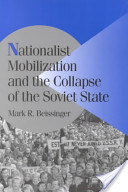
book cover

Mark R. Beissinger, 2002: Nationalist Mobilization and the Collapse of the Soviet State. Cambridge: Cambridge University Press.

In this important book Mark R. Beissinger, director of the Princeton Institute for International and Regional Studies (PIIRS) and former professor of political science at the University of Wisconsin-Madison sets out to explain how the collapse of the Soviet State  became viewed from the impossible to the inevitable within only a few years. While many studies refer to the inherent logic of the communist system as the main reason for its disintegration, Beissinger highlights the importance of nationalist events that took place during the years 1987 to 1991. Based on rich quantitative and qualitative data, the author argues that the tidal impact of these demonstration and protest events and their cross-country influence shaped a phase of history, in which institutions were changed not as the result of an inherent logic, but rather through the whole process itself.

Beissinger’s book offers a very productive combination of transnational and comparative sociological analysis. In the following review, I will focus on the second and fifth chapter of the book, in which Beissinger explains how the transnational glasnost tide of nationalism evolved and why some movements of nationalism succeded while others failed. On the basis of Beissinger’s analysis I will show that the development and the success of nationalist movements can be explained from a transnational perspective, whereas the failure of movements can rather be explained from a comparative view. Read the rest of this entry »

GovernanceXBorders co-editor Phil Mader contributes a review of Wolfgang Streeck’s new book “Gekaufte Zeit: Die vertagte Krise des demokratischen Kapitalismus“, a book which is highly critical of transnational regimes, at least regarding the European Union’s crisis management, at TheCurrentMoment.

Last semester I taught a class on “Comparative and transnational analysis of contemporary societies” for master’s and doctoral students at the University of Cologne. The aim of the course was to familiarize students with key approaches in comparative-historical social and political analysis, major critiques, and alternative approaches of world society and transnational analysis. We started with the now well-known critique that comparative-historical analysis often falls victim to “methodological nationalism” because it all too frequently assumes society to be bounded by the nation-state. In consequence, comparative-historical analysis often ignores cross-border social relations and horizons of actions, emerging from increasing cross-border flows of people, goods and cultures, transnational and global organizations, networks and communities, as well as transnational institution building.

We started with the sociological classics of whom many considered the comparative method as a key heuristic of social and political analysis. From that we moved on to post-World War II sociological analysis, world systems theory and the world society approach. Empirical illustrations covered issues such as state building, social classes and inequality, migration and diaspora communities, transnational movements, cross-border policy networks and the Europeanisation of welfare institutions.

Interestingly enough, we discovered that even within transnational analysis focusing on networks, diffusion or multi-level interactions, the comparative method does still have an important role to play. Going back to the classics, we found intriguing combinations of comparison and diffusion analysis in Tocqueville’s and Weber’s work. More contemporary critical approaches, such as world systems theory and world society theory, continue to use country comparison as a reference point. This led us to the conclusion that the comparative method is still very valuable but needs to be adapted and combined with other methodological approaches such as network analysis, process tracing or sequence analysis to encompass the transnational and global realities of contemporary societies. Read the rest of this entry »

One of the things that make blogs particularly interesting are series. The “series” series recommends series at related blogs.

When Daniel Rozas warns, I listen. Rozas forecasted the crisis of microfinance which broke out in India in late 2010, warning as early as November 2009 that Andhra Pradesh was the most saturated microfinance market in the world alongside Bangladesh, and mass defaults could begin any time.

2009:

I can’t predict whether the microfinance bubble I believe exists and continues to grow in Andhra Pradesh and other south Indian states will deflate quietly or burst spectacularly. […] In their pursuit of growth, many MFIs have continued to add large numbers of new customers in Andhra Pradesh and other highly saturated regions – I believe that is irresponsible. […] The spark that sets off a large-scale delinquency crisis can be anything and could come at any time – a rapid drop in economic growth, a populist political movement, a religious decree, or a collections effort gone bad.  One can’t control the spark, but one can control how much fuel that spark can ignite.

Since this February, Rozas has been outlining the scenario of a possible further repayment crisis in a series of posts (links to parts 2 & 3) on the Financial Access Initiative Blog. He says self-regulatory efforts over the past years have been important, but perhaps not enough to stem lending excesses in certain countries (I would agree). Looking at indebtedness and lending at the sub-national level, Rozas reveals a fairly alarming picture in the Mexican state Chiapas, which shows similar patterns to Andhra Pradesh in 2009.

But it is Rozas’ attunement to the political economy of microlending which sets him apart from most sector consultants. Read the rest of this entry »

Research on racism has mostly focused on territorial states and its politics, claims a recent call for papers just published by Gerhard Wolf in the forum of H-Soz-Kult. However, the phenomenon itself is clearly not bound to territorial borders.

A two day workshop at the University of Sussex titled “Everyday Racism in Transnational Perspective” attempts to widen the scientific angle of vision on the radical construction of race. Suggested topics of workshop contributions include, inter alia, racism and the marketplace, pop culture, religion, family or education.

The workshop takes place from October 31 to November 1, 2013. Deadline for applications is April 30.

Scholars engaged in this topic may also be interested in an older post about the Journal of Comparative Fascist Studies’ call for papers on fascism as a transnational concern – although the two phenomena are distinct.

(jiska)

The idea of international financial reporting standards as a single global financial reporting language has come to stay. There is no doubt that developing accounting standards can be a difficult and expensive exercise. The substantial cost associated with the development of international accounting standards seems to be borne by only a handful of actors where as other actors (users of the standards) are free riding.

Who pays and who free rides?

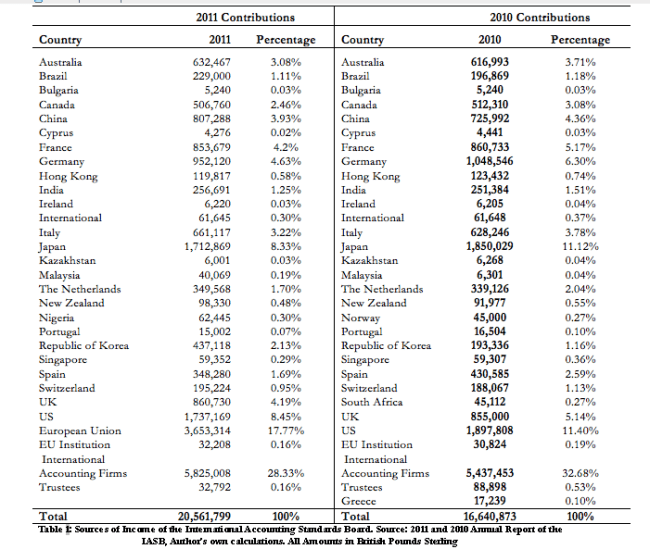
The International Accounting Standard Setter i.e the IFRS Foundation thrives as a non-profit private organization who’s business is to commit its rather limited resources solely to the development and promotion of the use of high quality global financial reporting standards. These resources largely come from the generosity of member countries, international organizations, international accountancy firms, accounting regulators, capital market regulators, multinational firms, transnational and national accounting standard setting bodies, international banks and in rare cases governments. Given these rather limited sources of financing and the lack of obligation on the part of these sponsors, it is hard to say how much funding the IASB actually needs to enable it develop credible global accounting standards. However, a quick look through the financial statements of the IFRS Foundation suggests that majority of its funding turns to come from accountancy practicing firms, national accounting regulatory authorities and accountancy bodies that share the dream of a single global accounting standard. These sources of funding got me thinking about the wide usage of the standards as to the number of user countries and the limited funding the IASB currently has.

As many as 120+ countries currently use IFRS globally. However, very few of these countries actually contribute financially to the development of these standards. What is even more surprising is the number of developing countries (especially countries from Africa, Asia and South America) that continue to use the standards without any financial contribution to the development of the standards. Take Africa for a test case. There are 57 countries in the continent and out of this number; about 21 countries currently use IFRS in one form or another either as full scale adopters or users of modified versions of the standards. Nevertheless, only two of these countries have contributed very small amounts to the overall development of the standards. In 2010, South Africa became the only African country to have contributed 45,112 British pounds sterling representing only 0.27% of the income of the IASB.  This example was followed by Nigeria in 2011 who contributed 62,445 British pounds sterling representing 0.30% of the annual income of the IASB. The table below indicates the sources of funding for the development of International Financial Reporting Standards.
Image

The one who pays the piper calls the tune!

I have often wondered how non-paying users of International Financial Reporting Standards (IFRS) could have influence on the work of the International Accounting Standards Board (IASB). As more countries continue to apply IFRS without contributing to its development, their ability to influence the work of the IASB become weak. Neither can they communicate problems with specific standards nor can they determine the direction or pace of international accounting standards.  Accounting standards by their nature are public goods i.e. the consumption of which by one party can not diminish the consumption of another party of the same good.  Nevertheless, what constitutes how a public good is constructed is on the bases that a common contribution is made by consumers or potential consumers of the same good. But this contribution is only made by a cross-section of the consumers while the others only wait to enjoy the benefits. On this basis, economists define public goods to mean any good from whose enjoyment non-contributors cannot be excluded.  Like many other public goods, the problem of free riding exists where some others pay to finance its construction while others do not pay but enjoy its use as much as those who paid for its construction.

IFRS has come along with such economic problem. IFRSs on this basis have equally come to represent public goods which only a handful of financial contributors make commitments towards the development of the standards while others only apply the standards without any contribution. As many developing countries look to enhance their financial informational needs, they turn to embrace the idea of IFRS and adopt these standards in some cases without the knowledge of the IASB.

The price for free riding the use of these standards is that, actors that contribute the development of these standards turn to dictate the direction of the standards. Non-paying actors will have no influence on how these standards are designed. With little or no voice on the IASB standard setting process by non-paying members, this group of users of the standards stands the chance of applying standards not designed to meet their needs.

(solomon)
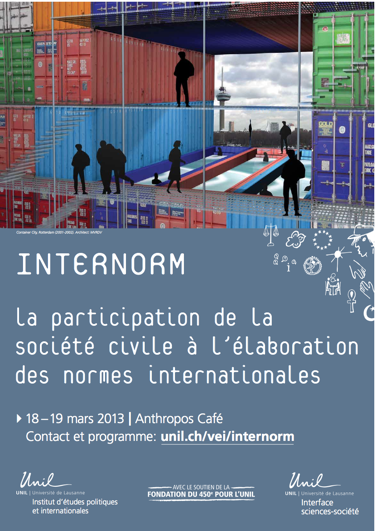
Image_affiche_INTERNORM_Mars_2013

Last week, I attended a very interesting conference organized by Jean-Christophe Graz, Christoph Hauert, Marc Audetat and Danielle Büschi at the University of Lausanne in Switzerland. At this conference, the prospects and limits of participation of civil society in international standardization were not only assessed by leading academics working in the field but also by members of various NGOs, including consumer and environmental organizations operating at the national and transnational level. The conference was part of a research programme at the University of Lausanne called “Living together under uncertainty” which has the aim to reinforce the relationship between academic knowledge and civil society. The INTERNORM project is trully transdisciplinary in the sense that Helga Nowotny understands the term: bringing together different types of knowledge from academics and practitioners for democratic problem-solving in the global sphere. The conference was one of the rare moments where academics and pratictioners engaged in really productive intellectual inquiry into how problems of standard-setting are framed, organized and managed in various national and transnational arenas. It also turned out to be a very cross-fertilizing event between the French and English-speaking communities in this field. Discussions revealed the many still persisting obstacles created by technical standard-setting organizations which make it difficult for civil society actors to participate on an equal footing. Yet, discussions also pointed to the strategic capacity of transnational and European NGOs to coordinate effectively across borders and to set their priorities in ways to enhance their leverage and influence. The presentations of the conferences are available on the INTERNORM project website.

(sigrid)

Yesterday was the first International Day of Happiness as proclaimed by the UN General Assembly in July 2012. The idea to introduce such a day derived from a meeting titled “Happiness and Well-being: Defining a New Economic Paradigm”. The meeting had been convened by the Government of Bhutan and is one of many initiatives questioning economic growth and the GDP as leading indicator for political success (e.g. summarized in a MPIfG working paper, in German). During the debates on alternatives, Bhutan gained a lot of prominence for its decade-old practice of focusing on citizens’ happiness instead.

The resolution which introduces the Day of Happiness also tells us that “the pursuit of happiness is a fundamental human goal”. Furthermore, the UN General Assembly recognizes

“the relevance of happiness and well-being as universal goals and aspirations in the lives of human beings around the world and the importance of their recognition in public policy objectives”

And

the need for a more inclusive, equitable and balanced approach to economic growth that promotes sustainable development, poverty eradication, happiness and the well-being of all peoples

The new economic paradigm which the world was supposed to reflect on yesterday is still one of economic growth, one might say – but in addition, there is an International Day of Happiness.

(jiska)

The Book

Governance across borders: transnational fields and transversal themes. Leonhard Dobusch, Philip Mader and Sigrid Quack (eds.), 2013, epubli publishers.
February 2026
M T W T F S S
 1
2345678
9101112131415
16171819202122
232425262728  

Copyright Information

Creative Commons License
All texts on governance across borders are licensed under a Creative Commons Attribution-Share Alike 3.0 Germany License.