Sidney Paget: Sherlock Holmes

Sidney Paget: Sherlock Holmes

Dave Itzkoff hit the nail on its head with the following opener to his New York Times article on the heirs to Sherlock Holmes in 2010:

“For a 123-year-old detective, Sherlock Holmes is a surprisingly reliable earner.”

In a more recent guest post at the 1709 blog, Miri Frankel reports about a new legal battle with regard to the copyright expiration date of some works of Arthur Conan Doyle, the creator of the fictional character Sherlock Holmes:

In February Leslie Klinger, a Los Angeles attorney, filed a lawsuit against the estate of Sir Arthur Conan Doyle — the creator and author of a series of fictional works featuring legendary investigator and crime-solver Sherlock Holmes. Mr Klinger is the author of numerous books and articles relating to the “Canon of Sherlock Holmes” […] For years, the Conan Doyle Estate has demanded and collected licensing fees from authors who created works drawing from or based on the Sherlock Holmes character or other elements from the world of Sherlock Holmes. […] But Mr Klinger’s view, and the view of other, sympathetic authors who have created new stories based on elements from the public domain works of Sir Conan Doyle, is that these licensing fees are not necessary, and the Conan Doyle Estate should not be allowed to threaten them with lawsuits to extract licensing fees.  The Complaint asserts that only new, original elements first published in the stories that remain under copyright protection are still protectable; copyright no longer protects, however, any elements that had already been published in earlier Sherlock Holmes works, so all such elements are now in the public domain.

Interestingly, Klinger makes his arguments not only in court but has also launched a website entitled “Free Sherlock!“, where he is even asking for donations “to offset legal fees and expenses of the litigation.” Read the rest of this entry »

The pope is a transnational actor ex officio. He fills the highest position in the hierarchy of the Roman Catholic Church which makes him: head of a state, head of an NGO-like organization, head of a huge religious organization, and spiritual leader of a transnational community.

However, the current discourses on the election of a new pope reveal that the affair has more layers than the universal doctrine of the church suggests. Discussions on ‘papapile’ cardinals included strong national allocations. Furthermore, focusing on internal challenges of the organization belittled the external relevance of the decision and the pope’s role as an advocate. With this blog, I want to shed light on those different dimensions of papacy and the Roman Catholic Church against the backdrop of the recent election of Franciscus I.

What the pope is and what he is not

Of course, the pope is the absolute head of a state. Since the Lateran Treaty in 1929, the Vatican is a sovereign state accepted in the international community. The pope is part of political struggles. However, he is no usual head of state. As a non-member permanent observer state since 1964, the Vatican representative has no right to vote at the United Nations (although all other rights of full membership were granted in 2004).

Analytically, the Roman Catholic Church is maybe best described as a unique hybrid on the world stage with state and non-governmental characteristics.

The Church today regards Vatican City as part of the infrastructure for carrying out its true mission. In the language of international relations, the Church understands itself as an NGO, and it additionally employs the benefits of sovereign status in the service of its advocacy interest. (Ferrari 2006: 40)

Read the rest of this entry »

Two summer schools will address problems of transnational research with a long term perspective:

The CENDARI Summer School “Historical Sources & Transnational Approaches to European History”, 22 -26 July 2013, in Florence, Italy, and the 3rd Doctoral Summer School “Between International, Transnational and Global History: Information Technologies at Borders, 19th-21st C.”, 23-25 September 2013, in Pleumeur-Bodou, France.

In Florence,

Sessions will apply the concept of ‘transnational moments’ to examine ways in which historical research is complicated by the nature of material records of the past. The Summer School will provide a context for the various collections-level challenges to transnational history, such as how to identify sources that have become ‘hidden’ or lost through accidents of history. (source)

Participants will have the chance to learn about the project CENDARI (Collaborative European Digital Archive Infrastructure) which is a collaboration of computer experts and historians integrating digital archives to facilitate science.

The summer school in Pleumeur-Bodou, on the other hand, attempts to overcome methodological nationalism in the study of the globalization of communications. Both summer schools offer opportunities to present one’s own research.

Deadlines for applications:
CENDARI Summer School, Florence: April 15, 2013
Doctoral Summer School, Pleumeur-Bodou: April 26, 2013

(jiska)

Suddenly, out of the blue, a debate about microfinance and child labour has erupted. Why?

Underage work caused by microloans is an uncomfortable topic for the microfinance sector, given the moral panic easily associated with child labour. It’s nearly impossible for the industry to publicly make dismissive or nuanced statements on the issue. David Roodman (self-styled “impertinent inquirer“) has now stepped up to the plate, publishing a thought-provoking short essay on his blog which critiques recent moves towards – or rather: rumours of some consideration being given to the idea of – enshrining policies against child labour in the microfinance sector’s transnational self-certification schemes.

Yes indeed, what are we going to do about it?

Photo: Children’s Bureau Centennial, Creative Commons Attribution 2.0 Generic

Roodman assumes Hugh Sinclair (self-styled “microfinance heretic“) to be a driving force behind this. While I have my doubts about it being that simple, I do think that, while not a driving force, Sinclair could be a contributing factor.

Which, incidentally, brings me to my hypothesis about the actual issue of child labour. Is microfinance a driving force? Hell no. Could it be a countributing factor? Logically yes. Consider these two very simplified causal chains:

Read the rest of this entry »

Today GovernanceXBorders co-editor Phil Mader contributes a guest post on microfinance and European austerity politics over at TheCurrentMoment.


The Andhra Pradesh crisis has been something of a turning point in public assessment of microfinance, with a suicide wave caused by widespread overindebtedness badly tarnishing the sector’s image in India as well as abroad. Some Indian politicians are now beginning to identify the idea of alleviating poverty with microfinance as “crap“.

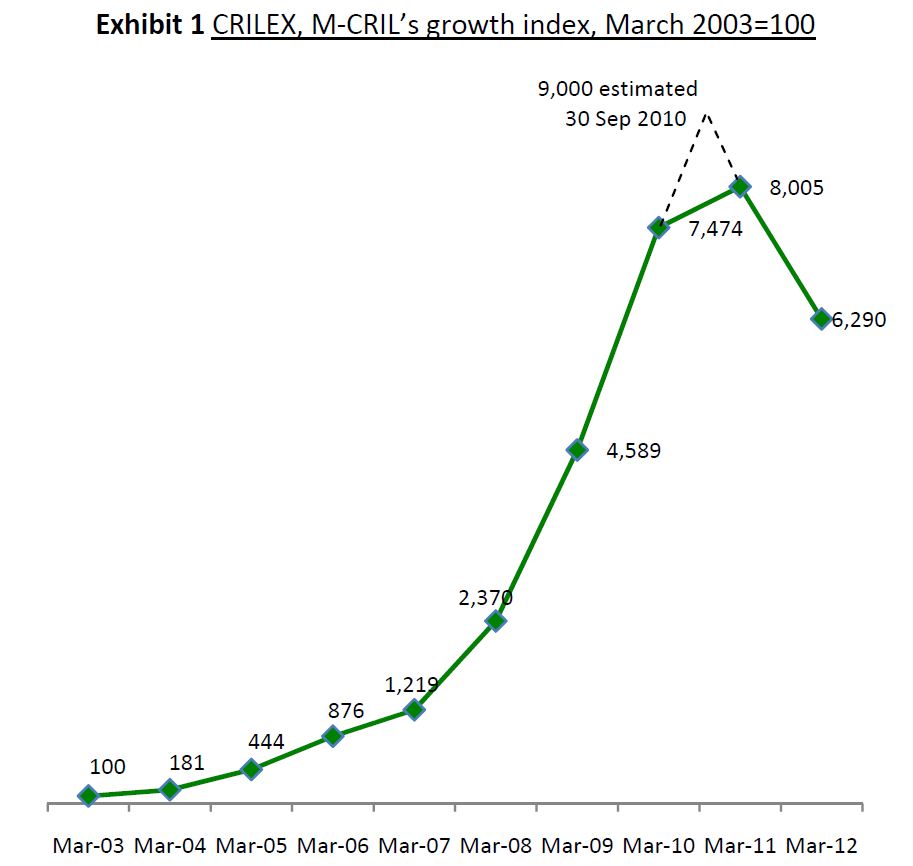
Crilex

Source: M‐CRIL Microfinance Review 2012 (vii)

Microfinance in India remains in protracted decline since 2010 (see graph), although talk of “green shoots” and catharsis after “near-death experience” has been around for some time. The industry’s stance for the past two years has been to deny responsibility for any wrongdoings, downplay its role in precipitating the dozens of suicides, and claim that the AP government’s October 2010 legislation was a surprising and unjust crackdown on healthy practices. I have claimed otherwise.

Yet, fairly surprisingly, my new paper investigating the causes of the crisis, and a recent interview with SKS Microfinance senior managers come to some similar conclusions about the causes. In particular, both versions see the unregulated hyper-competitive market as a significant cause of the tragedy which led to microfinanciers’ troubles. How can this be?

Read the rest of this entry »

In my last  blog entry, I referred to the chameleon nature of the description of IFRS adoption in many countries. I described the contradictions that the International Accounting Standards Board (IASB) presents when it refers to the overwhelming acceptance of the International Financial Reporting Standards (IFRS) globally. This contradiction and confusion generates ambiguity in the application of the standards in most less developed countries that seem to apply the standards from different angles than anticipated by the IASB. This in turn has the potential to undermine the achievement of the benefits of these standards as presented by proponents of IFRSs. 

The question is, how different or similar will the outcomes (results) of IFRSs application(s) be if some countries adopt IFRSs without modifications as compared to those that apply modified versions of the standards? Will the IASB be able to achieve the goal of comparability of financial statements across borders? Will the need to harmonize accounting practices globally in order to achieve uniformity be fulfilled?  The aim of this blog entry is to reassess the claims that countries and the IASB  make when they speak of IFRS adoption, looking for the best way to gauge if and when a country has actually adopted IFRSs.

Let’s start with the basic premise that a single global accounting standard has the prospects of improving information quality across borders and to foster cross border investments. This premise rests on the notion that granted that a single global accounting standard is in place, comparability of financial statements will be achieved, leading to a reduction in information processing costs associated with different national accounting standards, and thereby resulting in a reduction in the overall cost of capital.

Read the rest of this entry »

This post is provided by guest blogger Domen Bajde of the University of Southern Denmark.

As evidenced by inventive movements and campaigns (for a future example see Half the Sky Movement: The Game), the field of charity is undergoing considerable dynamics. As a skeptically-optimistic observer, I am happy to see research that explores such developments against the backdrop of broader material and social change, appreciating their innovativeness and critically questioning the suppositions, mechanics and stakes at play.

I recently stumbled upon a book sharing my skeptical optimism. Surveying historical change in Amnesty International and Oxfam advertising, Chouliaraki argues that poverty is increasingly instrumentalized, setting the focus on the “self” (of the Western donor), turning charity into an ironic spectacle largely shaped by “compassion fatigue” (a.k.a. avoiding stuff that is unpleasant). Rather than amplifying the voice of those in need, many charities end up prioritizing the interests/pleasures of donors.

Read the rest of this entry »

Just recently the renowned Göttinger Institute for Democratic Research has published a remarkable study on the motives of protest movements in Germany (“The new power of citizens”). While the book reveals interesting insights about who protests and why in 2012, it itself triggered public criticism – not for its content, but for who financed the study – the international petrol company BP. This triggered a larger debate about the role of transnational companies as financiers of research particularly into activism, which is occasionally also directed against such companies. Are research results used by companies to democratize economic projects or rather to further the economization of democratic concerns of citizens?

Read the rest of this entry »

I have always found it difficult to understand how nationalists can identify with each other across borders. But of course the oxymoron of “transnational fascism” is not just empty rhetoric, but real. Just recently, for example, German media reported on the Greek party Chrysi Avgi’s contact with German right-wing groups like the National Democratic Party (NPD) of Germany – for articles in German click here or here.

The open access Journal of Comparative Fascist Studies has issued a call for papers on fascism as a transnational phenomenon. Both theoretical and empirical contributions are welcomed. The editor-in-chief Madelon de Keizer is a historian, but the call explicitly invites social and political scientists to contribute to the volume to be published in October. The deadline is June 1, 2013.

(Jiska)

The Book

Governance across borders: transnational fields and transversal themes. Leonhard Dobusch, Philip Mader and Sigrid Quack (eds.), 2013, epubli publishers.
March 2026
M T W T F S S
 1
2345678
9101112131415
16171819202122
23242526272829
3031  

Copyright Information

Creative Commons License
All texts on governance across borders are licensed under a Creative Commons Attribution-Share Alike 3.0 Germany License.