Today, Google announced its acquisition of Motorola Mobility for not less than $12.5 billion in cash. And I completely agree with Forbes’ contributor Eric Jackson, who states that

Androids

Saad Irfan, CC BY-NC-ND

[i]f you think this is about Google getting into the handset business, think again. If Google were to get into the handset business, they would turn their back on partners like HTC, Samsung and others.
Today’s deal is all about acquiring Motorola’s backlog of mobile-related patents. When Google lost out on the batch of Nortel patents, they worried that Android was significantly at risk.

A risk stemming from the fact that, in spite of developing Android under an open source license, powerful patent holders such as Microsoft were able to squeeze out licensing fees from corporate Android users. The bizarre result being that Google, the main developer of Android, gives away its contributions to the operating system for free while its not-contributing competitor Microsoft charged hardware producer HTC $5 for any shipped Android (!) smartphone (see business insider). Read the rest of this entry »
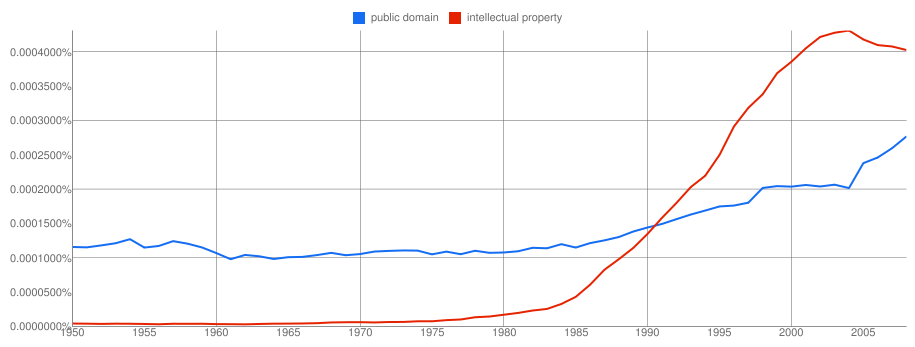
Google Books Ngram Viewer is a fantastic tool showing how certain phrases have occurred in a corpus of books over a selected period of time. Recently, fellow bloggers over at orgtheory have played around with this tool (see, for example, “market – science- religion“).

Working on the issue of the digital public domain during my stay at the WZB, I was curious to compare the mentions of “public domain” and “intellectual property”, which are depicted in the graph below:

The resulting graph is pretty interesting. First, I did not know that the term “intellectual property” was virtually non-existant at all prior to 1980. This is remarkable since the negotiations that in the end led to the WTO’s agreement on Trade-Related Aspects of Intellectual Property Rights (TRIPS) had started in the early 1980s. Again, we can observe a shifting baseline effect (see “Shifting Baseline in Assessing Copyright Regulation?“): today the concept of “intellectual property” has become completely taken for granted, while 30 years ago even the phrase hadn’t been used. Read the rest of this entry »

As mentioned in my last post, this summer I am visiting the WZB to work on a paper about the digital public domain. Rifling through a huge pile of papers on the issue, I recently stumbled across Robert P. Merges’ 2004 essay “A New Dynamism in the Public Domain” (PDF) – and I really regret not having read this piece much earlier. He summarizes the main point of his paper as follows:

The simple point of this Essay is that these investments are invigorating the public domain with a new dynamism stemming from private action. These investments demonstrate that private action, and not just government policy, can augment the public domain. (p. 184)

Such private investments into the public domain, Merges argues, are inspired by the very expansions of intellectual property rights they seek to counteract: Read the rest of this entry »

Lamia Karim, 2011: Microfinance and Its Discontents: Women in Debt in Bangladesh. Minneapolis: University of Minnesota Press.

Microfinance has built a significant part of its reputation on the assertion that small loans empower women. The assumption that every human being has entrepreneurship potential, but only lacks access to credit, underlies this “social business” intervention. The joint appeal of entrepreneurship and empowerment has cajoled many funders and donors to invest in microfinance. But critical research has been shedding doubt on the assumptions of empowerment through microfinance entrepreneurship for quite some time. Can or cannot a direct transfer of credit rouse the dormant and innate entrepreneur which lies within every woman?

Lamia Karim’s brave new book, “Microfinance and its Discontents- Women in Debt is Bangladesh”, delves deep into the social realities within which microfinance operates, in order to answer that question. As an Associate Professor of Cultural Anthropology at the University of Oregon, she performed research among the clientele of the four major microfinance NGOs in Bangladesh (Grameen Bank, Proshika, BRAC and ASA) first between 1998 and 1999, and following up in 2007.

Norms and obligations in a rural society are tilted against women, as is demonstrated by a proliferation of ethnographic accounts in Karim’s book. Take, for example, the incident of an elderly widow in Bangladesh, who was caught by her nephew on her way back home after taking a fresh loan from Grameen Bank. He pressured her into handing over the money to him because, he said, as his aunt it was her duty to help him start his business. Read the rest of this entry »

Starting this week and ending in October, I am visiting researcher at the Social Science Research Center Berlin (WZB). The reason for my stay is a research project on the societal and economic role of the digital public domain, which I am working on together with Jeanette Hofmann. In this context, I started re-reading some of the classic works on the issue, such as David Lange’s “Recognizing the Public Domain” (PDF) from the year 1981.

Photo of Pac Man JohnGiez

Intellectual Property as “a game of conceptual Pac Man”?

While reading through this paper and his assessment of then recent changes in copyright law, several of his conclusions are strikingly similar to the ones made by contemporary copyright critics:

“I will argue that the growth of intellectual property in recent years has been uncontrolled to the point of recklessness.” (p. 147)
“The [copyright] law seemed suddenly to metastasize” (p. 153)
“The field of intellectual property can begin to resemble a game of conceptual Pac Man in which everything in sight is being gobbled up” (p. 156)

Since Lange’s assessments in 1981, however, there have been some of the most fundamental revisions in copyright’s history such as the TRIPS treaty or the subequent WIPO Copyright Treaties and their respective implementation into national law – all further increasing strength and scope of intellectual property rights (for a detailed account of the regulatory changes between 1980 and 2000, see Drahos and Braithwaite 2002). Read the rest of this entry »

A recurrent topic across most fields covered here at governance across borders is standards. In the field of environmental standards, for example, Olga repeatedly discussed how transnational standards and local practices are interrelated (e.g. “From Transnational Standards to Local Practices“). In the field of copyright regulation, many posts deal with the issue of standard proliferation (e.g. “Money Buys You Standards?“) and diffusion (e.g. “Iconic Standards: Regulating and Signaling“) in the case of Creative Commons.

But as always, at least in our recurrent series “Wise Cartoons“, all our words cannot live up to the simple wisdom of illustrations such as the one provided by XKCD below:

Fortunately, the charging one has been solved now that we've all standardized on mini-USB. Or is it micro-USB? Shit.

(leonhard)

PS: For another wise cartoon on standards that features Scott Adam’s Dilbert check out “Google Books and the Kindle Controversy“.

Yesterday, as is reported by the 1709 Blog, the Recording Industry Association of America (RIAA) announced that “Music, Movie, TV and Broadband Leaders Team to Curb Online Content Theft“. The press release not only obtrusively evidences the change in wording from “piracy” to “content theft” (see “Too Sexy for Being an Insult: Framing Piracy“), but also advertised two remarkable initiatives: the introduction of a common framework for so-called “Copyright Alerts” and the foundation of a “Center for Copyright Information“. Taken together, these initiatives constitute the most comprehensive attempt of private regulation in the field of copyright since the (failed) attempt of establishing all-encompassing Digital Rights Management (DRM) systems at the end of the 1990s and the early 2000s (see also “DRM in the Music Industry: Revival or Retreat?“).

Screenshot of the Center for Copyright Information HomepageAccording to the RIAA, the “Copyright Alerts System” will address (alleged) online copyright infringement

with a series of early alerts — up to six — in electronic form, notifying the subscriber that his or her account may have been misused for online content theft of film, TV shows or music. It will also put in place a system of “mitigation measures” intended to stop online content theft on those accounts that appear persistently to fail to respond to repeated Copyright Alerts. Read the rest of this entry »

In their book “Information Feudalism” (2002), Peter Drahos and John Braithwaite argue that the “danger of intellectual property lies in the threat to liberty” (p. 3). Also Jamie Boyle, in his open access book “The Public Domain” (2008, PDF) warns against the potential of strong copyrights to interfere with some of the most basic human rights such as free speech. Only rarely, however, these dangers become so clearly visible as in the current controversy around a Greenpeace campaign video.

It all started with a very successful Superbowl commercial by VW, featuring a child as Darth Vader and being enormously successful on YouTube with over 40 million viewers so far:

Inspired by this commercial, Greenpeace created a parody featuring several kids playing other famous Star Wars characters and attacking VW for its CO2 policies on the campaign website www.vwdarkside.com. When today I wanted to see the video embedded at the site, I however only encountered the message delivered by YouTube that the video was not available due to copyright infringement (see screenshot below). Read the rest of this entry »

In late May, the Max Planck Institute for the Study of Societies published my paper on the implementation of transnational voluntary forestry standards in Russia in its discussion paper series (From Transnational Voluntary Standards to Local Practices: A Case Study of Forest Certification in Russia. MPIfG Discussion Paper 11/7). In the paper, I attempt to deconstruct the process of implementation and suggest that the current literature has paid little attention to two social processes that accompany – or even constitute – the implementation of transnational voluntary standards: collective learning and stakeholder interest negotiation. Basically, I argue that previous research examines carefully various factors that explain why certain companies in certain countries commit to voluntary environmental standards, but has so far mainly assumed that once standards are adopted, the improvements in practices will occur (if there is a gap between standards and practice, which is most often the case, as some research shows). Instead, I suggest that implementation should not be taken for granted and propose a framework for understanding how companies and activists translate transnational voluntary standards into on-the-ground practices, particularly in a difficult context of non-advanced industrial countries. Empirically, I apply this framework to the analysis of the implementation of the Forest Stewardship Council’s forestry standards in Russian forest enterprises. Read the rest of this entry »

A few days ago, the German collecting society GEMA was criticized by CEOs of leading music labels such as Universal or Sony Music for not being able to negotiate an agreement with Google, the owner of YouTube, that would allow their music videos to be featured on the site (see “Cracks in the Content Coalition: Corporations vs. Copyright Collectives“).  Today the German branch of the hacktivism group Anonymous weighed in and launched a campaign against GEMA (see the video message below).

At the time I am was writing this post, the GEMA homepage is was down, most likely because of a distributed denial-of-service attack – the standard form of online protest organized by Anonymous. The rationale for the attack given in the video explicitly refers to the recent criticism by major label representatives and reads as follows (my translation): Read the rest of this entry »

The Book

Governance across borders: transnational fields and transversal themes. Leonhard Dobusch, Philip Mader and Sigrid Quack (eds.), 2013, epubli publishers.
March 2026
M T W T F S S
 1
2345678
9101112131415
16171819202122
23242526272829
3031  

Copyright Information

Creative Commons License
All texts on governance across borders are licensed under a Creative Commons Attribution-Share Alike 3.0 Germany License.