
This post is provided by our first “guest blogger” Sebastian Botzem. He is research fellow at the department „Internationalization and Organization” at the Social Science Research Center (WZB) in Berlin.

Fair value accounting has been identified as one of the causes of the current global financial crisis (see, for example, on this blog “Fair Value Accounting in Retreat?“). While it would be unfair to bookkeepers, accountants, auditors and academics to make them solely responsible for the loss of wealth and jobs, the present twists and quirks with regard to accounting policy are remarkable and merit closer attention.

A good example to show that the logic of accounting is questioned is Germany’s “bad bank”  solution: In principle there seems to be agreement to clear balance sheets from heavily impaired assets in order to free up capital and cut the risk of further writedowns. How that should be done, however, remains a big question. One of the great unknowns is of course how to determine the price for the assets to be transferred. Also, it needs to be determined how and to which degree the German taxpayers are eventually being burdened with liabilities not just for years, but for decades. The legal construction is also interesting: Germany’s “bad banks” are supposed to be set up as Special Purpose Entities (SPE). Günther Merl, former speaker of Germany’s public banking rescue fund Soffin (Sonderfonds Finanzmarktstabilisierung, in English: Financial Market Stabilization Fund), has just argued in the German quality daily Süddeutsche Zeitung that the government should exempt the proposed “bad banks” from the usual regulation that applies to financial institutions. The intention of such a move is to allow for accounting provisions that treat “bad banks” not as banks. The creation of Special Purpose Entities – one cause of much of the turmoil at financial markets – to rescue financial institutions indicates the dire straits market advocates are in. Read the rest of this entry »
For this year’s Wikimania (26-28 August, Buenos Aires) I submitted an abstract of a paper comparing transnationalization processes and community relations of Creative Commons and Wikimedia. In this series I present some work in progress.

A few days ago, Wikimedia, the organization behind Wikipedia and its sister projects, announced the results of its most recent community vote: All contributors who had made at least 25 edits to any Wikimedia project prior to March 15, 2009 were invited to vote on the proposal to license Wikimedia material so it is available under the Creative Commons Attribution-ShareAlike license (CC-BY-SA), while retaining dual licensing with the GNU Free Documentation License (GFDL). This proposal is in line with earlier statements of Wikipedia founder Jimmy Wales, who repeatedly stated that “Wikipedia, had it been founded after Creative Commons, would have certainly been under a Creative Commons license” (see, for example, his speech at an iSummit party in December 1 2007 in the video below) The proposal was accepted by a solid 75.8 % majority (see results page). Read the rest of this entry »

At the workshop „Mashing-up Culture: The Rise of User-generated Content“, which had been perfectly organized by Eva Hemmungs-Wirtén of Uppsala University in Sweden, Sigrid and I not only presented a paper on “The Copyright Dispute” (see resources page for paper and slides respectively), but I also had the great pleasure of meeting Niva Elkin-Koren. She is not only project lead of Creative Commons Israel but does very instructive research on copyright licensing and governance in the realm of digital communities (see SSRN-page for details).

One of her most recent papers, titled “Governing Access to User-Generated-Content: The Changing Nature of Private Ordering in Digital Networks”, is of particular relevance for scholars of transnational governance: Most of the new digital communities and their respective carrier platforms such as Facebook, YouTube or Wikipedia are “born globals”. Their regulation, be it (seemingly) unilateral via terms of service (see “Private Copyright Regimes: Facebook”) or multilateral via optional licensing (see, for example, Flickr), represents a form of transnational private ordering. At the same time, the pace of technological change and the blurring boundaries between the commercial and the non-commercial sphere make this field particularly promising for studying (collisions of) transnational governance regimes. Read the rest of this entry »

A lot of people – labor groups as well as compliance people – talk about empowering workers. In the Chinese context this often means educating people about their rights. This is usually done by training programmes. These training programmes have also become part of the demands of NGOs as well as company CSR rating agencies in Europe and the US, and therefore became the next step in the labour supply chain management agenda.

Whereas no big differentiations are made between training programmes, a whole industry is emerging in China, where consulting companies compete with buying companies’ own compliance programme and NGOs, offering a variety of different services. A recent study of the Sino-German Social Responsibility Project on training providers evaluated 29 providers, including nine international providers. Read the rest of this entry »

Three days ago, on May 5, the Economist started a week-long public debate under the headline “Copyright and wrongs: this house believes that existing copyright laws do more harm than good.” In his opening remarks, Kenneth Cukier gives the following rationale for hosting the debate:

Copyright strangles creativity. Copyright rewards originality. It is a nuisance to the public that unduly enriches a few people. It is the backbone of our knowledge economy that fuels progress. Hate it, love it, break it, protect it; few people lack strong opinions about copyright and its place in society.

As debaters, the Economist invited Harvard’s copyright critic William Fisher and Justin Hughes from Yeshiva University as an advocat of the prevalent copyright regime. While both present utilitarian arguments rooted in standard neoclassical economics for their oppositional claims – which, by the way, demonstrates how arbitrary mainstream economic reasoning can be -, the former also gives a short explanation for the, in his view, distorted development of copyright legislation in his first statement:

How did we get into this pickle? At least three intertwined causes seem to be at work. First, most recent adjustments in the copyright system have been spurred and shaped by interest groups that have stakes in expansion of copyright protection and that fail to take into account the interests of the public as a whole. Second, the multilateral intellectual-property treaties that now govern most countries establish floors, not ceilings. The result has been a ratchet: it is easy to increase the levels of legal protection, but hard to decrease them. Third, lawmakers are afflicted with the local maximum problem; they seek to alleviate problems by making modest improvements in the existing regime, unable to see across the valley to radically different approaches that would be much better. Read the rest of this entry »

As a newcomer to blogging who recently learned that series are particularly “in”,  I decided to start my own series as well. I’m travelling China right now as a researcher, trying to better understand what all the people I’ve talked to in Germany mean by managing labor issues in the supply chain, compliance systems, training arrangements, etc.; but also seeking to understand how labour groups deal with the issue, form their strategies or give up strategising around it.

I’ll share my impressions here, so forthcoming posts in the series will be about compliance management, worker training, management training and how labor groups try to deal with this issues (spoiler: there is a big difference between Hong-Kong-based and mainland-China-based, and you often simply cannot name it, activism).

I’m talking to all kinds of people here in China: consultants, compliance managers, labor NGOs; I’ve taken part in an audit, a manager and a worker training.  As this is China I’m writing about, the first thing people tell you is: There is always more than one truth in China…

How to become a compliance manager in one day

Auditing has become an important business in labour supply chain management. Seminars and training courses are offered all over the world on how to become a successful auditor. But, actually, it doesn’t take you more than a day. It means having an open eye for obvious problems which are often so similar that you almost don’t need to go into the factory to know about them. Read the rest of this entry »

Small loans for women, often organised in groups, to build their own businesses – that’s a standard model of microfinance, and many microfinance organisations are focused on women. In fact, it used to be the case that 95 percent of Grameen Bank’s borrowers were female.

Through the establishment of self-owned businesses which provide an independent income stream, it is theorised (or often simply claimed) that women will be empowered thanks to microcredit. A compelling argument it is, but the evidence, sadly, is thin.

Many men send their women to obtain loans which they themselves would not be eligible for, as Weber (2002) found. Thereupon they allocate the loan within the family as they see fit, possibly buying a rickshaw which they themselves pull, or on-lend to a relative with an existing business. However, if repayment becomes a problem, it is the woman who is held responsible by the microfinace organisation, and is then subject to legal and social sanctions. Read the rest of this entry »

Sorry, but I simply have to add my two cents on what Leonhard is writing about. Yeah, I’m blogging a bit out of my depth here, but as an ardent fan of original music and deep skeptic of intellectual property rights, I’ve had a strong opinion on this subject for years.

It comes as no surprise that ABBA are arguing for the preservation of the music industry. Too old or forgotten to sell any new songs, their income depends on the re-selling and licensing of old songs. Björn claims that downloaders are stealing the ideas of “single individuals” who, presumably, should receive income for it.

But the real question is: who needs the music industry? By pitting overproduced, overfinanced pop products against homegrown artists and appropriating the majority of proceeds, does the music industry really encourage creativity? I wonder how many professional musicians actually work for (major) record labels, but beyond any doubt it’s a very small percentage. The rest ekes out an honest and more or less satisfying existence doing what they can’t resist doing: making. good. original. music.

And here’s a link to the current capitalist crisis: As banking practices show, financial incentives just simply do not produce excellence. Read the rest of this entry »

One of the things that makes blogs particularly interesting are series. In this blog, for example, Phil features a series on “microcredit myths“. Today we are starting a series recommending series at related blogs. As an opener I present Digital Renaissance’s “Songs to the Music Business”.

The guys behind Digital Renaissance  –  two music label owners, a researcher and an expert on the movie business – describe the rationale for their blog as follows:

There need to be a Digital Renaissance. Renaissance is the french word for rebirth. It was a cultural movement that brought us out of the middle ages and into the future and then some with a vengeance 4.0 style. The world adjusted to this cultural movement. It is time for the world to start adjusting to the Digital Renaissance.

Yesterday, they started a series “with songs that can be translated as good stories of – or advice/mindsets to the music business”. The first entry of the series is devoted to Warren G and his piece “What’s love got to do with it?” (YouTube-Video) . There they are claiming that Warren G is “telling the whole truth” in the third verse, where he raps:

“Now for these labels tellin’ fables, makin’ the messed-up deals under the tables. You think that you smart, but, fool, I’m the smartest. You can’t make no money if you can’t keep an artist.” Read the rest of this entry »

In his recent article “Decoding Divergence in Software Regulation”* Thomas Eimer very convincingly demonstrates and explains differences in software patent regulation between the United States and the European Union. He basically distinguishes three “structural causes for the persisting divergence” (p. 276) – namely the US practice of patenting software versus the European reluctance of doing so:  (1) incompatible underlying paradigms, (2) differentiated patterns of power structure, and (3) unsynchronized institutional arrangements.

Especially in dealing with the first cause, “paradigmatic cleavage”, Eimer argues rather broadly, embracing both patent and copyright law. And I completely agree, when he contrasts the strong “utilitarian” rationale of intellectual property rights in the US with European scepticism for such utilitarian reasoning. I am not so sure, however, that the partial rejection of utilitarian welfare assumptions automatically leads to a better balance between “public and private interests” in the field of intellectual property regulation in general, as implied by Eimer when he writes: “Opponents of strong intellectual property rights in Europe can refer to a long tradition of suspicion”. Read the rest of this entry »

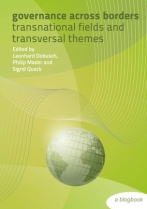
The Book

Governance across borders: transnational fields and transversal themes. Leonhard Dobusch, Philip Mader and Sigrid Quack (eds.), 2013, epubli publishers.
March 2026
M T W T F S S
 1
2345678
9101112131415
16171819202122
23242526272829
3031  

Copyright Information

Creative Commons License
All texts on governance across borders are licensed under a Creative Commons Attribution-Share Alike 3.0 Germany License.