
You are currently browsing the category archive for the ‘Copyright Regulation’ category.
At the end of the year, Time Magazine traditionally publishes “The Top 10 of Everything” online. Many of those lists contain videos and some lists, such as “Viral Videos“, “Talented Web Videos” or “Songs“, are exclusively composed out of web videos.
As discussed before on this blog (“This Post is Not Available in Your Country” and “Private Negotation of Public Goods: Collateral Damage(s)“), many user created videos that remix existing works are not available in certain areas of the world due to intervention of large rights holders such as SonyMusic or Warner Music Group. Looking at the three top 10 lists mentioned above, I put together the following graph showing how many of these videos were blocked in Germany:

Interesting detail: the 3 blocked videos in the category “Talented Web Videos” are ranked 1, 3 and 4 in the Times top 10 list. In other words: the most creative videos – at least according to Time Magazine – are blocked. In the description of the category, Time wrote the following:
“As this year’s list of the top viral videos clearly shows, not all that goes viral is great. The flipside is also sadly true: not all great videos go viral.” Read the rest of this entry »
Harward law professer Lawrence Lessig is one of the most recognized copyright experts in the world. When giving public presentations, he regularly includes short video clips to make his point. Obviously, these video quotations are covered by the fair-use-clause in US copyright. Residing in Germany, however, YoutTube does not allow me watching the video of one of Lessig’s talks embedded below. I stumbled upon the link to the video as a Slovenian colleague, Domen Bajde, recommends it to his students in a course on global business environments. When clicking on the link, YouTube just tells me that
“Dieses Video enthält Content von UMG. Es ist in deinem Land nicht verfügbar.” (translation: “This video contains content from UMG. It is not available in your country.”)
Previously on this blog, I have described how such problems arise as a consequence of (re-)negotiations between platform providers such as Google (the owner of YouTube) and rights holders, which demand a share from the platform’s ad revenues and hold content created and shared by users hostage (see “Private Negotation of Public Goods: Collateral Damage(s)“). The funny thing is how this erects new and increasingly ridiculous barriers in the seemingly global online world that are still tied to national borders. As an Austrian living in Germany, for example, I can only watch every second video shared by my Austrian friends via Facebook. Obviously, I am not the only one annoyed by this phenomenon. Paul Mutant, a Hungarian artist currently living in Brighton, U.K., converted his frustration into the great painting featured below. Read the rest of this entry »
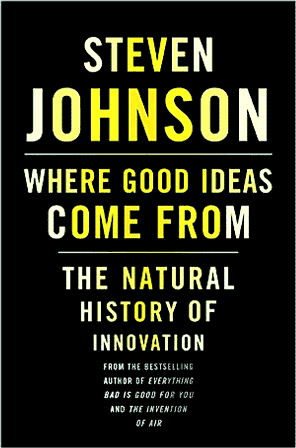 Steven Johnson, 2010: Where Good Ideas Come From: The Natural History of Innovation. New York: Riverhead Books.
Steven Johnson is all about crossing borders. His books deal with a great variety of topics, ranging from London’s most terrifying cholera epidemic (“The Ghost Map“) to a praise of popular culture (“Everything Bad is Good for You“). And also in his most recent book, Steven Johnson crosses disciplinary and historical borders, when he, in his own words, “analyzed 300 of the most influential innovations in science, commerce and technology — from the discovery of vacuums to the vacuum tube to the vacuum cleaner”.
The list of reviews and summaries of the book availble online is endless, including a TED talk given by the author himself and a great video summary featured above. So I am not going to reproduce any of these but very selectively refer to one of the examples presented in the book that relates most to the issues discussed in this blog. This example is the web-based patent marketplace GreenXChange, where Nike publicly released more than 400 of its patents that involve environmentally friendly materials or technologies. Johnson discribes rationale and realization of the project as follows (p. 125):
“By keeping its eco-friendly ideas behind a veil of secrecy, Nike was holding back – without any real commercial justification – ideas that might, in another context, contribute to a sustainable future. In collaboration with Creative Commons, Nike released its patents under a modified license permitting use in ‘non-competitive’ fields. (They also created a standardized, pre-negotiated contract for patents, thereby reducing the transaction costs of haggling over each patent license individually.)”
This is the first example, at least to my knowledge, where Creative Commons was active in standardizing licenses outside of the field of copyright regulation (see the respective announcement on its blog). Moreover, it demonstrates how similar problems and solutions in both so-called “hemispheres” of intellectual proporty – patents and copyright – might be after all. Hopefully, I will soon find the time to do some comparative studies on private regulation in both these fields.
(leonhard)
This post is provided by our guest blogger Thomas Gegenhuber, who studies Business Administration at Johannes Kepler University in Linz and is a regular contributor to wikinomics.com. He participated as a live-blogger at the Free Culture Research Conference 2010 in Berlin.
The Facebook-Movie is hitting the movie theatres. The catchy ad for the movie says: You don´t get to 500 Million friends without making a few enemies“. From an economic perspective, the social networking market has an oligopolistic structure, with facebook as a market leader. Facebook is under fierce criticism for its privacy policy. Yet, events like the “quitting facebook day” resulted only in 34.000 drop outs. Critique might lead to some minor changes in the privacy settings, but the switching costs for facebook users to another social network are very high. To use following analogy: Moving from one social network to the next is like moving into another city. You lose a lot of your friends.

Geert Lovink, who held the keynote at the Free Culture Conference in Berlin, believes the facebook problem is rooted in its business model. At the end of the day, facebook needs to monetize people’s social graph. He highlighted that some services address this problem. “Sepukoo and the web2.0suicidemachine allow you to remove your data; other services enable you to download your data.” Evolving alternatives like Appleseed and the more famous Diaspora are still in the early stages. Read the rest of this entry »
License proliferation – the development and use of different and incompatible licenses – has always been an issue in the field of open content licensing. As in any process of standardization, the utility of a certain standard depends on its diffusion. Open content licensing regimes thus become a viable alternative to the prevalent all-rights-reserved copyright regime only insofar as a critical mass of works is licensed under compatible licensing standards.
In the field of free/open source software the GNU General Public Licens (GPL) has more and more become the de-facto standard. The Black Duck Open Source Resource Center reports that about 65 percent of all software packages released under free software/open source licenses use the GPL or one of its deratives.
One of the two major innovations* brought by Creative Commons to the realm of open content licensing was the modularity of its licenses: probably inspired by libertarian ideals of maximizing individual choice (see Elkin-Koren 2005), Creative Commons allows combining different license modules such as “share-alike” or “non-commercial” (see also “Iconic Standards: Regulating and Signaling“) and thus ends up with actuall 6 different and partially incompatible licenses. Initially, Creative Commons had even allowed five more combinations and developed several special purpose licenses such as the “Sampling licenses” or the short-lived “Developing Nations License”. Recognizing that this increase of license choice led to a fragmentation instead of a maximization of the aspired commons of digital works, Creative Commons now struggles to solve a problem it partially helped to create in the first place. Read the rest of this entry »
Before the Wikimedia Foundation was established as the organizational carrier for Wikipedia and its sister projects, the Wikipedia trademark as well as the server infrastructure had been owned by the start-up company bomis.com, which ran an ad-funded search engine mainly targeting a male audience. Wikimedia was founded over two years after Wikipeda and only after a substantial part of the Spanish Wikipedia community had started a Wikipedia-fork named “Enciclopedia Libre Universal” to prevent Bomis from including advertisments in Wikipedia. Bomis then handed on all Wikipedia-related intellectual property to Wikimedia.
In projects using open or free licensing standards such as Wikipedia (Creative Commons By-Share-Alike license) or Linux (Gnu General Public License) a “fork” is always a (mostly: latent) option. In a way, the mere possibility of a fork should secure that an organizational carrier is attentive to the needs and positions of the community, whose contributions the project depends on. Of course, forking is also a way to resolve conflicts within communities, for example between sub-communities with different priorieties as the case of BSD Unix.
In the case of Wikimedia, choosing the organizational form of a non-profit foundatiofn allowed for community participation and tax-exempt donations (see “The Importance of Clear Boundaries for Community Participation“); but most of all it was a signal to the community of volunteer contributors that their content will not be exploited by a private enterprise. It is all about trust. Read the rest of this entry »
Governance across borders is all about building and/or changing institutions in a transnational realm. In this regard, existing institutions often turn out to be not so rigid or firm after all. The cartoon below, taken with permission of the author Winston Rowntree from a larger piece at viruscomix.com (via), hits the nail on the head: In the context of copyright as an institution, I like to think of the large monster’s feet representing international copyright treaties such as WTO’s TRIPS Agreement or the WIPO Internet Treaties, the small monster being Shawn Fanning, the programmer of Napster.
(leonhard)
When discussing national copyright legislation with lawyers, most discussions end relatively quickly with reference to the inherent necessities of international treaties. Legalize non-commercial file-sharing? In conflict with the Berne three-step test, which is included in the TRIPs Agreement, the WIPO Copyright Treaty, the EU Copyright Directive and the WIPO Performances and Phonograms Treaty (see also the Declaration on the Three-Step Test by the Max Planck Institute for Intellectual Property in Munich). Introduce a so-called cultural flat-rate (see also “Extending Private Copying Levies“)? Not in line with the Three-Step Test, either. Shorten copyright terms below the 50 year threshold? Impossible, at least for WTO member states, which have to abide to the TRIPs Agreement.
And there is, of course, some truth in the prevailing view that most aspects of copyright legislation are already mapped out by international law, leaving national legislatures with only little room for maneuver. Nevertheless, two recent and very antagonistic examples of national copyright reform efforts show that this national leeway is not so small after all.
In sharp contrast to European tendencies to increase scope and length of copyright protection, the Brazilian copyright reform proposal put forward by the governing Worker’s Party includes wide exceptions for non-profit educational uses, a reduction of the copyright term from 70 to 50 years, and it even flirts with the introduction of a cultural flat-rate (see vgrass; an English version of the proposal: PDF). One of the most striking clauses in the bill deals with circumvention of copy protection measures (so-called “DRM“), as is reported by Michael Geist:
Not only does the proposal permit circumvention for fair dealing and public domain purposes, but it establishes equivalent penalties for hindering or preventing the users from exercising their fair dealing rights. In other words, the Brazilian proposals recognizes what the Supreme Court of Canada stated several years ago – over-protection is just as harmful as under-protection. Read the rest of this entry »
The impact of copyright regulation on economic development in general and innovation in particular is not the primary topic discussed in this blog, even though it is the issue that feeds most of the current conflicts about copyright regulation. In last week’s issue, the German magazine “Der Spiegel” published a feature entitled “Explosion of Knowledge” (German article). The article is more or less a synopsis of the comprehensive, two-volume and over 860 pages strong “Geschichte und Wesen des Urheberrechts” (“History and Essence of Copyright”) by Eckhard Höffner, historian based in Munich. Why does a general interest magazine like “Der Spiegel” feature a book on copyright in 19th century Germany? Obviously, the reason are implications for ongoing debates on copyright legislation and its impact on economic development, or, as stated in the article’s subheadline:
Has Germany’s industrial rise in the 19th century happened because the country did not have copyright?
Following Höffner, Wolfgang Menzel’s famous dictum of Germany as a nation of “poets and thinkers” (“Dichter und Denker“) did not so much refer to prominent German writers such as Goethe or Schiller, but rather to Germany as a whole. Compared to England, where the Statute of Anne had introduced the first “modern” copyright in 1710, 19th century Germany produced more books, written by more authors, distributed to more readers. In 1843 over 14.000 different titles – a majority being non-fiction books – were printed in Germany compared to only about 1.000 titles printed in England. The main reason, according to Höffner, was weak copyright enforcement due to Germany’s small-statism. Read the rest of this entry »


 governancexborders.com