In April this year, broadcasters, collecting societies, and representatives of the music and film industry in Germany publicly announced the foundation of the “Deutsche Content Allianz” (“German Content Alliance”) at a press conference in Berlin:

Member sof the German Content Alliance

Source: Stefan Krempl / heise.de

Harald Heker, CEO of the leading German collecting society GEMA, even praised the initiative as an “important closing of ranks” among rights holders (via heise.de, German only).

Only two months later, this coalition exhibits some severe cracks. And the reason for these cracks is the extensive blocking of YouTube videos demanded by GEMA – something we have repeatedly discussed on this blog (see, for example, “Viral Web Videos and Blocked Talent” and, most recently, “Art Across Borders“). Originally, blocked videos only delivered a page stating that the video was not available “in your country” and referring to the rights holder – the latter mostly being one of the leading media corporations such as Universal, Warner or Sony. Read the rest of this entry »

The series “Tagged Tabs” is short list of commented links in a recurrent attempt to clean my browser from open tabs containing interesting articles on governance across borders in the field of copyright regulation published elsewhere.

(leonidobusch)

"This Painting is Not Available in Your Country" A recurrent theme on this blog is how the seemingly global online world is still  – and in some fields even increasingly – divided by barriers, which are still tied to national borders. In this context, about eight months ago our article “This Post is Available in Your Country” featured a painting by the Hungarian artist Paul Mutant that ironically addressed the omnipresence of blocked video content on the web. Actually, very recently a Berlin based copyright expert told me that, for example, in Germany the majority of videos on YouTube were blocked because of (alleged) copyright infringements.

In an exhibition in the Három Hét Galéria in Budapest, Mutant now takes his idea to the extreme, as is evidenced by the pictures below (all photos provided by the artist).

Wall full of "This painting ..." paintings

Read the rest of this entry »

It’s great to know that people take note of the ideas we share on this blog. In April, I posted an entry introducing a paper I had recently presented in Croatia, called “Attempting the Production of Public Goods through Microfinance: The Case of Water and Sanitation“. The argument was that water and sanitation, because they have the characteristics of public goods, cannot be provided adequately via private individual credit like microfinance loans.

In a thoughtful article on microfinancefocus.com Katya Jenkins recently re-iterated this point (and quoted the paper). Her basic argument: some organisations are reporting successes, but we have good reasons to be skeptical, and it might not work in every case.

Jenkins makes one very important point at the end, which is that there may be a better case for small self-financing in water and sanitation if we were talking about community systems. Agreed. But microfinance organisations would have to adapt their business models a lot, giving out much larger loans (€ millions rather than hundreds), being far more patient with repayments (slower repayment means slower turnover means lower profits), and actually bothering to “know” their clients’ business (instead of easy and cheap “no questions asked” lending). That’s a long shot from today’s microfinance, even if a select few organisations like ProCredit have taken the step into SME finance; and probably “microfinance” would be the wrong name for it. Read the rest of this entry »

Today YouTube announced on its official blog the introduction of Creative Commons support:

Have you ever been in the process of creating a video and just needed that one perfect clip to make it pop? Maybe you were creating your own music video and needed an aerial video of Los Angeles at night to spice it up. Unless you had a helicopter, a pretty powerful camera and some fierce editing skills, this would have been a big challenge. Now, look no further than the Creative Commons library accessible through YouTube Video Editor to make this happen. Creative Commons provides a simple way to license and use creative works.

Actually, YouTube had tested the implementation of Creative Commons licenses already more than two years ago (see Creative Commons blog) but has shied away from introducing it as a general feature until today. That this has now finally happened is celebrated by many Creative Commons sympathizers in the blogosphere under headings such as “Why YouTube Adopting Creative Commons Is a Big Deal” and, of course, Creative Commons officials. Read the rest of this entry »

Markus Beckedahl, blogger, digital rights activist and one of the representatives of Creative Commons Germany, inspired a raging controversy within the German blogosphere with the following simple statement:

“Anyone, who actively uses the Internet and shows media literacy, constantly infringes copyright.”
(German original: “Jeder, der das Internet aktiv nutzt und Medienkompetenz zeigt, begeht die ganze Zeit Urheberrechtsverletzungen.”)

David Ziegelmayer, lawyer at CMS Hasche Sigle, immediately cast doubt whether Beckedahl were serious and admits to be swept off his feet by that statement. He claims that, on the contrary, uneducated users are responsible for copyright infringments such as unauthorized copying of pictures and texts, not the media literate ones.

Simon Möller, law blogger at Telemedicus, however supports Beckedahl’s claim and gives the following five examples:

  1. Commented links in blogs: the media literate blogger copies passages of texts, includes the links and a short comment. such a behavior is not covered by the citation exemption of copyright due to the unqeual ratio between cited text and comment.
  2. Embedding videos in blogs, since this would often require a license.
  3. Using ID pictures:  the rights for publishing ID pictures online is normally not acquired from the photographer.
  4. Unclear terms in open content licenses such as, for example, the Creative Commons NonCommercial clause (see also “Standardizing via Polling” on this blog).
  5. Using cloud services, which are not necessarily covered by extant copyright exemptions, at least in Europe. Read the rest of this entry »

Dirk von Gehlen, editor in charge of the German portal jetzt.de, points in his blog to the following impressive and viral Google commercial featuring Lady Gaga and dozens of Lady Gaga fans all around the world:

As von Gehlen emphasizes, the video is effectively a collage of copyright infringements by YouTube users, ending with the request to provide even more of those:

the web is what you make of it

In the official description of the video, Google gives more details on the background and the making of the video:

This film celebrates Lady Gaga’s special and unmediated relationship with her fans, the Little Monsters. The making of this film is a demonstration of the power of the web in its own right. […] Within hours of the release of her new single “Edge of Glory” on May 9th, fans began uploading videos on YouTube, making the song their own by dancing to it, singing it and playing it on all kinds of instruments.

The whole video and its imperative is thus completely at odds with another video released by Google about a month ago: the YouTube Copyright School, which was meant to educate users about copyright and warned them to abstain from infringements like those presented in the Lady Gaga commercial. Read the rest of this entry »

The following video is a trailer of an ethnographic film that arose during the course of my PhD project at the Max Planck Institute for the Study of Societies:

The implementation of the EU’s main nature conservation program, Natura 2000, has more side effects than Brussels’ bureaucrats envisaged. Two village communities own common forests and pastures in Natura 2000 protected areas – one located in Vrancea Romania and the other in Galicia, Spain. Both are struggling to defend their rights to access natural resources, vital for the local economy. However, communities are not homogenous and different discourses get shaped during the village assemblies where people seem to prime their immediate needs.  Culiţǎ, a 45 year old forestry worker, and Henar, a Galician farmer, build on the collective memories of disspossetion an active resistance behavior against the EU’s Natura 2000 program. Yet, the makeshift ethos in the first community, and the demographic decline in the second seem to lead to the failure of a coherent collective resistance.

(liviu)

Cover "The Master Switch"Tim Wu, 2010: The Master Switch: The Rise and Fall of Information Empires. New York: Alfred A. Knopf.

The main theme of “The Master Switch” is the “oscillation of information industries between open and closed”, a phenomenon  Tim Wu finds and tracks in “any of the past century’s transformative technologies, whether telephony, radio, television, or film”, referring to it simply as “the Cycle” (p. 6). The historical description unsurprisingly culminates in an analysis of current battles around net neutrality and the openess of the internet.

Wu sees “a chasm opened between Google and its allies like Amazon, eBay, and nonprofits like Wikipedia on the one side and Apple, AT&T, and the entertainment conglomerates on the other” (p. 289).  Those two coalitions, however, are not to be considered “one pack of wolves chasing another” but rather as “polar bears battling lions for domination of the world”:

“Each animal, insuperably dominant in its natural element – the polar bear on ice and snow, the lion on the open plains – will undertake a land grab where it has no natural business being. The only practicable strategy will be a campaign of climate change, the polar bears seeking to cover as much of the world with snow as they can, while the lion tries to coax a savannah from the edges of a tundra.” (p. 289-290)  Read the rest of this entry »

Microfinance in India is still where it was months ago – in a stalemate with the government. The crisis of microcredit in the southern Indian state of Andhra Pradesh which began last October with a rash of client suicides – we were the first to blog about this, and followed its development throughout – climaxed in a standoff in late October between the state legislature and microfinance institutions (MFIs). Mud was thrown by both sides in an intense blame-game, while actually the crisis had systemic causes rooted in weak legislation and a hyper-competitive market.

Neither side has found a way to break out. But the stalemate is becoming unstable. It is increasingly clear to MFIs and their funders that most loans in Andhra Pradesh will not be recoverable, since trust in the MFIs’ promise of being “here to stay” is dwindling, and the new legislation has rendered erstwhile coercive recovery practices impossible. On the other hand, the Andhra government cannot step down from its legislature issued under the promise of protecting the poor without losing face, and the Indian federal government has chosen to largely ignore the issue.

The Economic Times from Mumbai recently provided a thorough update on what happened in the past few months, which I’m quoting here. The growing problem is that the MFIs in Andhra Pradesh will need new capital soon in order to replace the loans they have written off, or will soon be forced to write off. Read the rest of this entry »

The Book

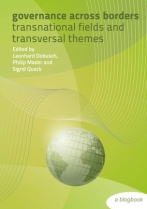
Governance across borders: transnational fields and transversal themes. Leonhard Dobusch, Philip Mader and Sigrid Quack (eds.), 2013, epubli publishers.
March 2026
M T W T F S S
 1
2345678
9101112131415
16171819202122
23242526272829
3031  

Copyright Information

Creative Commons License
All texts on governance across borders are licensed under a Creative Commons Attribution-Share Alike 3.0 Germany License.