
The Forest Stewardship Council (FSC) has recently started a dual certified timber pilot project with the Fairtrade Labelling Organizations International (FLO) and is now recruiting a manager for it. While this may seem to be a mere routine, it is in fact an interesting and significant development for the FSC. It may help it strengthen its credibility as an environmental certification organization.

The FSC is an international nongovernmental organization that seeks to promote environmentally appropriate, socially beneficial and economically viable management of the world’s forests through the certification of forest management and supply chains. In order to achieve this, forest certification uses conventional market channels. In contrast, fair-trade organizations challenge the conventional market organization by providing poor farmers and communities in developing countries with higher prices for their products compared to global market prices. The adherence of the FSC to conventional market logics caused concern among the FSC stakeholders. They argued that communities and small-scale forests operations, especially in the tropics, did not benefit from the FSC certification program because they were excluded from global markets and because reforming their forest management practices would be too costly. By implementing fair-trade projects, the FSC addresses these concerns. Read the rest of this entry »
“It never got weird enough for me.”

     – Hunter S. Thompson

Development and finance are increasingly intertwined, and both fields have over time produced their share of strange but successful, but also many odd and failed ideas. Here are a few recent bits of news from the weird world of finance and development.

#    Since February, East African villagers can buy themselves carbon-efficient stoves to replace their tradtional fireplaces, financed via microcredit. This contribution to reducing global warming then pays off for them via carbon-offsetting credits which they can claim via mobile phone SMS.

The father of this brainchild, Carbon Manna Unlimited, estimates that in this way, an African family can save around 3 tonnes of CO2 per year, earning them between 20 and 30 US Dollars worth of carbon credits on European markets…

Carbon efficiency, mobile banking and emissions trading applied to African cooking – it sounds adventurous, to say the least. But I was also wondering whether, sociologically speaking, is this an immense act of pragmatic creativity or rather simply one mimetic behaviour? After all, emissions trading, mobile technology and carbon footprint reduction are recieved wisdom at the moment in the north.

On another sociological note, the project’s name, Carbon Manna (TM) Xchange, has a both distinctly religious and capitalistic ring to it – what would Weber say? Read the rest of this entry »

The second version of Amazon’s relatively successful ebook-reader “Kindle” comes with a new feature, the so-called “text-to-speech function”: it enables ebooks to be read aloud. So, while you are cooking or driving to work this feature allows you to continue “reading” a book. Computers have had this feature for a long time (e.g. to read aloud PDF documents) but the Kindle with its specialization on ebooks is the first to bring it to the world of mobile devices. Or better, it could be the first.  Soon after the president of the US Authors Guild, Roy Blount, had publicly critized the feature in a New York Times piece titled “The Kindle Swindle” as a potential threat to audio books, Amazon gave in and agreed to disable text-to-speech on a title-by-title basis at the rightsholder’s request (see Slashdot). In his blog, Creative Commons founder Lawrence Lessig describes this as “caving into bullies“, emphasizes that Amazon did not violate any exclusive copyrights with this feature and bemoans that “users and innovators have less freedom“. Read the rest of this entry »

I hate to say “I said so”, and I know it’s horrible style. But sorry, this issue is too important to be ignored. My fears about the credit crunch and microfinance are being confirmed. 

The current economic crisis threatens to set back development and poverty reduction by years. Who coul really be surprised? In a globalised world, when Wall Street sneezes, everyone else catches the Flu. Read the rest of this entry »

In theory, copyright first and foremost belongs to the creator of any new work. In practice, creators are often forced to give up their copyright completely. Most researchers, for example, who need to publish in high impact journals have hardly any choice but handing over it their copyright to journal publishers. Or, Musicians cannot exclude some of their works from the terms of their copyright collectives to publish them under alternative licenses. By joining a collecting society like the German GEMA you trade certain parts of your copyright for the right to receive royalty payments. GEMA’s terms of service, however, are non-negotiable for individual musicians: like it or leave it. (see “Competition for Copyright Collectives“).

In many sectoral contexts private copyright regimes more or less completely replace the logic of (inter-)national copyright legislation.  Mostly this is due to private standardization and respective network effects: if the individual benefits of adopting a standard depend on the total number of adopters,  “exit” is not an option. People dissatisfied with such a private copyright regime are only left with the possibility of “voice”, thereby revealing the inherently political nature of private copyright regulation. Read the rest of this entry »

How can you win small and medium sized companies to take responsibility for their suppliers in China? Each year, this topic is brought up at the international toy fair by civil society organisations and the international toy association.

The challenge seems tremendous:  Big companies who source in developing countries usually establishe a whole department or CSR team, whereas smaller companies lack the capacity at home as well as the buying power abroad to influence factory behaviour.  Therefore it is even more surprising, that the toy industry, with a high share of medium sized enterprises has established an international, industry wide approach – But how do you get companies to join? Read the rest of this entry »

Since the beginning, proponents of microcredit have argued that they have found a self-sustaining, profitable route to reducing poverty: borrowers repay loans with enough interest to cover the costs plus an increase in the bank’s capital base, plus a payout for its owners. Sceptics of this story point to the fact that most microcredit programmes are still subsidised by donors. They argue that this is because many borrowers cannot afford to repay so dearly, and that the cost of capital should be lower in order to help more and poorer people.

Welcome to the ‘sustainability versus outreach’ debate. At the core, it is about the question whether incentives or impact matter more. Time to examine the arguments. Read the rest of this entry »

“It is difficult to make predictions, especially about the future.”
(Karl Valentin and others)

Not so long ago, the monopolistic concept of musician’s copyright collective like the German GEMA or the British PRS seemed to last forever. Even in countries with more than only one copyright collective like the US (e.g. BMI, ASCP) membership is exclusive and all-encompassing, meaning that an artist is not allowed to license only some works differently.

Yet, jamendo’s recently launched service jamendo pro might prove that forever was yesterday. Jamendo is an aggregator of Creative Commons (CC) licensed music. Commercial revenue is shared equally between jamendo and the artists, non-commercial use is free. In spite of the collecting societies’ prohibition of any open content licensing such as CC, the back catalogue of Jamendo consists of already more than 15.000 albums. Read the rest of this entry »

Credit is a useful lever for helping businesses grow. Many poor people in the developing world are self-employed farmers or petty traders, so technically they can be conceived of as businesspeople. But most farmers are actually subsistence farmers, working not for the market but for their own family’s meals, and many traders are simply traders for lack of a better alternative of stable, paid employment. They resiliently eke a meagre living out of their harsh surroundings, and truly deserve admiration by comfortable Westerners. But does that necessarily warrant them being treated as Schumpeterian entrepreneurs, willing and able to “creatively destroy” their traditional economic environments, if only they were lent the necessary finance?

We should keep in mind that people are incredibly diverse, and this must be taken into account and respected when formulating development policies. One-size-fits-all approaches have repeatedly failed in development history, and serve as a warning. Read the rest of this entry »

In the popular literature surrounding microcredit (or microfinance), a number of claims is repeatedly made which deserve a closer look. The mass media are full of heartwarming stories, anecdotes and PR-like representations of MFIs’ work, showing the apparent power of microcredit to improve the lives of the poorer inhabitants of this planet. In fact, many academic productions make similar claims without providing sufficient evidence to back them up.

In this way, the impression is being created that the development industry has found a panacea for poverty; a dangerous insinuation which can only lead to disappointment. Over my next few blog entries I will address and critically illuminate some myths – insufficiently supported claims or untested assumptions – which currently stand in the way of a balanced assessment of the true powers and drawbacks of microcredit as a development tool.

(phil)

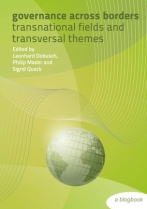
The Book

Governance across borders: transnational fields and transversal themes. Leonhard Dobusch, Philip Mader and Sigrid Quack (eds.), 2013, epubli publishers.
March 2026
M T W T F S S
 1
2345678
9101112131415
16171819202122
23242526272829
3031  

Copyright Information

Creative Commons License
All texts on governance across borders are licensed under a Creative Commons Attribution-Share Alike 3.0 Germany License.