You are currently browsing the category archive for the ‘Bordercrossing News’ category.
Let me point to two calls for papers for Special Issues relating to topics regularly covered on this blog that I am involved with as a guest editor.

“Creativity and copyright in the shadow of GenAI: Managing and organizing creative content in the digitalization frenzy” in the journal “Innovation: Organization & Management,” co-edited with Konstantin Hondros (HSU Hamburg), Astrid Mager (Austrian Academy of Sciences), Patricia Aufderheide (American University Washington) and Patrick Cohedent (HEC Montréal). Deadline for submission of full papers is September 30, 2026.

“Collective actorhood and organizationality: Recalibrating responsibility in business-society relations” in the journal “Business & Society,” co-edited with Dennis Schoeneborn (Copenhagen Business School), Héloïse Berkowitz (LEST, CNRS, Aix Marseille), Frank de Bakker (IÉSEG School of Management) and Consuelo Vásquez (Université du Québec à Montréal). We will be supported in the editorial work by consulting editor Devi Vijay (IIM Calcutta) as well as Business & Society editor Colin Higgins (Deakin University.
(leonhard)
This week, my University of Innsbruck hosted the conference on “Enhancing the voice of science on Wikipedia: How universities can collaborate with the online encyclopedia in science communication”. I had the honor to deliver the opening keynote on “Science (Communication) and Wikipedia: Potentials and Pitfalls”. In this talk, I offer some thoughts on the following questions:
- How ‘scientific’ is Wikipedia?
- How important is science for Wikipedia?
- How important is Wikipedia for science?
- How important is Wikipedia for our common knowledge?
- What are potentials when science communication meets Wikipedia?
- What are the pitfalls?
- Is it worth it?
The slides are available over at Slideshare.
Florian Überbacher (Montpellier Business School), Elke Schüßler (Leuphana University) and Arno Kourula (University of Amsterdam Business School) are calling for submissions to their 2024 EGOS Subtheme on “Regulating Organizations: Re-Examining the Intersections between States and Businesses”.
In view of the grand environmental, political, and social problems we are facing, we would – perhaps more urgently than ever – need a functioning regulatory and legal environment that motivates companies contribute towards making our world more sustainable. But how should such a ‘better’ and ‘smarter’ regulatory system look like and how should regulatory processes be organized?
To address such questions, and connect organizational scholarship with ongoing debates on (trans)national governance and regulation, the aim of this subtheme is to invite scholarship that seeks to integrate, extend, or contradict regulatory and organizational research in novel ways.
The deadline for the submission of short papers is January 9th, 2024.

In the article “’We Can’t Compete on Human Rights’: Creating Market-Protected Spaces to Institutionalize the Emerging Logic of Responsible Management“, which has just come out at the Academy of Management Journal, Nora Lohmeyer, Sarah Ashwin and myself argue that the protection of labor and environmental standards in the global economy relies on the construction of “market-protected spaces”, institutionally bound spaces that suspend the dominance of the market logic on selected issues based on a binding regulatory infrastructure that allows prioritizing responsible management practices. This conclusion is based on years-long research on the consequences of the deadly Rana Plaza accident in Bangladesh in which thousands of garment workers were killed or injured. Our research shows that voluntary corporate social responsibility (CSR) initiatives are not enough to address systemic, complex social or environmental problems in the global economy. We agree with De Bakker, Matten, Spence, and Wickert (2020), who
Read the rest of this entry »see an urgent need to address an “elephant in the room” of corporate social responsibility (CSR) research: the systemic constraints exerted by the current economic paradigm that might not be reconcilable with responsible business conduct.

Over at Elephant in the Lab, Paul Börsting and Maximilian Heimstädt blogged about “Wikipedia as Science Communication” and provide a neat step-by-step guide for researchers who want to improve their field’s coverage in the world’s most important encyclopedia:
Instagram, TikTok, Clubhouse: Today, researchers who want to share their work with non-academic audiences can choose between a vast array of digital platforms. Some of them vanish as quickly as they appear. Others attract an audience that is looking for something other than scientific content. This blogpost is a plea for researchers to consider one of the most important and yet oftentimes neglected digital platforms when thinking about science communication: Wikipedia. Occupying a stable position among the most accessed websites, it has become the most popular encyclopedia worldwide. However, when considering various alternatives for digital science communication, many scholars think of Wikipedia as just another profile page on the web, complimenting their institutional website. However, they are missing the point. The great but underappreciated advantage of Wikipedia is that it allows researchers to communicate research results and scientific expertise in exactly the place where people look for it: in topical Wikipedia articles. In this way, Wikipedia provides one of the most straightforward and effective means to share knowledge and to leverage research findings towards societal impact. Engaging with the vibrant community of co-editors on Wikipedia is also not a one-way street but in turn can broaden one’s horizon and potentially inspire future research.
Check it out!

Over at the Käte Hamburger Kolleg / Centre for Global Cooperation Research, we have recently launched Cooperadio – The Global Cooperation Podcast. In its most recent episode on “Patents, Profits & Pandemics”, I had the honor and pleasure to host intellectual property scholar Susan Sell, who echoes a growing consensus that our intellectual property regime, that is so essential for 21st century intellectual monopoly capitalism, is hampering global health outcomes – not just in the current pandemic.
Together, we addressed questions such as the following:
- While in regions like Europe and North America national vaccination campaigns have been picking up speed over the past months, the less well-off majority of the world has seen little to no vaccine supplies.
- Why does it have to be like that?
- Is there a moral obligation to make health innovations easily available globally?
- What about the intellectual property rights of the researchers and creators of these innovations, should they not profit from their work?
Check it out!
(sigrid)

Screenshot of website for the course “Organizing in Times of Crisis”
Confronted with the need to adapt teaching in the summer term to the ongoing corona cris, my colleague Elke Schüßler, who is regular contributor to this blog, and I teamed up with six other organization scholars in Germany and Austria to design a collaborative open course on “Organizing in Times of Crisis: The Case of Covid-19”. From the course description:
The worldwide spread of the Covid19 virus poses a grand social challenge. Seriously threatening the health of the world’s population and accompanied by huge social and economic disruption, it is one of the largest immediate crises for Western societies since World War II and a humanitarian disaster for humankind around the world. Drawing on classic and contemporary organization theory, this course aims to illuminate many pressing questions surrounding the pandemic, such as how supply chains can be organized to ensure adequate supplies of health material, the strengths and difficulties of open science approaches to the development of a vaccine or capabilities of different forms of organization and coordination to quickly and adequately respond in times of crisis.
All course materials, readings, assignments and video lectures are available open access at timesofcrisis.org and the corresponding YouTube channel respectively. Given that all is available under a Creative Commons license, we invite lecturers to use, adapt and build upon our materials. Where possible, we offer the course material in open, changeable formats to make adaptation as easy as possible (e.g., the standard course syllabus). Check it out!
(leonhard)
Inspired by a post on this blog about the dangers of predatory publishing and open peer review as a potential response, Maximilian Heimstädt and I decided to dig deeper into the issue. Specifically, we were able to get access to some data on (potentially) predatory journals in organization and management studies. Based upon the analysis of this data we discuss the potentials of open peer review for our own discipline. The abstract reads as follows:
Predatory journals have emerged as an unintended consequence of the Open Access paradigm. Predatory journals only supposedly or very superficially conduct peer review and accept manuscripts within days to skim off publication fees. In this provocation piece, we first explain how predatory journals exploit deficiencies of the traditional peer review process in times of Open Access publishing. We then explain two ways in which predatory journals may harm the management discipline: as an infrastructure for the dissemination of pseudo-science and as a vehicle to portray management research as pseudo-scientific. Analyzing data from a journal blacklist, we show that without the ability to validate their claims to conduct peer review, most of the 639 predatory management journals are quite difficult to demarcate from serious journals. To address this problem, we propose open peer review as a new governance mechanism for management journals. By making parts of their peer review process more transparent and inclusive, reputable journals can differentiate themselves from predatory journals and additionally contribute to a more developmental reviewing culture. Eventually, we discuss ways in which editors, reviewers, and authors can advocate reform of peer review.
The article has been published in the journal Management Learning and is available as an open access full text.
Together with Rick Delbridge (Cardiff University, Wales), Markus Helfen (University of Innsbruck, Austria), Andi Pekarek (Melbourne University, Australia) and Charlene Zietsma (Pennsylvania State University, USA), I am co-organizing the upcoming Organization Studies Summer Workshop on the topic “Organizing Sustainably: Actors, Institutions, and Practices”.
Our main aim is to go beyond the common mantra of contemporary management scholars and practitioners that there is a ‘business case’ for sustainability towards examining what alternative forms of organizing can contribute to the sustainable usage of environmental, social, and economic resources in ways that avoid their degradation and exhaustion. While such models already do exist, they often do not spread or scale up, remaining exploitative business practices untouched on a larger scale.
The submission system is now open, and the full call can be found here: https://osofficer.wixsite.com/osworkshop?fbclid=IwAR3bV80vSvxpbVMF-IWiOiPYmR5Vv022ganthYq2xj6MBACe6R_Uxf2xvdE
We will also use this workshop to reflect about sustainable forms of organizing in our own scholarly community. As a temporary team of organizers meeting a long-standing routine of highly productive summer workshops, we are ourselves directly faced with the challenge of being unable to meet the “triple bottom line” of environmental sustainability (these are typically bad, because academics fly to conferences), social and economic impacts on the local community and employees (these in our case are good, because the venue has strong sustainability policies), and economic/academic “performance” (the summer workshops are usually seen as a highly productive meeting format). We will use the direct experience of this contradiction to reflect about our own scholarly practices during our workshop to hopefully develop some ideas for more sustainable forms of scholarship.
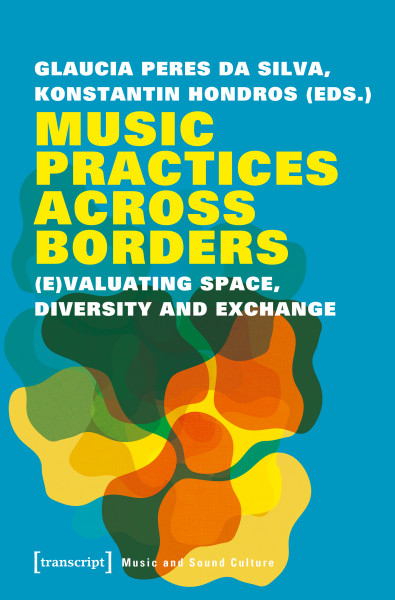
Cover “Music Practices Across Borders”
Connecting migration studies and the theory of valuation, the collection edited by Glaucia Peres da Silva and Konstantin Hondros (both from University of Duisburg-Essen) offers an interdisciplinary approach to the study of transnational music practices. Conceiving music as a practice not confined to audibility, the interdisciplinary contributions reveal how music emerges in concrete situations through people, objects, techniques, meanings, and emotions in different parts of the world and during different historic periods. Values are thereby created and shared, and creative processes are evaluated in terms of diversity, space and exchange.
The book presents cases of contemporary, popular and traditional music, festivals and trade fairs, albums and band projects, shedding light on the tensions between the transfer, reconstruction and creation of music in different contexts. Since the editors were able to publish the anthology open access – thanks to the university library of the University Duisburg-Essen – the book “Music practices across borders” as a full-text PDF.

 governancexborders.com
